
Key takeaways
- Asked the same question in three ChatGPT modes, the answers drew on different data providers, and the Rushcutters Bay vacancy rate came back as 3.45% in one and 0.74% in another.
- Accurate data can still tell the wrong story: a falling three-month rolling median reflected a shift towards older, lower-priced houses being sold, not comparable houses losing value.
- AI is most useful inside a research process, with reliable data sources, a clear methodology and human judgment about which indicators matter and what they mean.
AI has made property investment research easier than ever.
Today, you can ask ChatGPT to compare suburbs, analyse market conditions, identify major infrastructure projects, or even review due diligence findings for a property you're considering buying.
Tasks that once required hours or even days of research could now be completed in minutes.
At InvestorKit, we use AI every day too. It helps us find information, explore questions and work more efficiently.
But because we analyse property markets and data every day, we also regularly encounter situations where AI-generated information is incomplete, inconsistent or misleading.
And that's where investors need to be careful.
AI can be a powerful research tool. But can you rely on AI alone for property investment research?
AI can find information. But can you trust it?
One of AI's biggest advantages is its ability to gather information quickly. However, it doesn't always retrieve consistent data, even when we ask exactly the same question.
Let's take a simple example.
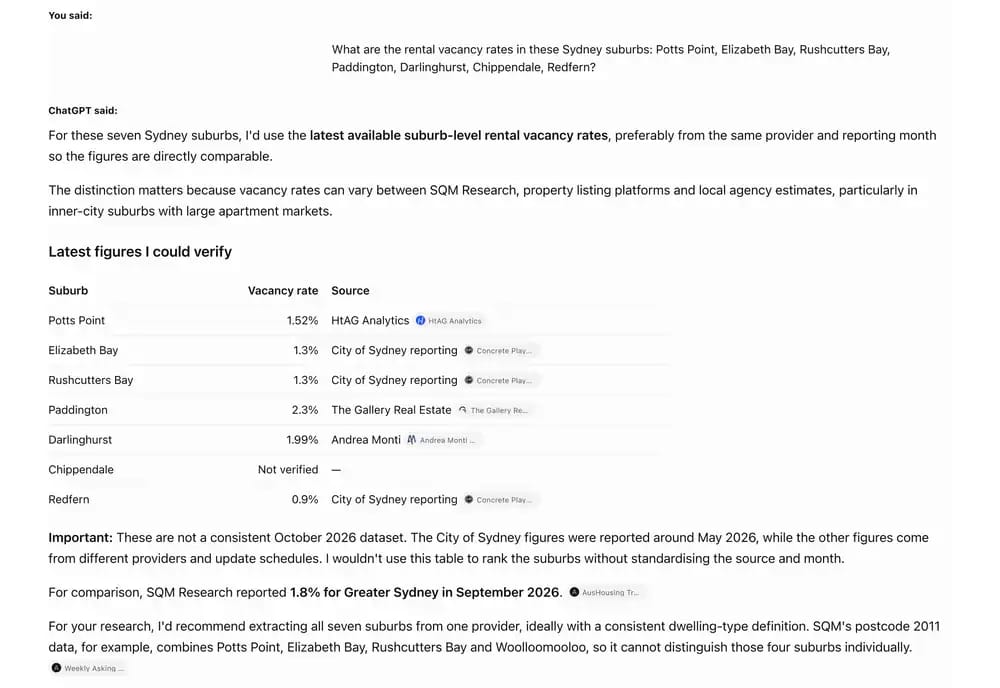
We asked ChatGPT to find the rental vacancy rates for seven Sydney suburbs:
Potts Point
Elizabeth Bay
Rushcutters Bay
Paddington
Darlinghurst
Chippendale
Redfern
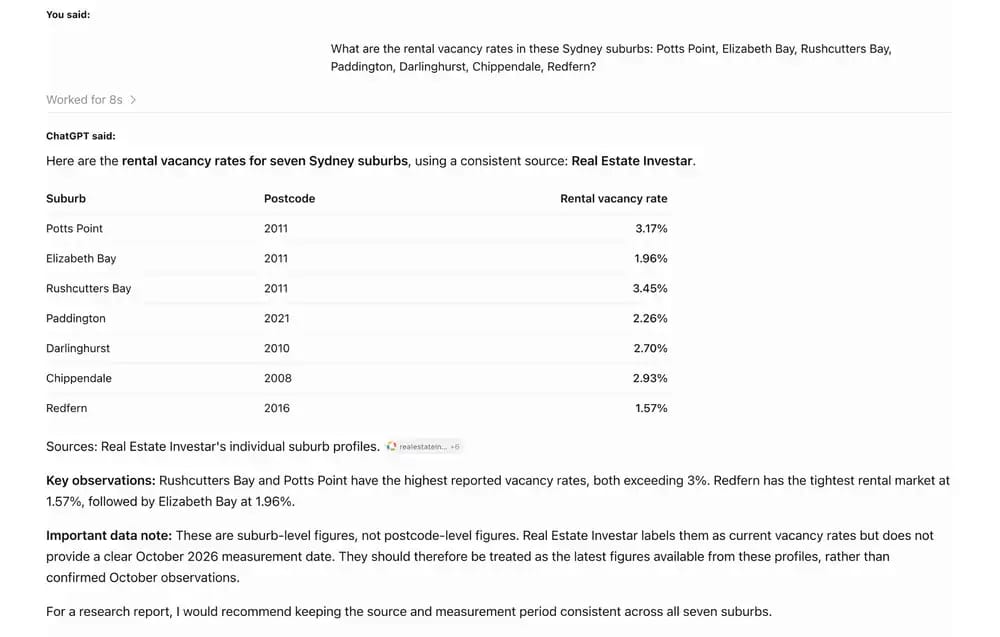
We tested the same question using three different ChatGPT modes, each in a separate conversation.
The results were surprisingly different.
Screenshot 1: Response in Instant mode
Screenshot 2: Response in High-thinking-effort mode
Screenshot 3: Response in Pro mode
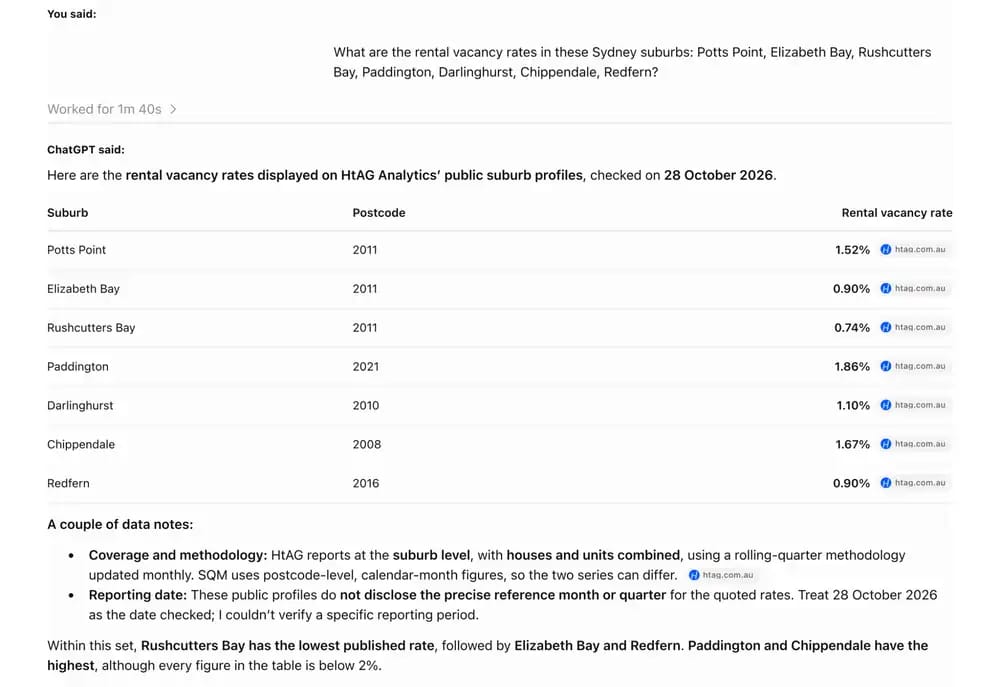
The Instant mode gathered figures from several property data providers, with different reporting periods. The higher thinking effort mode used Real Estate Investar for all seven suburbs, while Pro used HtAG Analytics.
And the differences weren't small. For Rushcutters Bay, one model reported a vacancy rate of 3.45%, while another reported just 0.74%.
To its credit, ChatGPT acknowledged limitations in the data, including differences in methodology and reporting periods.
But which figures should an investor rely on?
When you're checking just one or two indicators, it's relatively easy to investigate different data providers, compare their methodologies and decide which sources to use consistently.
But imagine researching hundreds of suburbs across dozens of market indicators. Identifying and verifying the most reliable data source for each indicator could become a time-consuming exercise.
And that raises an interesting question: if you need to spend days developing your own research methodology and verifying AI-generated information, is AI still serving your initial purpose, i.e., to save time?
Even accurate data can tell the wrong story
Sometimes, the challenge isn't the accuracy of the data. It's how that data is interpreted.
We encountered an interesting case in one of the suburbs we were monitoring a few months ago.
The three-month rolling median house price was declining (see chart below). On paper, this seemed to suggest weakening market conditions.
Rokeby Median House Prices, Jun 2025 to Jun 2026
12-month and 3-month rolling median house prices, Rokeby (TAS), Jun 2025 to Jun 2026. Source: Domain Insight. Prepared by InvestorKit.
View chart data
| Category | 12-month rolling median | 3-month rolling median |
|---|---|---|
| Jun-25 | $635,999 | $605,000 |
| Jul-25 | $632,500 | $600,000 |
| Aug-25 | $630,000 | $615,000 |
| Sep-25 | $632,500 | $620,000 |
| Oct-25 | $632,500 | $650,000 |
| Nov-25 | $645,000 | $745,500 |
| Dec-25 | $660,000 | $752,500 |
| Jan-26 | $670,000 | $750,000 |
| Feb-26 | $675,500 | $705,000 |
| Mar-26 | $679,000 | $728,000 |
| Apr-26 | $668,500 | $637,500 |
| May-26 | $672,750 | $630,000 |
| Jun-26 | $680,000 | $627,000 |
But our acquisitions team was seeing something different.
Based on their firsthand experience, buyer competition remained strong. Properties were still selling quickly, at prices consistent with their valuations.
Something didn't add up.
So our research team investigated individual sales transactions over the previous year.
What we found was that earlier transactions were concentrated among newer, higher-priced houses, while more recent sales predominantly involved older, lower-priced properties (see chart below).
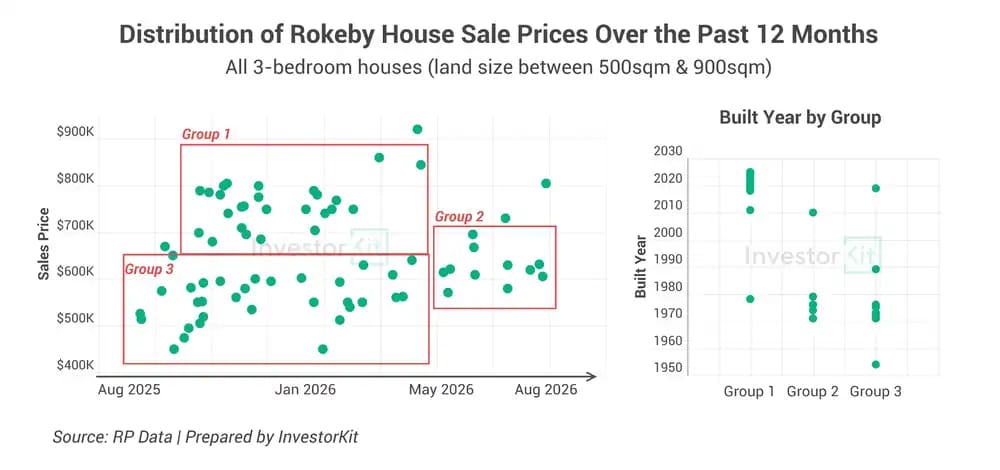
This shift in the types of houses being sold had pushed the median price down.
In other words, the declining median didn't necessarily mean comparable houses were losing value.
Without the acquisitions team's firsthand observations, we might not have questioned the initial trend. And without further analysis, we wouldn't have understood what was driving it.
This is why property research requires more than identifying patterns in a dataset. It requires understanding the market behind the numbers.
AI is only as useful as the research process behind it
Does this mean investors shouldn't use AI for property research or due diligence?
Absolutely not.
AI can be extremely useful for checking information, reviewing documents, explaining technical findings and identifying potential risks.
For example, if you're considering purchasing a property, you could use ChatGPT to help check for potential risks such as flooding, bushfire exposure, heritage restrictions or planning overlays. It can also guide you to the relevant government websites and planning tools, where you can verify these risks directly.
But there's an important consideration.
Knowing what to check and how to interpret the results is just as important as performing the checks.
For instance, identifying a flood overlay is one thing. Understanding the actual level of flood risk is another. Some overlays may affect only a small section of land, without posing a significant risk to the dwelling itself. For investors, it's also important to be aware of the potential impact on insurance costs, rental income if the property becomes uninhabitable, and future resale risks.
The same applies to market research. As our earlier experiment demonstrated, AI can help investors gather and analyse data, and even develop a research framework. But human judgment is still needed to determine which data sources are reliable, which indicators matter most and how to interpret the indicators.
InvestorKit combines AI, data and real-world experience
At InvestorKit, we don't see AI as a replacement for professional research. We see it as another tool that can make our research process more effective.
Our proprietary technology platform, EDGE, brings together more than 30 property, demographic and economic data sources, our established research methodology and AI-assisted market intelligence.
One of EDGE's capabilities, Vision, is an AI-powered market analysis tool. What makes it different from general-purpose AI tools like ChatGPT is how we control the information it uses. Rather than relying on information retrieved from the internet, we feed Vision with structured, verified datasets and deliberately design it to avoid generating unsupported figures.
In October 2026, EDGE was recognised at the Australian AI Awards, winning the AI Innovator – Property Investment category.
But reliable data is only the start.
Our research methodology guides how we assess markets and properties, considering a wide range of factors including supply and demand, affordability, economic conditions, rental conditions, due-diligence risks, and more.
Our research team then interprets the findings, investigates inconsistencies and challenges conclusions that don’t align with other evidence.
And our acquisitions team’s firsthand experience, together with local agent relationships, provides additional market intelligence that may not be captured in published datasets.
As our earlier median-price example demonstrated, these different sources of information can challenge and complement one another.
AI helps us work faster and more efficiently. But it’s the combination of reliable data, systematic research methodology and real-world experience that gives us confidence in our findings.
AI is a tool, not an investment strategy
AI has made property research more accessible, and investors should absolutely take advantage of it.
But an AI-generated answer shouldn't be the final word on an investment decision.
Before relying on its findings, it’s crucial to consider whether the underlying information is current and trustworthy, whether the relevant checks are complete, and whether the results are interpreted correctly.
When everyone has access to AI, the advantage no longer comes from access to the technology. Instead, it comes from knowing how to use it.
At InvestorKit, we combine technology, research expertise and firsthand market intelligence to help investors make informed property decisions.
Want to see how our research-led approach could support your next investment? Book a free 15-minute discovery call with our team.