A $5 million commercial property doesn't attract land tax on $5 million. It attracts land tax on whatever the underlying land is worth once the building, fit-out and improvements are stripped away, and that gap can run into the millions.
It's a distinction that catches out investors moving from residential into commercial property, where thresholds, exemptions and structures vary so significantly between states that a decision made without checking them can cost hundreds of thousands of dollars over a decade.
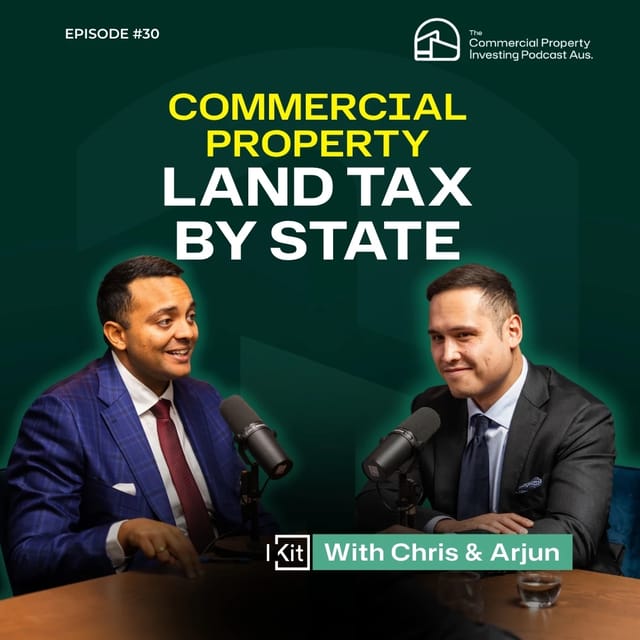
A conversation between Arjun Paliwal and commercial buyer's agent Chris Huxter walks through how land tax actually works on commercial property, state by state, and why the ownership structure an investor chooses can matter just as much as where they buy.
What Happened
The discussion opens by clarifying a common misunderstanding: land tax on commercial property is calculated on the unimproved land value, not the purchase price, and the difference between the two can be substantial for asset-heavy properties like childcare centres or industrial facilities with significant building content. From there, the conversation moves state by state, covering Northern Territory's complete land tax exemption, New South Wales's high threshold paired with a recent freeze that will quietly capture more properties over time, Victoria's low threshold and additional CIPT charge, and the varying thresholds across Queensland, South Australia, Western Australia, Tasmania and the ACT.
A significant portion of the conversation addresses how ownership structure interacts with these thresholds, using a specific example where holding a property in a trust rather than a company structure resulted in a $171,000 difference in land tax paid over ten years. The discussion also covers how commercial leases, unlike residential tenancies, can shift responsibility for land tax onto the tenant depending on the lease type and specific wording, closing with a broader observation that these thresholds were designed with residential property in mind and were never really built to accommodate multi-million dollar commercial assets.
Key Takeaways
Land Tax Is Calculated on Land Value, Not Purchase Price
The distinction at the centre of this discussion is that land tax applies to the unimproved land value, determined annually by the valuer general, and excludes the building, tenant fit-out and other improvements. A $5 million commercial property with a genuine land value closer to $2 million illustrates how large this gap can be, and assuming land tax scales directly with purchase price is a common and costly misreading of how the tax actually works.
Northern Territory's Land Tax Exemption Comes With Trade-Offs
Northern Territory is the only jurisdiction that charges no land tax at all on commercial property. However, the discussion is clear that this exemption shouldn't drive an investment decision on its own, given the more limited liquidity and buyer pool in that market. Understanding the land tax landscape should inform a decision, not dictate it.
New South Wales Has the Highest Threshold, But a Frozen One
New South Wales currently has the highest land tax threshold nationally, at $1.075 million, with land tax charged at $100 plus 1.6% above that threshold. The catch is that this threshold has been frozen until at least mid-2027, meaning that as land values rise, more properties will cross the threshold and attract land tax even without any change in the rate itself.
Victoria's Low Threshold and the Added CIPT Charge
Victoria has the lowest land tax threshold of any state, at $50,000 generally, or $25,000 for properties held in a trust structure. Victoria also introduced a separate charge known as CIPT (Commercial and Industrial Property Tax) from July 2024, under which a property pays stamp duty once on its first transaction after that date and becomes stamp duty exempt for all future transactions, with a 1% annual tax on site value applying from July 2035. Because CIPT is tied to the property rather than the individual owner, it passes on to future buyers regardless of who initiated the original transaction.
How Structure Choice Can Cost or Save Six Figures Over a Decade
One of the clearest illustrations in the discussion involves a $2 million land value held in New South Wales: holding that asset in a family trust structure resulted in approximately $171,000 more in land tax paid over a ten-year period compared to holding the same asset in a company structure. This reflects how land tax can apply as a special levy at the entity level for certain structures, making the choice of structure a material factor in long-term investment returns.
Thresholds Across Queensland, South Australia, WA, Tasmania and the ACT
Queensland's threshold sits at $600,000, dropping to roughly $350,000 for trust structures. South Australia recently indexed its threshold upward by 12%, from around $860,000 to $936,000. Tasmania and Western Australia have notably lower thresholds, at $125,000 and $300,000 respectively. The ACT charges no land tax at all on commercial property, though owners are instead subject to general rates, which can also be structured to pass through to the tenant depending on the lease.
Stamp Duty Variations Worth Noting Alongside Land Tax
South Australia exempts all commercial property transactions from traditional stamp duty, instead charging a 1% transfer duty, a significant reduction from the roughly 5% rate seen elsewhere. The ACT exempts transactions under $2 million from stamp duty entirely. These state-based differences in upfront transaction costs sit alongside, and separately from, the ongoing land tax obligations discussed elsewhere in the conversation.
Who Actually Pays Depends on Structure, Lease Type and Wording
Unlike residential tenancies, commercial leases can shift responsibility for land tax onto the tenant, but this depends on three factors: the ownership structure, whether the lease is a retail or non-retail lease, and the specific recoverability wording within that lease. Some leases, described as "triple net," make the tenant liable for land tax regardless of the owner's structure, while others leave some or all of the liability with the owner.
Why Commercial Land Tax Thresholds Weren't Designed for Commercial Assets
A recurring theme in the discussion is that land tax thresholds across most states appear to have been set with residential property values in mind, without adjustment for the significantly larger scale of commercial transactions. This means investors purchasing $3 million, $10 million or $20 million commercial assets are working within threshold systems not originally designed to accommodate assets of that size.
Land Tax Is a Deductible Expense, But Still a Real Cost
Land tax paid by an owner is generally deductible as an expense, which softens but doesn't eliminate its impact on overall returns. The discussion emphasises keeping assessment notices and receipts and factoring the expense into deal modelling from the outset, rather than treating deductibility as a reason to overlook the cost.
Land Tax Thresholds and Notable Rules by State
Northern Territory: No land tax charged
New South Wales: $1.075 million threshold (frozen until mid-2027); $100 + 1.6% above threshold
Victoria: $50,000 threshold (general); $25,000 for trust structures; additional CIPT of 1% of site value from July 2035 for eligible properties
Queensland: $600,000 threshold; approximately $350,000 for trust structures
South Australia: $936,000 threshold (recently indexed up from ~$860,000, a 12% increase); 1% transfer duty replaces standard stamp duty
Western Australia: $300,000 threshold
Tasmania: $125,000 threshold
ACT: No land tax; general rates apply instead; stamp duty exempt under $2 million
Structure impact example: approximately $171,000 more land tax paid over 10 years in NSW when holding a $2 million land value asset in a trust versus a company structure
Actionable Lessons for Investors
Confirm the land value, not the purchase price, before estimating a property's land tax exposure, since the difference can be substantial for improvement-heavy assets.
Review how your chosen ownership structure interacts with the relevant state's land tax rules before settling on a structure, since the difference between options can amount to hundreds of thousands of dollars over a decade.
Check the specific lease wording to understand what land tax is actually recoverable from the tenant, rather than assuming a lease clause covers the full amount.
Factor in frozen or slow-moving thresholds, such as those in New South Wales, when modelling long-term holding costs, since rising land values can push a property into a higher tax bracket even without a change in tax rate.
Treat state-based land tax advantages as one input into a broader investment decision, not a reason to select a location or asset on its own.
Work with an accountant and buyer's agent who can model the interaction between structure, lease type and state-based thresholds before a purchase is finalised.
Land tax on commercial property is rarely as simple as a single number attached to a purchase price. It depends on land value, state, ownership structure and the specific terms of a lease, and getting any one of those wrong can meaningfully erode long-term returns. For investors weighing a move into commercial property, or expanding an existing portfolio across states, understanding this layer of complexity in advance, with the right accounting and legal support, is what keeps land tax a manageable cost rather than an unwelcome surprise.
If you want to see how this can apply to your own portfolio, book a free discovery call with the InvestorKit team.