When most investors think about commercial property, they focus on the headline numbers.
Purchase price.
Yield.
Lease length.
Location.
But experienced commercial investors know that the biggest value is often created before settlement.
It's created through due diligence.
The right questions.
The right inspections.
And the right negotiations.
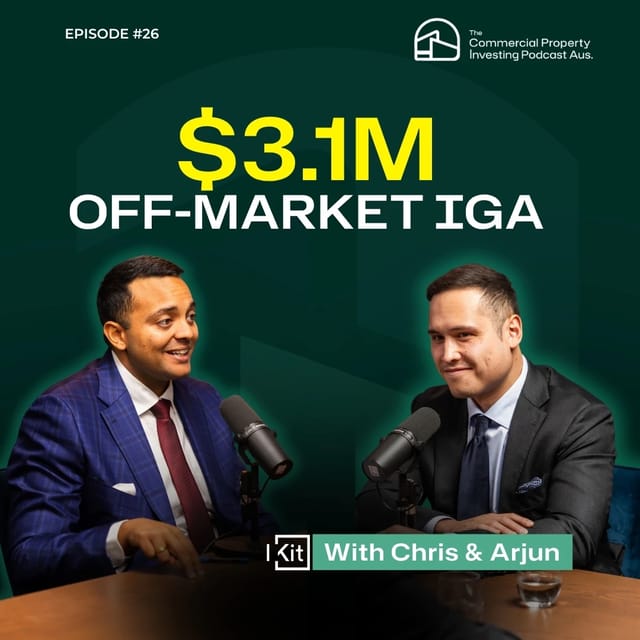
In this episode of the Commercial Property Investing Podcast's Deal Vault series, Arjun Paliwal and InvestorKit's Head of Commercial, Chris Huxter, unpacked a real client acquisition that demonstrates how a structured due diligence process transformed an already strong deal into an even better one.
What started as a $3.1 million commercial property purchase eventually became a significantly stronger investment after uncovering hidden opportunities during the due diligence process.
What Happened
The property was an off-market regional retail asset anchored by an IGA supermarket and supported by a bakery tenant.
At first glance, the numbers already looked attractive.
The property offered:
Purchase price of approximately $3.1 million
Initial net yield of 6.1%
Two essential-service tenants
Strong regional location
Off-market acquisition
For many investors, that would have been enough to proceed.
Instead, the team dug deeper.
Building inspections.
Tenant interviews.
Specialist trade reports.
Physical site inspections.
Those additional steps uncovered opportunities that ultimately improved both the purchase price and the long-term investment potential.
Key Takeaways
1. The best commercial deals are often improved after they're found
Finding a quality commercial property is only the beginning.
The real work starts during due diligence.
Rather than accepting the initial asking price, Chris and the team treated the inspection period as an opportunity to understand every aspect of the asset.
That included:
Building condition
Tenant quality
Future lease intentions
Capital expenditure requirements
Operational opportunities
The result was a significantly stronger investment outcome than the original listing suggested.
2. Tenant quality goes beyond the lease document
One of the most valuable parts of the process involved speaking directly with the supermarket operator.
Rather than relying solely on lease paperwork, Chris spent time understanding the tenant's business.
The discussion revealed:
The tenant operated multiple IGA supermarkets.
The business had successfully turned around the site.
Approximately $200,000 had already been invested into improving the store.
The owner intended to continue operating for many years before eventually passing the business to family.
While these conversations don't replace formal due diligence, they provide valuable context about the long-term commitment of the tenant.
3. Short lease terms aren't always a deal breaker
Many investors automatically dismiss commercial properties with shorter remaining lease terms.
This property had approximately two years remaining on the lease.
Instead of walking away, the team asked a different question:
Why is the lease short?
After understanding the tenant's long-term plans and broader business strategy, the shorter lease became less concerning than it initially appeared.
The key lesson was simple:
Context matters more than headline numbers.
4. Specialist inspections create negotiating power
One of the biggest turning points came after the standard building inspection.
Rather than stopping there, additional specialists were brought in to assess specific building components, including HVAC systems.
The inspections uncovered approximately $80,000 worth of recommended works.
Instead of simply accepting those future costs, they became part of the negotiation process.
Ultimately, the purchase price was reduced by approximately $130,000.
5. Every negotiation should account for future risk
The negotiation wasn't simply based on today's repair costs.
It also recognised that unforeseen issues often arise once works begin.
Rather than negotiating only the quoted amount, additional allowances were factored into discussions with the vendor.
The final outcome reduced the purchase price to approximately $2.9 million while increasing the property's net yield to around 6.4%.
6. Visiting the property changes everything
One theme repeated throughout the episode was the importance of physically inspecting commercial assets.
During the due diligence period, Chris:
Visited the property.
Walked through the building.
Met the tenant.
Observed business activity.
Inspected surrounding infrastructure.
Worked alongside specialist inspectors.
Commercial property is ultimately a business investment.
Understanding how that business operates often reveals opportunities that paperwork alone cannot.
7. Solving tenant problems can increase property value
One of the most interesting discoveries had nothing to do with the building itself.
It came from a conversation with the supermarket owner.
The tenant revealed annual electricity costs of approximately $90,000.
That sparked a discussion around installing solar panels.
The idea wasn't simply to reduce power bills.
It was to create value for both parties.
Lower operating costs would benefit the tenant while providing an opportunity to negotiate higher rent and improve the property's long-term value.
It's an example of how commercial investing often focuses on creating value rather than simply collecting rent.
8. Commercial property should be viewed as a business partnership
Throughout the episode, Chris described an approach many residential investors rarely experience.
Rather than viewing tenants as anonymous occupants, commercial investing often involves genuine business relationships.
Meeting tenants.
Understanding their challenges.
Learning about future plans.
Helping improve business outcomes.
When tenants succeed, landlords often benefit too.
That collaborative mindset can produce stronger leasing outcomes and more resilient investments over the long term.
9. Commercial property is often the next stage after wealth creation
The episode also reinforced why many investors eventually transition into commercial property.
Residential property often focuses on capital growth.
Commercial property frequently becomes the income-producing phase of the journey.
For the client featured in this case study, commercial property formed part of a broader strategy to move business profits into long-term income-producing assets outside the business.
It wasn't simply another purchase.
It was a portfolio transition.
The Deal Snapshot
This featured acquisition included:
Off-market commercial property
Purchase price negotiated from approximately $3.1 million to around $2.9 million
Net yield improved from approximately 6.1% to 6.4%
Anchored by an IGA supermarket and bakery
Approximately $130,000 negotiated during due diligence
Future value-add opportunity through potential solar installation
Action Steps
If you're considering commercial property investing, remember that the purchase price is only one part of the equation.
A structured due diligence process should include:
Reviewing the tenant's business, not just the lease.
Physically inspecting every commercial property.
Speaking directly with tenants where appropriate.
Engaging specialist inspectors beyond standard building reports.
Identifying future capital expenditure risks.
Looking for opportunities to create additional value after settlement.
Negotiating based on both current and future costs.
Thinking like a long-term business owner rather than simply a property investor.
The best commercial investors don't just buy good deals.
They improve them.
Because in commercial property, some of the biggest gains are created long before settlement ever takes place.
If you'd like help building a long-term property strategy designed around your goals, book a discovery call with InvestorKit.