
Blue piggy bank with "My Super" written on it

3 Numbers about SMSF Property Investing That May Surprise You

As more Australians realise that traditional superannuation alone might not secure a comfortable retirement, Self-Managed Super Funds (SMSFs) are growing in popularity. In late 2024, InvestorKit commissioned Agile Market Intelligence…

As more Australians realise that traditional superannuation alone might not secure a comfortable retirement, Self-Managed Super Funds (SMSFs) are growing in popularity.

In late 2024, InvestorKit commissioned Agile Market Intelligence to conduct a survey on the awareness and use of SMSF among Australian investment enthusiasts. Among the survey respondents, 88% own investment vehicles, 61% owning investment properties. We may call the respondents “Australian investors” in this blog, given the overwhelming proportion of investors. 

The results were quite surprising. 

This blog highlights three key findings from the report. Curious to learn more? There’s a download button for you at the end!


A Quick Introduction to SMSF Property Investing

A Self-Managed Super Fund, or SMSF, is a private superannuation fund where individuals make their own investment decisions to grow their retirement wealth. Like traditional super funds, SMSFs benefit from concessional tax rates, but they offer much greater control over investment choices.

With an SMSF, you can invest in a wide range of assets, including:

  • Shares

  • Residential and commercial properties

  • Managed funds

  • Cryptocurrencies

  • Collectibles (eg. artwork) meeting specific rules.

If investing in residential properties with SMSF, the property should be purchased solely for investment purposes: It can neither be resided by any fund member nor used as a holiday home. If investing in commercial properties, it can be leased at the market rate to a fund member for their business, given that specific rules are followed.

As SMSFs are regulated by the Australian Taxation Office (ATO), you can find more information about them on the ATO website.

While SMSFs can be a powerful tool for building retirement wealth, they are not widely used in Australia yet. The three numbers below will reveal more.


60% 

60% of Australian investors are eligible for an SMSF.

A household needs a superannuation balance of at least $150,000 to set up an SMSF, though balances over $200,000 are generally considered ideal.

How many Australian investors have over $200,000 in super?

Our survey revealed that 60% of the 423 respondents met this threshold. Yet, despite their eligibility, many are unaware of the opportunity SMSFs present.
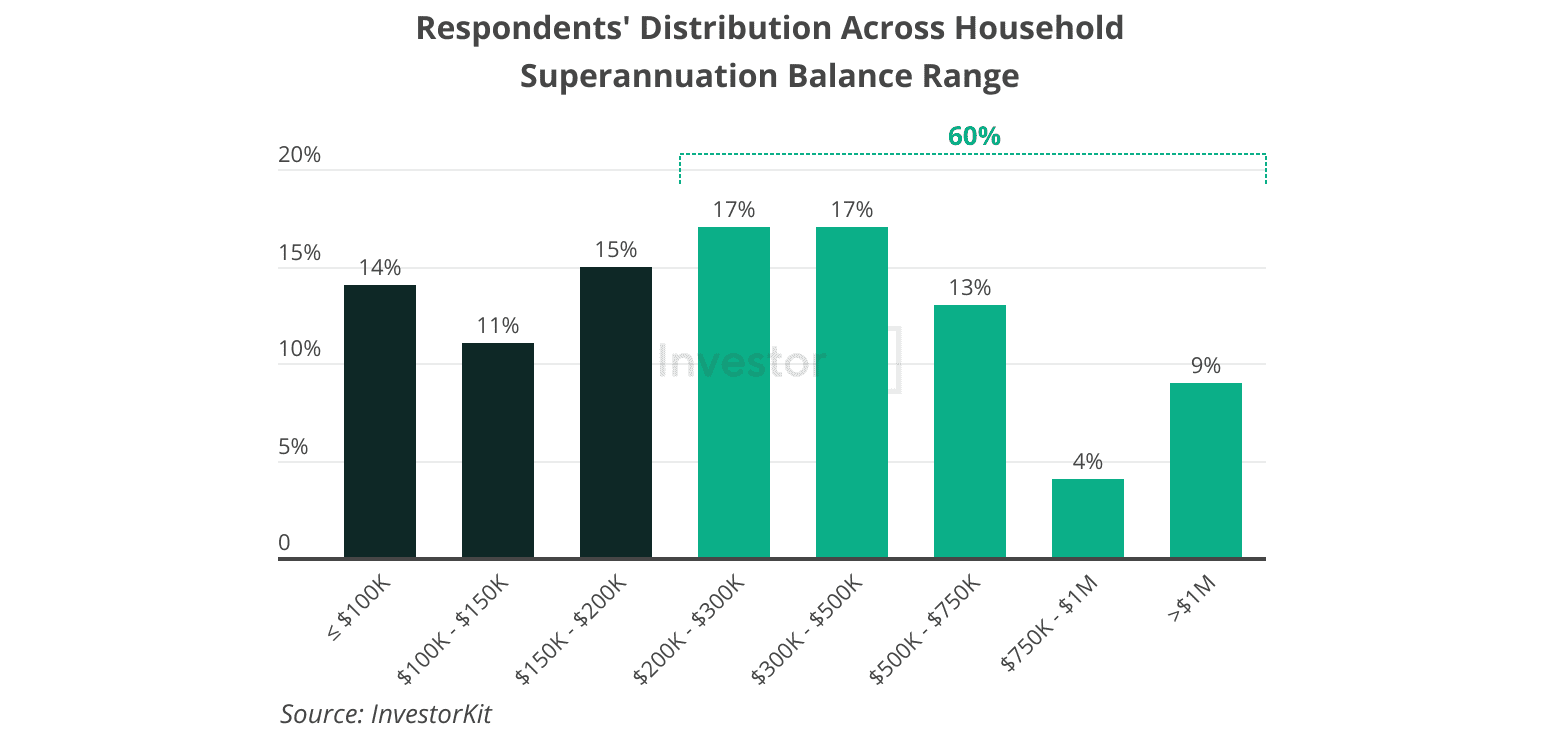
Respondents' Distribution Across Household Superannuation Balance Range


35%

Only 35% of those eligible for an SMSF are using one.

Only 35% of SMSF-eligible households currently manage their super via an SMSF (see chart below). The majority keep their funds in managed super accounts, either by choice (44%) or as default options provided by employers (16%).
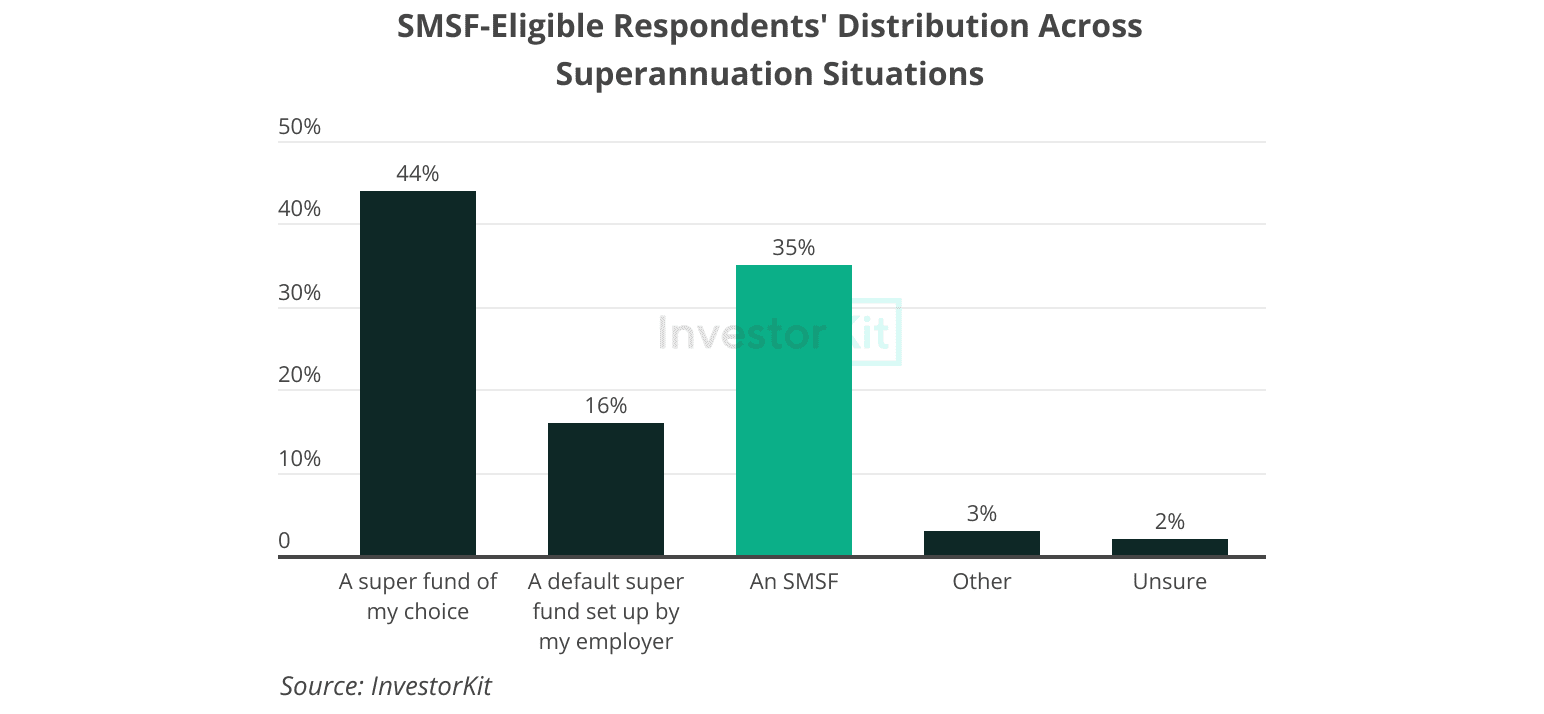
SMSF-Eligible Respondents' Distribution Across Superannuation Situations

That means that 65% of these households are potentially missing out on the benefits and opportunities SMSFs can offer!

The survey also finds that more than half of the respondents are not really satisfied with the performance of their super funds. For those who are not happy with the current managed super funds, what’s stopping them from self-managing their super funds? The following number says something about it.


39%

At least 39% of SMSF-eligible respondents don’t have an SMSF because of a lack of knowledge about it.

When the SMSF-eligible investors who were not using one were asked what barriers prevented them from investing via an SMSF,  they cited lack of knowledge as a major barrier:

  • 38% didn’t have an SMSF because they didn’t know they were eligible.

  • 39% say they didn’t use an SMSF because they didn’t know how to set one up or felt it would be too complicated (see chart below). 
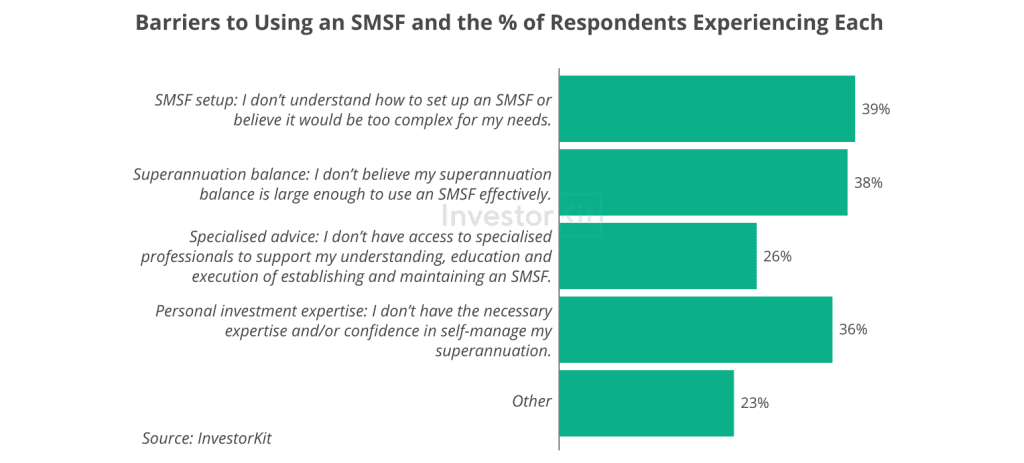
Barriers to Using an SMSF and the % of Respondents Experiencing Each

Say that the two groups overlap perfectly (which is highly unlikely); 39% of Australian investors who are eligible for an SMSF do not use it merely because of the lack of information! 

The good news? These barriers can be overcome with expert guidance. InvestorKit, for example, can guide you step-by-step through setting up your SMSF and investing in properties with it!


The above are just a glimpse into our survey-based whitepaper, The Evolution of SMSF Property Investing. For more insights from the survey, click here to access the full report!


Interested in SMSF property investing and taking 100% control of your retirement wealth growth with a trustworthy buyers agency? Talk to the InvestorKit team today by requesting your 15-min FREE no-obligation discovery call!


Keep Reading

Explore other Blogs

Construction site with multiple cranes and unfinished buildings.
The Tax Trap: Why the 2026 Budget May Actually Hurt New Build Investors

Tax treatment shapes how much of your return you keep, not how large that return is. A larger gain taxed less favourably can still outperform a smaller one taxed more favourably. This blog models the full 10-year after-tax outcome for both property types and tests the theory against real Australian market data.

Construction site with multiple cranes and unfinished buildings.
Tax Benefits Alone Don’t Automatically Make New Builds Better Investments

However, tax benefits are only one factor in your investment performance, not the whole picture. Structural factors that shape long-run property growth, such as supply scarcity, land value, location quality, and underlying demand, are not shaped by tax policy. Favourable tax treatment can improve the outcome of a strong investment, but it cannot compensate for a weak one.

Construction site with multiple cranes and unfinished buildings.
Rental Boom Coming? How the tax reform is actually going to change the rental market

The federal budget, delivered last month, introduced tax reforms, sparking widespread predictions of drastic changes in the rental market. While sentiment is shifting and some markets are already reacting, the core question remains: how will these changes ultimately reshape the market?

Construction site with multiple cranes and unfinished buildings.
The Tax Trap: Why the 2026 Budget May Actually Hurt New Build Investors

Tax treatment shapes how much of your return you keep, not how large that return is. A larger gain taxed less favourably can still outperform a smaller one taxed more favourably. This blog models the full 10-year after-tax outcome for both property types and tests the theory against real Australian market data.

Construction site with multiple cranes and unfinished buildings.
Tax Benefits Alone Don’t Automatically Make New Builds Better Investments

However, tax benefits are only one factor in your investment performance, not the whole picture. Structural factors that shape long-run property growth, such as supply scarcity, land value, location quality, and underlying demand, are not shaped by tax policy. Favourable tax treatment can improve the outcome of a strong investment, but it cannot compensate for a weak one.

Construction site with multiple cranes and unfinished buildings.
Rental Boom Coming? How the tax reform is actually going to change the rental market

The federal budget, delivered last month, introduced tax reforms, sparking widespread predictions of drastic changes in the rental market. While sentiment is shifting and some markets are already reacting, the core question remains: how will these changes ultimately reshape the market?

Construction site with multiple cranes and unfinished buildings.
The Tax Trap: Why the 2026 Budget May Actually Hurt New Build Investors

Tax treatment shapes how much of your return you keep, not how large that return is. A larger gain taxed less favourably can still outperform a smaller one taxed more favourably. This blog models the full 10-year after-tax outcome for both property types and tests the theory against real Australian market data.

Construction site with multiple cranes and unfinished buildings.
Rental Boom Coming? How the tax reform is actually going to change the rental market

The federal budget, delivered last month, introduced tax reforms, sparking widespread predictions of drastic changes in the rental market. While sentiment is shifting and some markets are already reacting, the core question remains: how will these changes ultimately reshape the market?

Construction site with multiple cranes and unfinished buildings.
Tax Benefits Alone Don’t Automatically Make New Builds Better Investments

However, tax benefits are only one factor in your investment performance, not the whole picture. Structural factors that shape long-run property growth, such as supply scarcity, land value, location quality, and underlying demand, are not shaped by tax policy. Favourable tax treatment can improve the outcome of a strong investment, but it cannot compensate for a weak one.

© 2026 InvestorKit Pty Ltd. All rights reserved. It is illegal to reproduce or distribute copyrighted material without the permission of the copyright owner.

This website, and any content provided by is general information, not investment advice. InvestorKit and affiliates are not liable for actions taken based on this content.Always seek advice from relevant professionals such as legal, financial, and accounting experts. Past performance doesn’t guarantee future results.

© 2026 InvestorKit Pty Ltd. All rights reserved. It is illegal to reproduce or distribute copyrighted material without the
permission of the copyright owner.

This website, and any content provided by is general information, not investment advice. InvestorKit and affiliates are not liable for actions
taken based on this content.Always seek advice from relevant professionals such as legal, financial, and accounting experts. Past
performance doesn’t guarantee future results.

© 2026 InvestorKit Pty Ltd. All rights reserved. It is illegal to reproduce or distribute copyrighted material without the permission of the copyright owner.

This website, and any content provided by is general information, not investment advice. InvestorKit and affiliates are not liable for actions taken based on this content.Always seek advice from relevant professionals such as legal, financial, and accounting experts. Past performance doesn’t guarantee future results.

© 2026 InvestorKit Pty Ltd. All rights reserved. It is illegal to reproduce or distribute copyrighted material without the permission of the copyright owner.

This website, and any content provided by is general information, not investment advice. InvestorKit and affiliates are not liable for actions taken based on this content.Always seek advice from relevant professionals such as legal, financial, and accounting experts. Past performance doesn’t guarantee future results.