Key takeaways
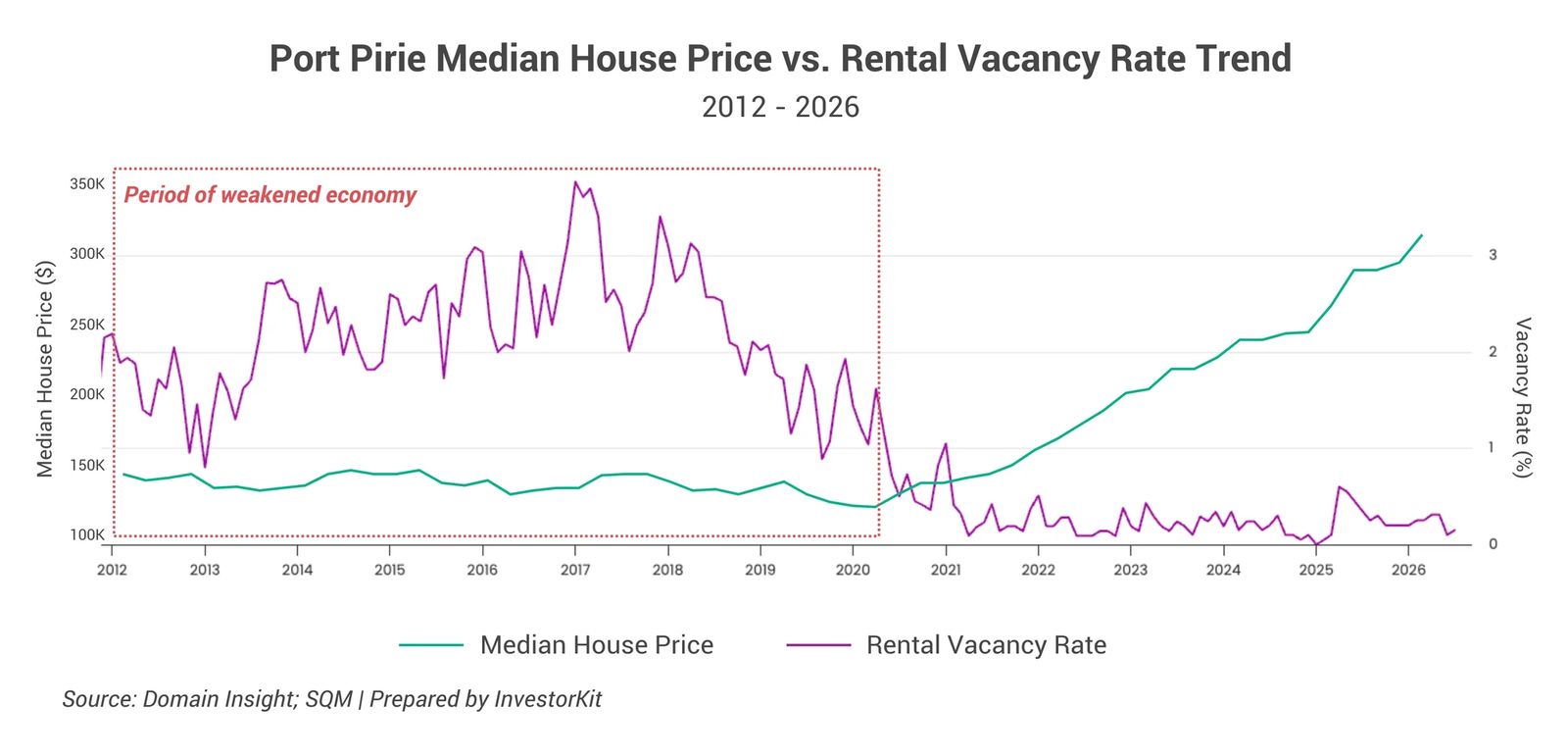
- When the mining boom ended in the early 2010s, Port Pirie's unemployment rose to close to 16%, and its house prices fell between 2012 and 2020.
- Over the three months to July, 22 of the 50 largest regional Significant Urban Areas saw dwelling values decline, while Port Pirie grew 6.8%, Dubbo 3.9% and Geraldton 3.8%.
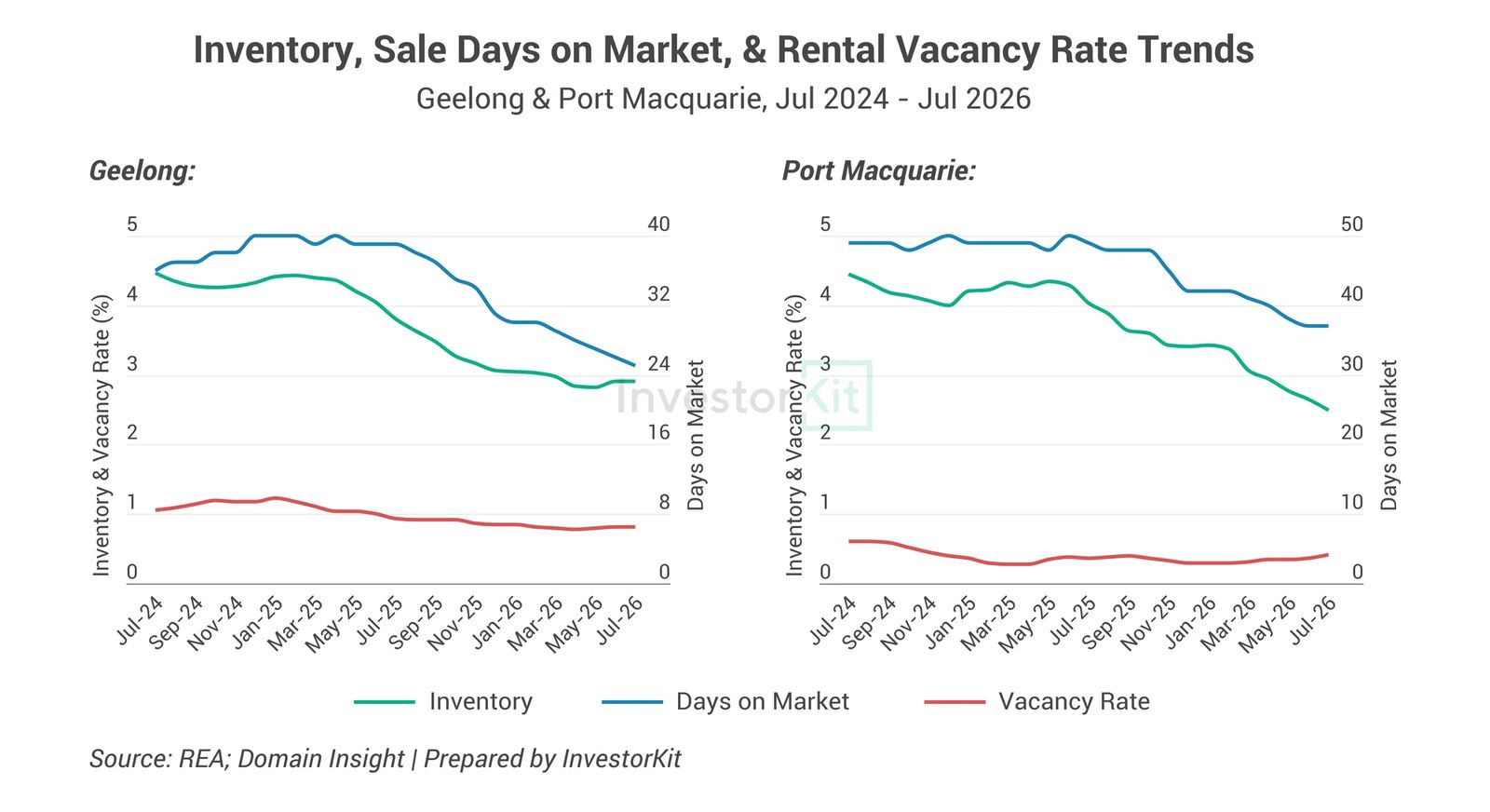
- Geelong and Port Macquarie recorded dwelling value declines of 1.2% and 0.3% over the past three months, while their inventory and days on market have declined for many months.
Australia’s property market has become more challenging in recent months.
Higher interest rates and weaker consumer confidence have reduced buyers’ borrowing capacity and willingness to transact. But while these conditions are affecting markets across the country, the impact has been far from uniform.
Some markets are declining. Others are continuing to grow strongly.
This divergence gives investors an opportunity to look beyond short-term price movements and ask a more useful question:
What makes a property market resilient when conditions become harder?
The answer can tell us a lot about what to look for when choosing where to invest next.
Affordability Matters More When Buyers Are Under Pressure
One of the clearest trends in the current environment is the strength of more affordable markets.
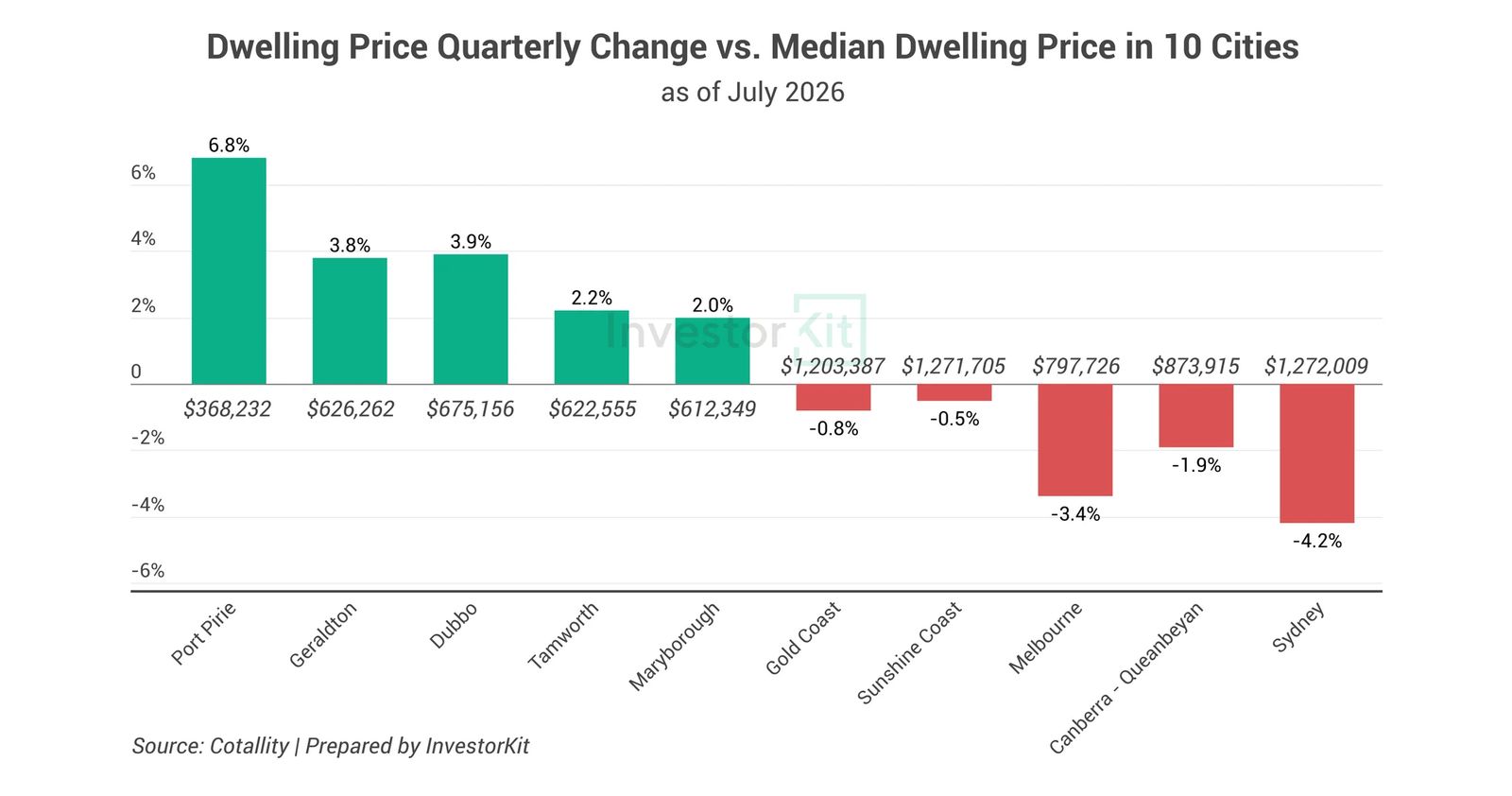
Cotality’s latest Regional Market Update examined Australia’s 50 largest regional Significant Urban Areas (SUAs). While 22 recorded declining dwelling values over the three months to July, several affordable regional markets continued to perform strongly.
Port Pirie recorded 6.8% quarterly growth, Dubbo grew 3.9%, and Geraldton grew 3.8%. By comparison, higher-priced markets such as the Gold Coast, Melbourne, and Sydney have seen dwelling values decline (see chart below).
This makes sense.
When interest rates are high and borrowing capacity is constrained, buyers become more price-sensitive. Lower-priced markets have a broader pool of potential buyers who can still afford to participate, helping demand hold up when overall confidence weakens.
Affordability, therefore, isn’t simply about buying a cheaper property. It can help make a housing market more resilient to financial pressure.
But that doesn’t mean investors should simply chase the cheapest markets.
Don’t Fall Into the Affordability Trap
Affordability is an important fundamental, but it is only one part of the picture.
A market can be affordable because it offers genuine value and sustainable housing demand. It can also be cheap because its economic and population drivers are weaker or more volatile.
This is why we need to look deeper.
How diverse is the local economy?
Is employment healthy?
Is the population growing sustainably?
Does the city play an important regional role?
Or is economic activity heavily concentrated in one industry?
Then there is the housing market itself:
How much demand exists relative to available supply?
Is inventory tightening or expanding?
What does the future construction pipeline look like?
Is the rental market undersupplied?
Together, these factors help us understand market pressure, the relationship between housing demand and supply.
Some small single-industry-based markets, for example, can experience periods of exceptional housing demand when their dominant industries are performing strongly. That doesn’t necessarily make them poor investments, but greater economic concentration can introduce additional risk over a long holding period.
Port Pirie is one example. Manufacturing, largely centred on metal smelting and refining, accounts for 60.4% of its local economic output. When the mining boom ended in the early 2010s, local unemployment rose sharply to close to 16% and housing demand weakened. As the chart shows, rental vacancy remained elevated for years, while house prices recorded negative growth between 2012 and 2020. For investors, this meant not only limited capital growth, but also greater risk of prolonged rental vacancies.
So the goal can’t be simply to find affordability.
It is to find affordability supported by a healthy economy and sustainable housing demand.
The Fastest-Growing Market Isn’t Always the Best Opportunity
There is another trap investors can fall into: assuming the markets growing fastest today must be the best places to buy tomorrow.
Recent growth tells us what has happened. It doesn’t necessarily tell us what happens next.
Different markets can sit at very different stages of their property cycles.
Some affordable regional markets are already experiencing strong growth because demand is high and supply is tight.
Others may currently be growing more slowly, but their underlying conditions are improving. Inventory might be declining, rental markets tightening and demand strengthening before this pressure has fully flowed through to prices.
This can be particularly relevant in markets recovering from a previous downturn. Geelong and Port Macquarie, for example, recorded dwelling value declines of 1.2% and 0.3% respectively over the past three months. But underneath these headline figures, both markets are showing signs of strengthening market pressure, with inventory and days on market declining for many months, and rental vacancy rate getting lower and lower (see chart below). This suggests recent price weakness is more reflective of softer sentiment than deteriorating local fundamentals. As confidence improves, these tightening demand and supply conditions could provide a stronger foundation for price growth.
The same principle applies to larger markets experiencing temporary weakness as well, such as Sydney, Melbourne, or South East Queensland.
A market declining because its economy is weakening or housing supply is excessive is very different from a fundamentally healthy market where prices have temporarily softened because buyers have become cautious.
In the latter case, weaker sentiment may even create an opportunity before stronger demand returns.
That is why looking only at today’s growth leaderboard can be misleading. Sometimes the strongest opportunity is already growing. Sometimes it is only just beginning to recover.
Start With Your Portfolio, Then Choose the Market
So which type of market should you buy in?
That depends on what your portfolio needs your next property to do.
An investor with constrained borrowing capacity might need an affordable property with healthy rental yield and strong near-term market pressure. The objective could be to preserve cash flow while positioning for equity growth.
Another investor may have greater borrowing capacity and substantial cash buffers. Immediate yield may matter less to them, and a fundamentally strong but temporarily suppressed market could provide a better long-term opportunity.
Someone else may not need immediate capital growth. They may be comfortable entering an earlier-stage recovery market where supply is tightening and demand is improving, allowing time for those fundamentals to flow through to prices.
None of these strategies is automatically better than the others.
The important thing is to work backwards from the portfolio outcome you need, then identify the market conditions most likely to support it.
That means assessing affordability alongside economic strength, housing demand, supply conditions, rental pressure and where the market sits in its cycle.
Look Beyond What’s Growing Today
A softer property market can make investors more cautious. But it can also make the differences between markets much easier to see.
Affordability is proving to be an important source of resilience in the current environment. But affordability alone doesn’t make a good investment.
Neither does being at the top of today’s growth rankings.
The stronger approach is to understand why a market is performing the way it is, whether its fundamentals can support future housing demand, and how that market fits into your broader portfolio plan.
Remember the goal isn’t to buy whichever market is growing fastest today.
It’s to buy the right market for what your portfolio needs next.
Build Your Next Purchase Around Your Portfolio
The best-performing market today isn’t necessarily the market your portfolio needs next.
At InvestorKit, we start with your long-term portfolio plan, then use in-depth research to identify the markets and properties that fit your financial position, borrowing capacity and next investment goal.
If you’re considering your next purchase, book a discovery call with our team to understand what your portfolio needs next.