
Bay with boats and coastal town

Market Categorisation Deep-Dive: Second-Wind

InvestorKit buys in three categories of markets based on each client’s portfolio requirements – Early Adopters, Hotspots and Second-winds. We are creating a blog trilogy to explore each of these…

Following the Early Adopters and Hotspots, let’s talk about the Second-winds today as the final part of our Market Categorisation trilogy.

What is Second-wind?

Second-winds are the markets that have gone through a boom in the past 5-10 years and are catching a second wind (eg. Reduced interest rates encouraging property transactions) and becoming a hotspot again. In the long term, their previous growth has been in line with or higher than average level but is gaining strength again for further rise (as shown in the chart below).
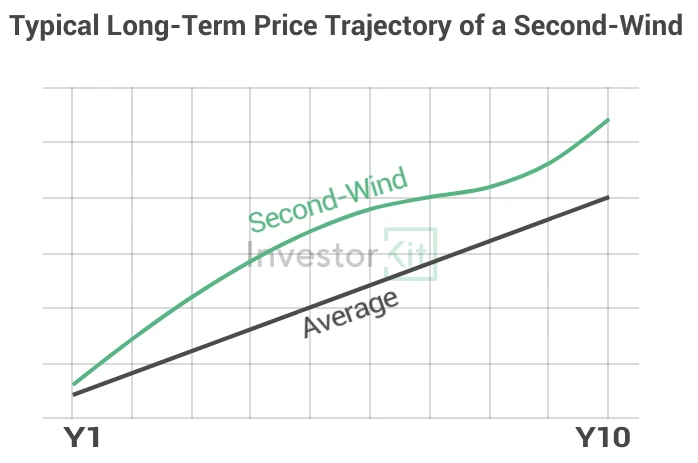

Image of 6482d8bdea6246b23f3b8876 1.%20Typical%20Trajectory

Port Stephens was a Second-wind in 2021. Its house prices have achieved fairly strong growth in 2014-18 and cooled down in 2019. If nothing happened, it might take a few years before Port Stephens reaches its next booming phase; However, it started booming again just one year later, stimulated by the historically low interest rate and people’s chase for lifestyle during the pandemic, achieving another 34% growth in 2 years (June 2020-June 2022).
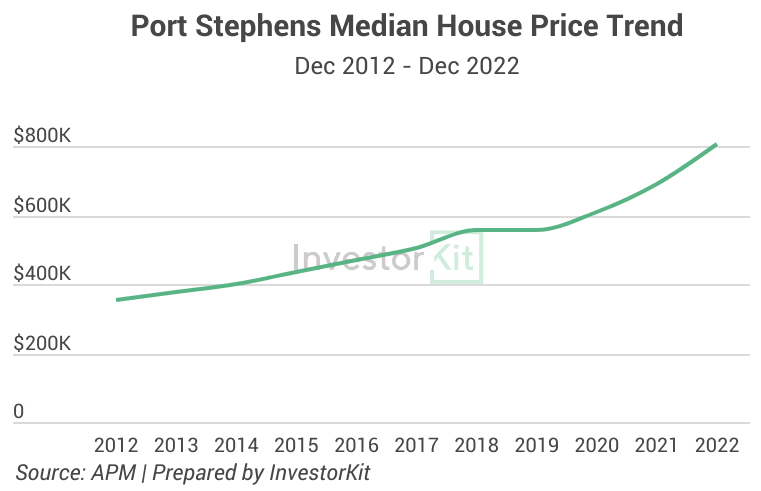

Image of 6482d8cd08f0edfc86afb62c 2.%20Port%20Stephens%20Price%20Trend


What do market indicators look like in a Second-wind?

The spiderweb chart below is a brief description of the market conditions and trends in a Second-wind (indicator scores: 1=worst, 5=best):
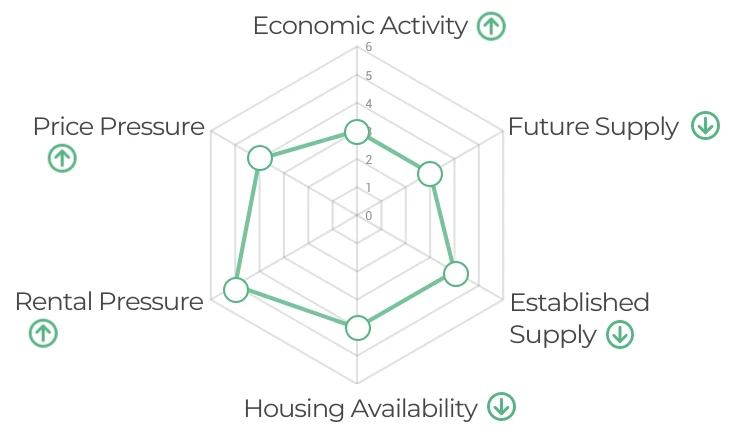


Image of 6482d8fa9ed007962f2195b4 3.%20Spiderweb%20chart


•  Improving Economy

Unlike Early Adopters and Hotsopts’ fast recovering/booming economy, Second-winds’ economy is usually relatively stable. However, a second wind tends to boost it further by bringing more business opportunities (eg. infrastructure investment) or more consumption demand (eg. incoming migration). In Port Stephens’ case, it’s more of the latter.

Port Stephens’ coastal lifestyle and relatively affordable housing prices have caused a significant surge in its net internal migration since the pandemic started (below chart).
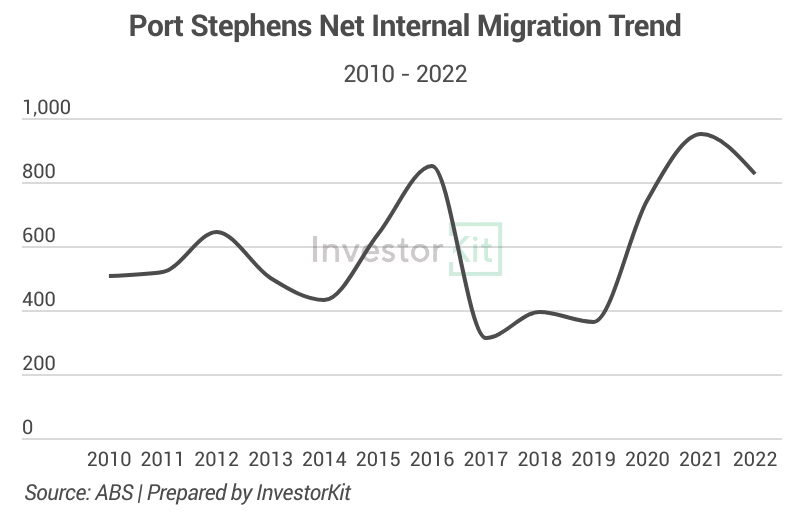

Image of 6482d91108f0edfc86aff660 4.%20internal%20migration


The internal migration surge, accompanied by major infrastructure investments such as a $1 billion upgrade to the nearby RAAF Base, and a $121 million Newcastle Airport expansion, has led the local unemployment rate to decrease further from the quite healthy level pre-COVID.
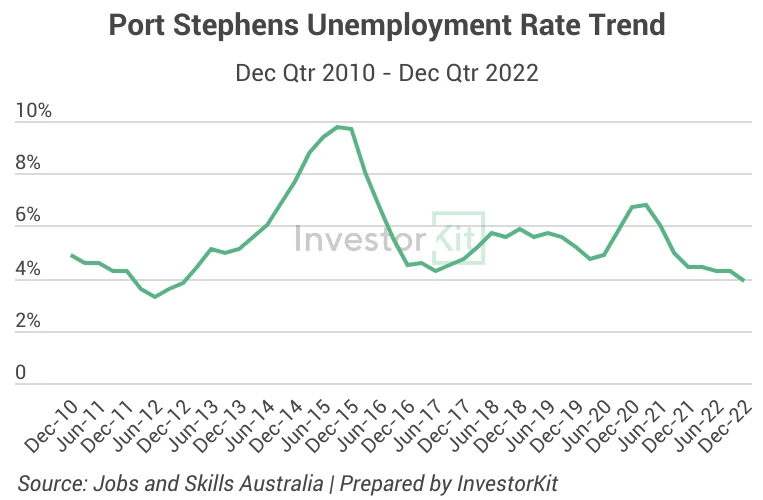

Image of 6482d922ea6246b23f3bbe1d 5.%20Unemployment%20Rate


The thriving economy and surge in internal migration led to high property market pressure again, bringing the Second-winds to another boom.


• Relatively High price pressure

Like the other two categories, Second-winds supply can’t cope with the demand surge, which would lead to higher price pressure. The chart below shows that the gap between total listings and total sales narrowed fast in 2021, leading the inventory to drop to a low level of around 3 months of stock (high-pressure benchmark) and stay there until early 2022.
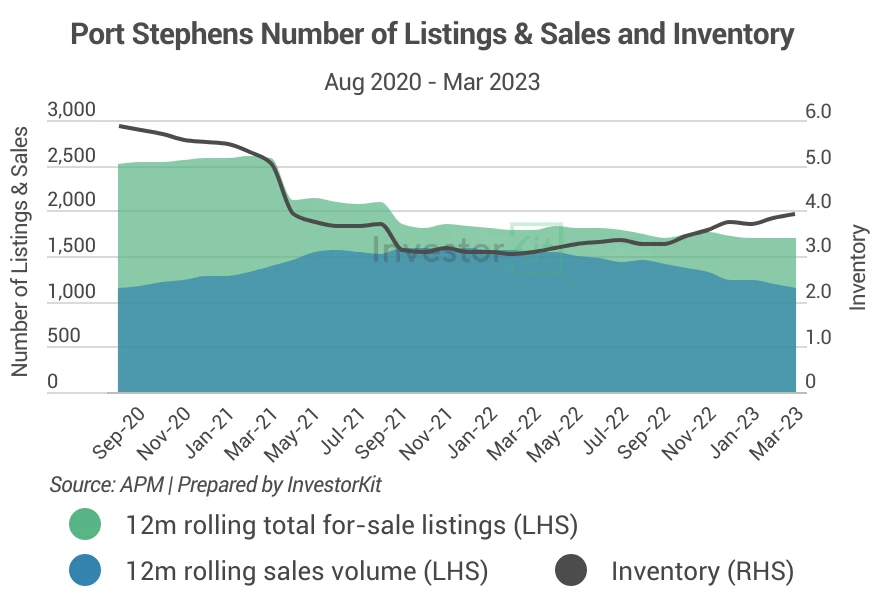


Image of 6482d935a5b907fbae4442ff 6.%20Inventory

The high market pressure could also be seen in the Sale Days on Market.

Port Stephens’ number of days on market for sale started declining in late 2020 as inventory went down and dropped steadily until early 2022, reaching a tight 34 days before bouncing (below chart).
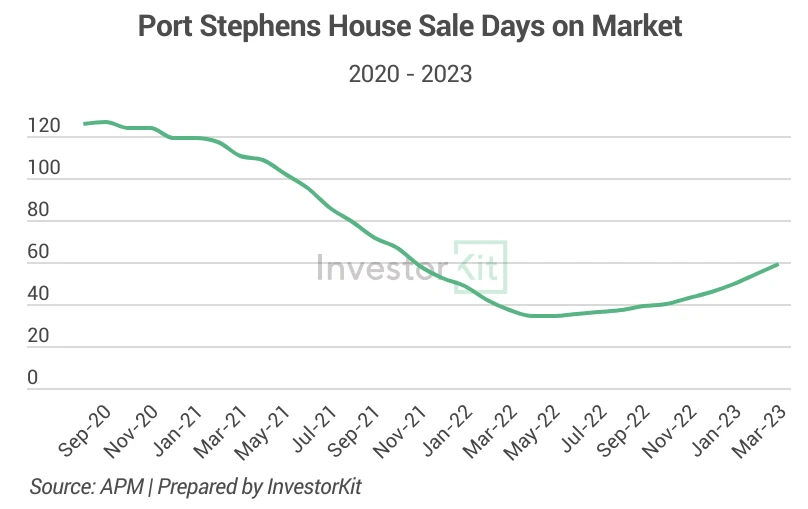


Image of 6482d9599dde40f94fab4604 7.%20Sale%20days%20on%20market

• High rental pressure

High rental pressure is a must for all three market categories we love, as it indicates a vibrant economy, high housing demand, and, what’s more, high/increasing rental returns for investors.

The below chart shows Port Stephens’ rental vacancy rates over the past 3 years. Before COVID, its rental market was already tight and healthy, with an around 2% vacancy rate. The pandemic internal migration surge broke the demand-supply balance and brought vacancy rates further down to around 0.2%. As a result of the extremely tight rental market, rent level went up by 26% from Dec 2020 to Dec 2022.
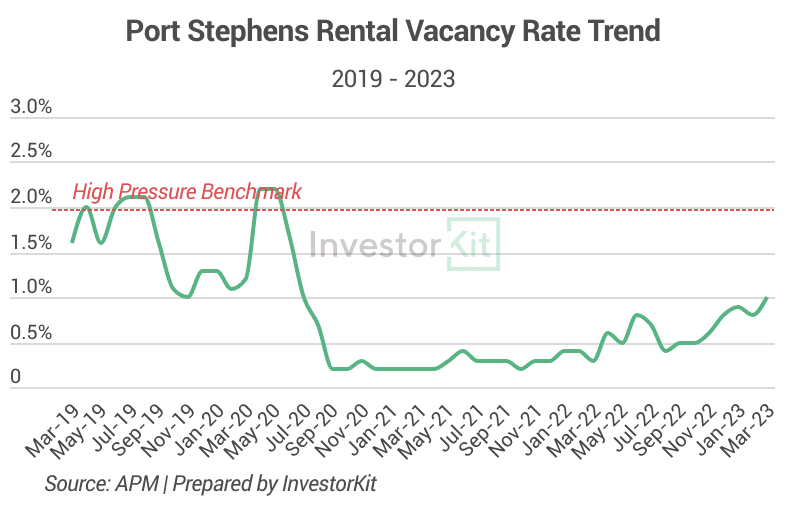

Image of 6482d9bb9dde40f94fab94ab 8.%20Vacancy%20rate


• Low established supply

Established supply is reflected by the number of for-sale listings. Second-winds usually see a slight increase in the number of listings (due to the end of the last boom) before decreasing again (entering the next boom).

The chart below shows the total number of for-sale listings over the past 13 years in Postcode 2315, one of the main postcode areas in Port Stephens. In the last booming period (2014-18), the region saw its number of listings dropping fast to a much lower level than the early 2010s. 2019 saw a slight recovery, but it soon started dropping again from 2020 on.
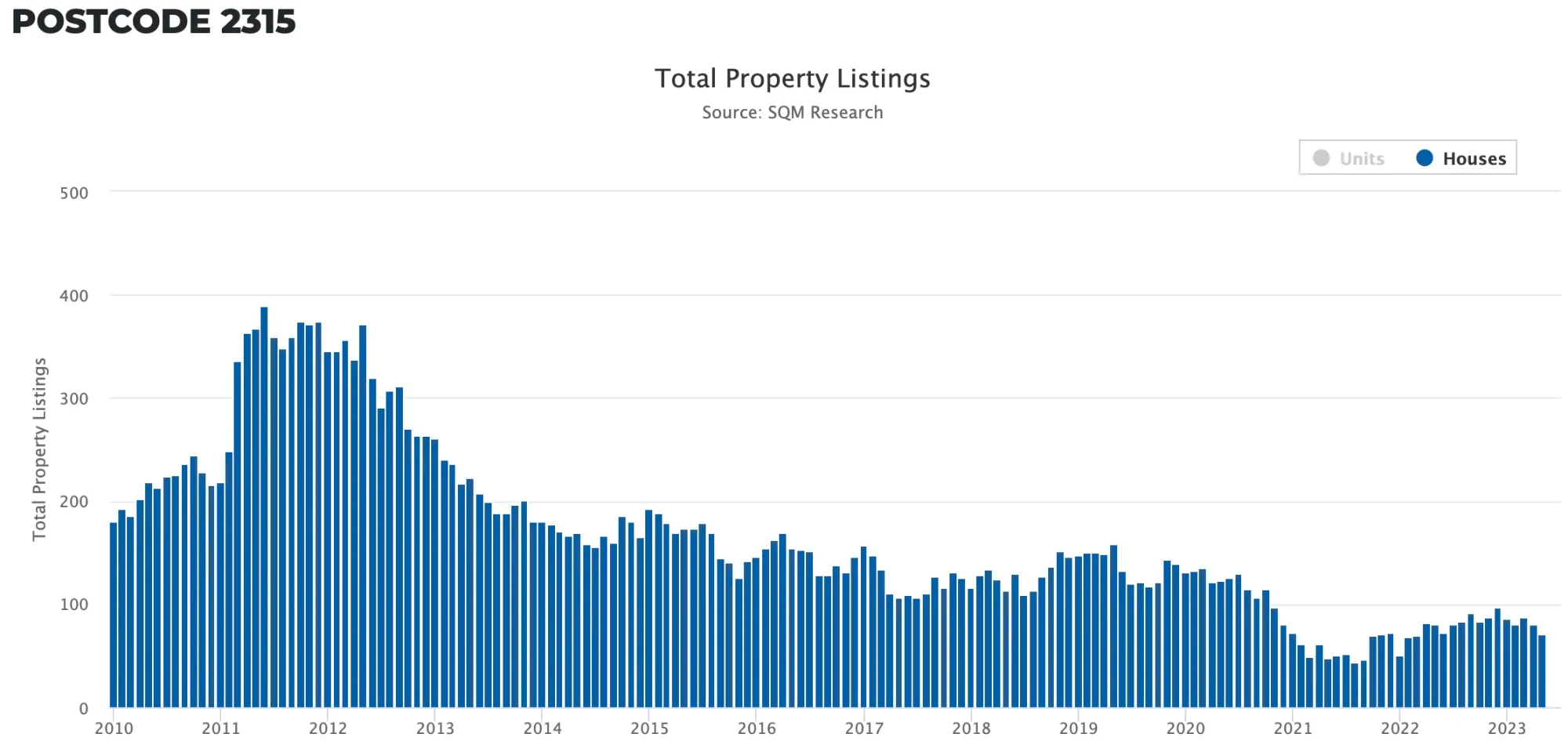

Image of 6482d9e356e0714fadb2f9c7 9.%20%23%20of%20listings


• Incoming supply not necessarily decreasing

Unlike Early Adopters and Hotspots’ low incoming supply level, Second-winds could see an increasing level of incoming supply as its last booming period have triggered more construction activities.

Port Stephens is an example.

The below chart shows Port Stephens’ building approval level over the past 10 years (we use the building approval numbers / total number of houses ratio to measure the incoming supply level). An upward trend can be seen from 2014 to 2019, which is approximately Port Stephens’ last booming period. However, it’s noteworthy that while construction activities were increasing, the total amount of incoming supply still just represented around 1.6% of the region’s total house stock in 2019, a low enough level to push market pressure up quickly when the second wind (exodus to lifestyle migration trend) came in 2020.
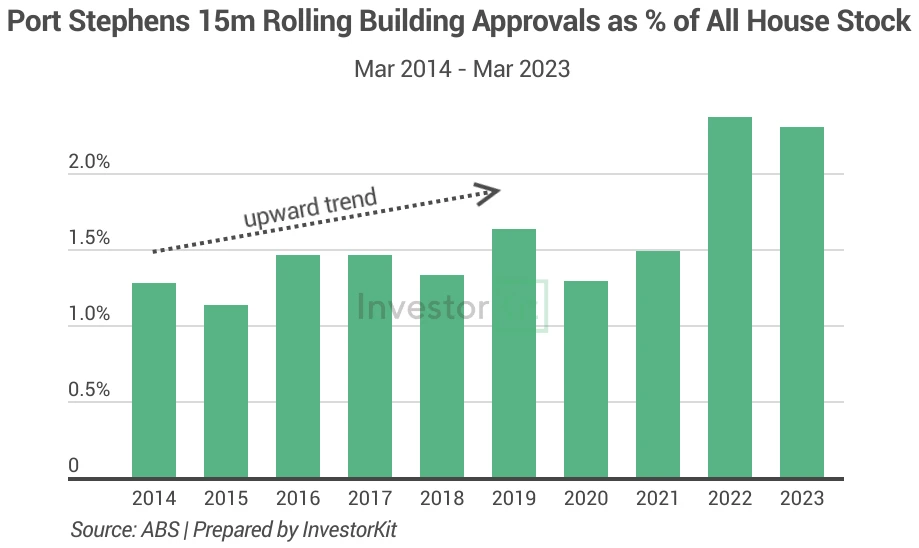

Image of 6482d9fd095da12d439d1182 10.%20BA%20%25


Who is it ideal for?

Second-winds are likely to be pricy with lower rental yields (eg. Port Stephens’ rental yield was around 3.7% in mid-2020 when it became a Second-wind) and limited growth, so they won’t be your first choice if you emphasise positive cash flow or continuously robust capital growth. However, if you have already built a sizeable portfolio (i.e. cash flow and capital growth secured) and are just seeking diversity or great opportunities no matter the price, Second-winds would be ideal for you.


In this Market Categorisation Trilogy, we have discussed Early Adopters, Hotspots and Second-winds. Each of these market categories meets different portfolio-building requirements. Which market category do you need for your portfolio now? Talk to the Buyers Agency of the Year 2023, and let’s find out together! Simply click here and request your FREE discovery call!

Keep Reading

Explore other Blogs

Construction site with multiple cranes and unfinished buildings.
The Tax Trap: Why the 2026 Budget May Actually Hurt New Build Investors

Tax treatment shapes how much of your return you keep, not how large that return is. A larger gain taxed less favourably can still outperform a smaller one taxed more favourably. This blog models the full 10-year after-tax outcome for both property types and tests the theory against real Australian market data.

Construction site with multiple cranes and unfinished buildings.
Tax Benefits Alone Don’t Automatically Make New Builds Better Investments

However, tax benefits are only one factor in your investment performance, not the whole picture. Structural factors that shape long-run property growth, such as supply scarcity, land value, location quality, and underlying demand, are not shaped by tax policy. Favourable tax treatment can improve the outcome of a strong investment, but it cannot compensate for a weak one.

Construction site with multiple cranes and unfinished buildings.
Rental Boom Coming? How the tax reform is actually going to change the rental market

The federal budget, delivered last month, introduced tax reforms, sparking widespread predictions of drastic changes in the rental market. While sentiment is shifting and some markets are already reacting, the core question remains: how will these changes ultimately reshape the market?

Construction site with multiple cranes and unfinished buildings.
The Tax Trap: Why the 2026 Budget May Actually Hurt New Build Investors

Tax treatment shapes how much of your return you keep, not how large that return is. A larger gain taxed less favourably can still outperform a smaller one taxed more favourably. This blog models the full 10-year after-tax outcome for both property types and tests the theory against real Australian market data.

Construction site with multiple cranes and unfinished buildings.
Tax Benefits Alone Don’t Automatically Make New Builds Better Investments

However, tax benefits are only one factor in your investment performance, not the whole picture. Structural factors that shape long-run property growth, such as supply scarcity, land value, location quality, and underlying demand, are not shaped by tax policy. Favourable tax treatment can improve the outcome of a strong investment, but it cannot compensate for a weak one.

Construction site with multiple cranes and unfinished buildings.
Rental Boom Coming? How the tax reform is actually going to change the rental market

The federal budget, delivered last month, introduced tax reforms, sparking widespread predictions of drastic changes in the rental market. While sentiment is shifting and some markets are already reacting, the core question remains: how will these changes ultimately reshape the market?

Construction site with multiple cranes and unfinished buildings.
The Tax Trap: Why the 2026 Budget May Actually Hurt New Build Investors

Tax treatment shapes how much of your return you keep, not how large that return is. A larger gain taxed less favourably can still outperform a smaller one taxed more favourably. This blog models the full 10-year after-tax outcome for both property types and tests the theory against real Australian market data.

Construction site with multiple cranes and unfinished buildings.
Rental Boom Coming? How the tax reform is actually going to change the rental market

The federal budget, delivered last month, introduced tax reforms, sparking widespread predictions of drastic changes in the rental market. While sentiment is shifting and some markets are already reacting, the core question remains: how will these changes ultimately reshape the market?

Construction site with multiple cranes and unfinished buildings.
Tax Benefits Alone Don’t Automatically Make New Builds Better Investments

However, tax benefits are only one factor in your investment performance, not the whole picture. Structural factors that shape long-run property growth, such as supply scarcity, land value, location quality, and underlying demand, are not shaped by tax policy. Favourable tax treatment can improve the outcome of a strong investment, but it cannot compensate for a weak one.

© 2026 InvestorKit Pty Ltd. All rights reserved. It is illegal to reproduce or distribute copyrighted material without the permission of the copyright owner.

This website, and any content provided by is general information, not investment advice. InvestorKit and affiliates are not liable for actions taken based on this content.Always seek advice from relevant professionals such as legal, financial, and accounting experts. Past performance doesn’t guarantee future results.

© 2026 InvestorKit Pty Ltd. All rights reserved. It is illegal to reproduce or distribute copyrighted material without the
permission of the copyright owner.

This website, and any content provided by is general information, not investment advice. InvestorKit and affiliates are not liable for actions
taken based on this content.Always seek advice from relevant professionals such as legal, financial, and accounting experts. Past
performance doesn’t guarantee future results.

© 2026 InvestorKit Pty Ltd. All rights reserved. It is illegal to reproduce or distribute copyrighted material without the permission of the copyright owner.

This website, and any content provided by is general information, not investment advice. InvestorKit and affiliates are not liable for actions taken based on this content.Always seek advice from relevant professionals such as legal, financial, and accounting experts. Past performance doesn’t guarantee future results.

© 2026 InvestorKit Pty Ltd. All rights reserved. It is illegal to reproduce or distribute copyrighted material without the permission of the copyright owner.

This website, and any content provided by is general information, not investment advice. InvestorKit and affiliates are not liable for actions taken based on this content.Always seek advice from relevant professionals such as legal, financial, and accounting experts. Past performance doesn’t guarantee future results.