
In our previous article, Why Townhouses Are the Smarter Play in 2026, we looked at why townhouses are becoming increasingly relevant to property investors.
Our research suggests that houses have historically delivered stronger long-term capital growth than townhouses. But with house prices increasingly out of reach for many investors, townhouses can offer a more affordable entry point, while typically providing stronger rental yields.
This raises another question:
If houses are the faster-growing asset, should you simply wait until you can afford one?
At first glance, this sounds logical. You can continue saving, potentially benefit from improved borrowing conditions in a couple of years, and eventually buy the asset with stronger long-term growth prospects.
But there is something overlooked: the opportunity cost of waiting.
Waiting Comes With A Cost
Australia is not one homogeneous property market.
Across the country, hundreds of local markets are moving through different stages of their property cycles at any given time. While some markets may be flat or declining, others can be experiencing strong price growth.
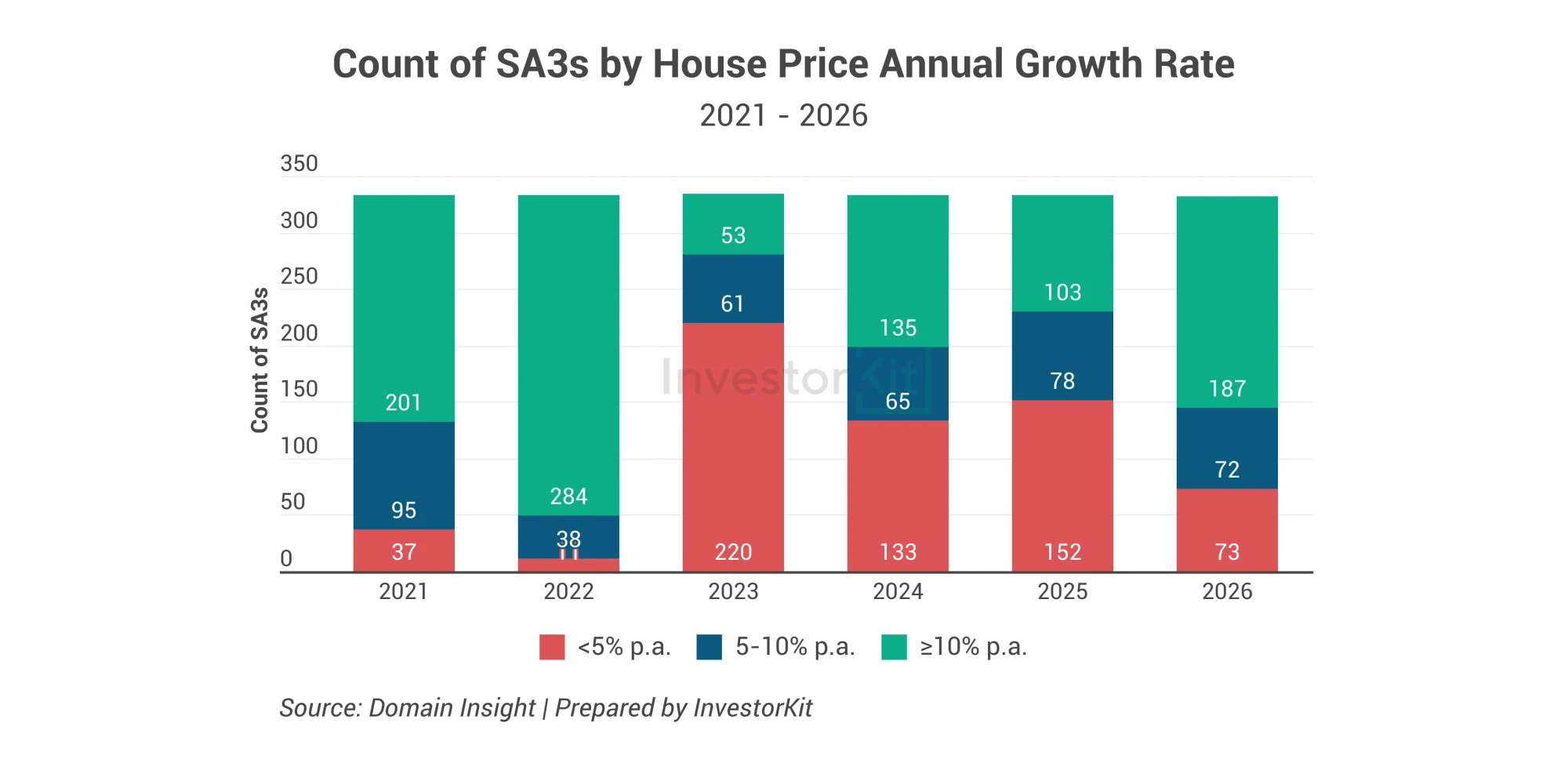
As the chart above shows, even in years when the broader Australian property market appears relatively subdued, there can still be plenty of individual markets recording double-digit annual growth.
Property markets always experience ups and downs. But by studying factors such as economic fundamentals, housing demand and supply, affordability and rental conditions, investors can identify markets that are more likely to deliver strong performance and contribute to long-term wealth creation.
This is why waiting for the “perfect” time to enter the market can be counterproductive. There may never be a perfect time. Interest rates change; prices change; lending conditions change; and different property markets move through their cycles at different times.
What matters is selecting the right market and giving your investment enough time to perform.
In other words, time in the market can be more important than trying to perfectly time the market.
And sometimes, getting that extra time in the market could mean making a seemingly imperfect choice on the type of property you buy, such as choosing a well-selected townhouse today rather than waiting another few years until you can afford a house.
Does that actually stack up financially?
Let’s look at a simplified example.
Buying A Townhouse Today vs. Waiting Two Years For A House
Let’s assume two investors, Tom and Harry, each have $110,000 available today as their initial wealth.
They make two different choices today, and we compare their wealth positions five years later, in 2031.
Tom: Buying a townhouse today
Tom uses the $110,000 as a 20% deposit to purchase a $550,000 townhouse in mid-2026.
For this scenario, the table below shows our key assumptions.
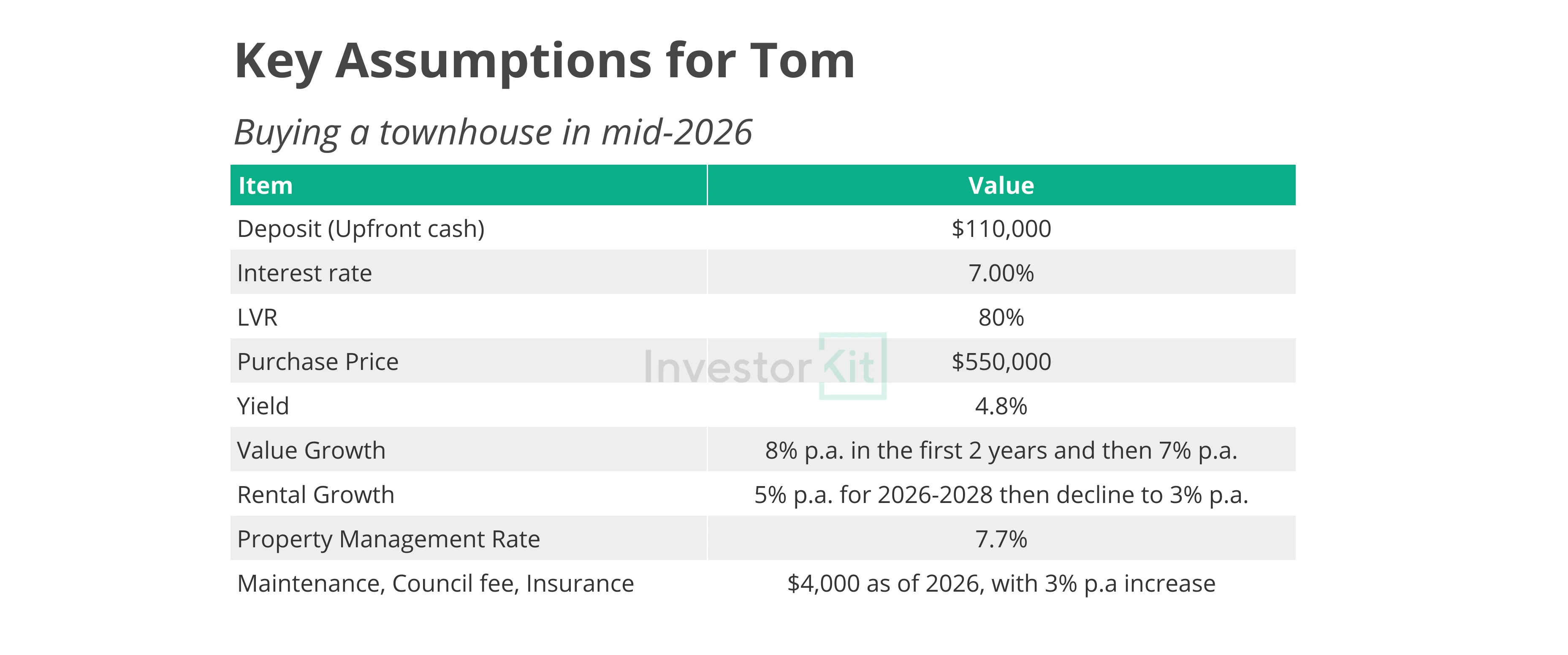
Because the property is negatively geared before tax, Tom contributes approximately $29,400 in additional cash flow over the first two years to hold the property.
Harry: Waiting two years to buy a standalone house
Harry decides not to buy.
Instead, he keeps his $110,000 in an interest-bearing account earning 4% p.a. while continuing to save. He also saves the same $29,400 that Tom uses to cover the townhouse’s cash-flow shortfall.
By mid-2028, Harry has approximately $148,400 available as a deposit, allowing him to purchase a house worth around $742,000 at an 80% LVR.
Because Harry can now afford a higher-priced house, we assume a slightly lower rental yield of 3.7%, but stronger capital growth of 8% p.a. throughout the modelling period.
We also assume Harry enters the market at a lower interest rate of 5.5%.
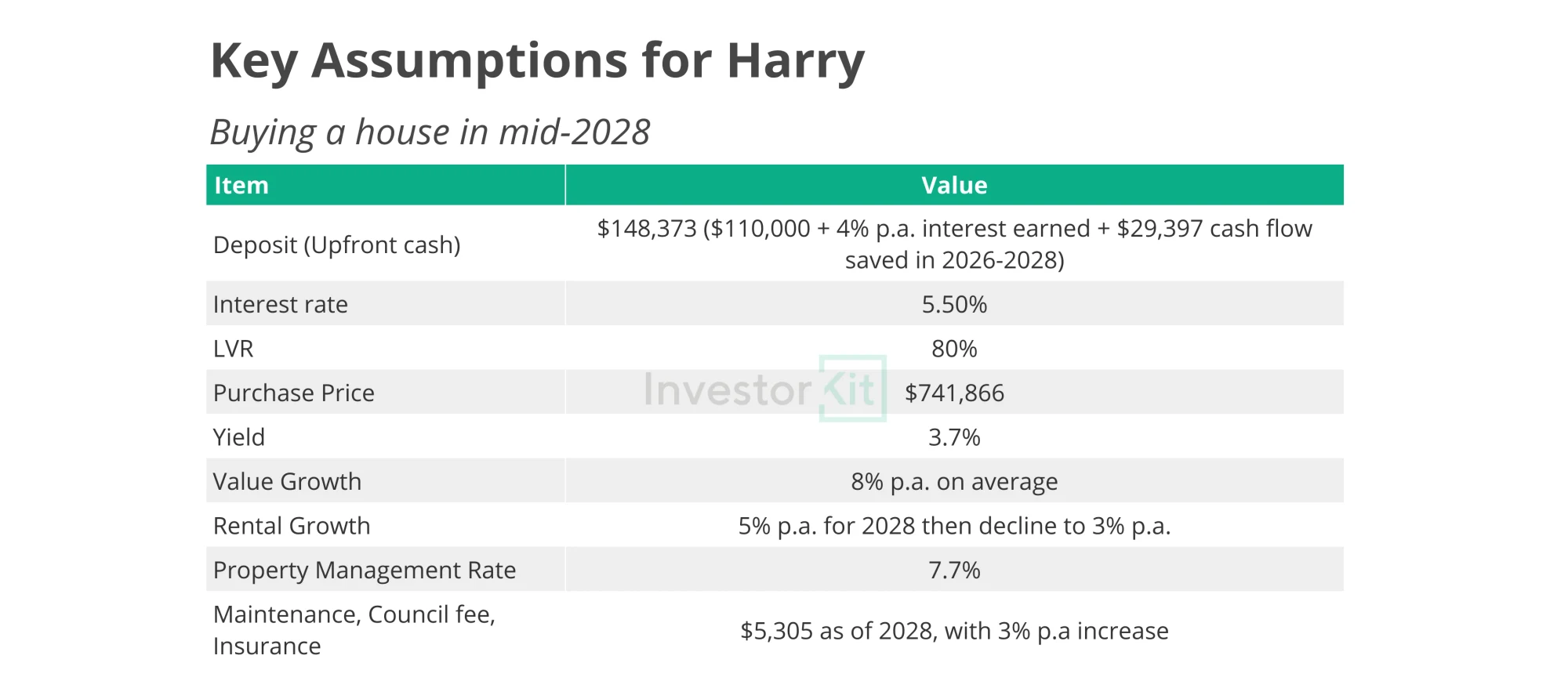
In other words, Harry has used the two years to improve his position. His savings have continued earning a return, he has accumulated a larger deposit, and he can now access a more expensive asset with stronger assumed capital growth.
So, does waiting pay off?
By 2031, There Is Almost No Difference
The result is probably closer than you might expect.
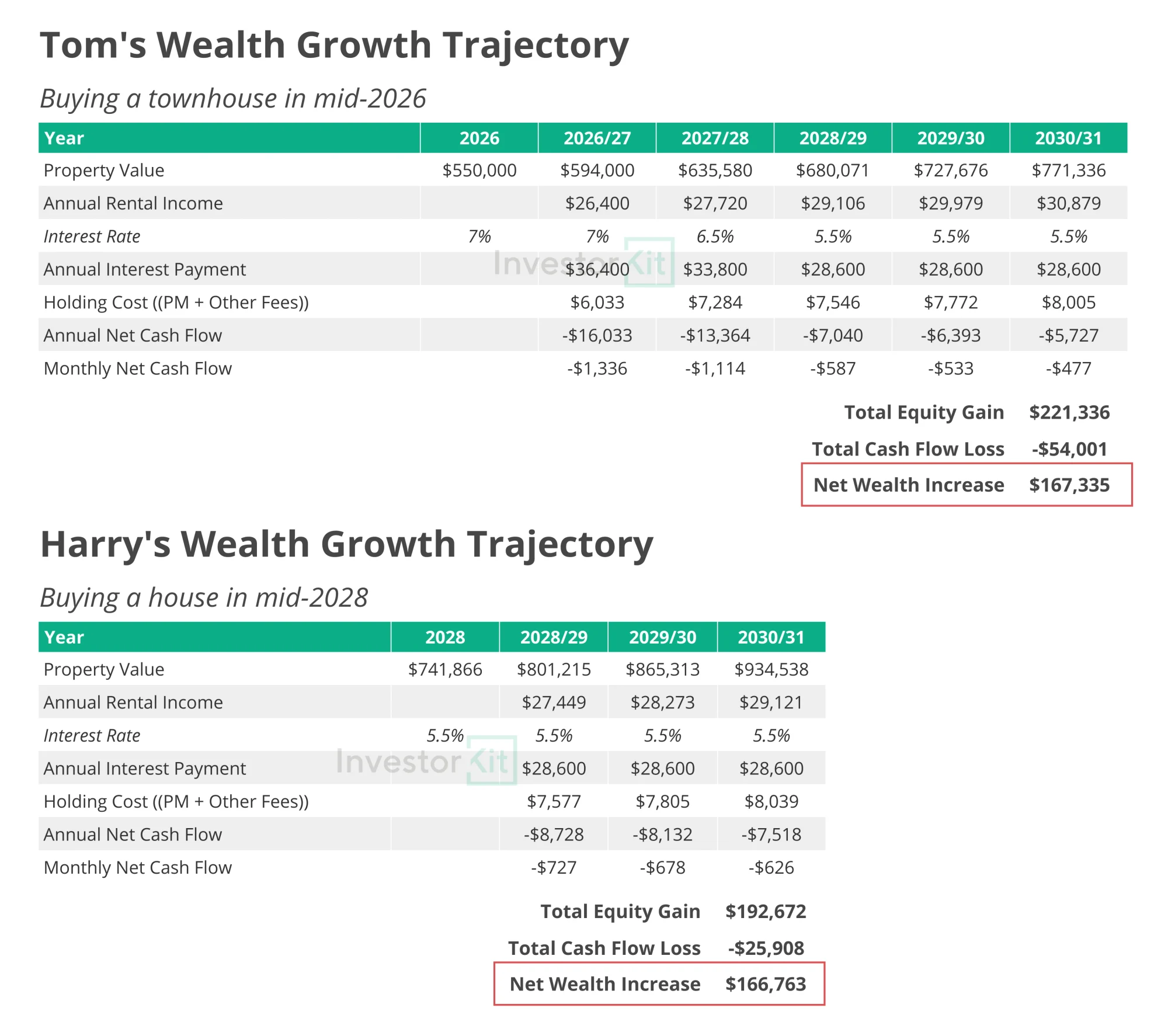
By 2031, Tom’s townhouse has grown from $550,000 to approximately $771,000, creating around $221,000 in capital growth.
After accounting for approximately $54,000 in cumulative negative cash flow, Tom’s modelled net wealth increase is around $167,300.
Harry’s house grows from approximately $742,000 to $935,000, generating around $193,000 in capital growth. After accounting for approximately $26,000 in cumulative negative cash flow, Harry’s modelled net wealth increase is around $166,800.
The difference between them is around $500.
For the purpose of a simplified five-year model, that difference is negligible.
So on the surface, despite the fact that Tom entered the market two years earlier, he would end up with a broadly similar wealth outcome to waiting for the higher-growth house.
But the final number doesn’t tell the whole story.
The Real Difference Is Where They Are Along the Journey
The final numbers may be almost identical, but by 2028, Tom and Harry are at very different stages of their property journeys.
Harry has used those two years to build a bigger deposit. With around $148,000, he is now ready to purchase his first property.
Tom has used those same two years to build equity towards his next purchase. His townhouse has grown from $550,000 to approximately $636,000, creating around $86,000 in additional equity through capital growth.
Subject to borrowing capacity and lending conditions, Tom may be able to access some of this equity to help fund another investment. And under our assumptions, interest rates have also fallen by 2028.
So, while Harry is using his accumulated savings to purchase property number one, Tom may already be thinking about property number two.
For investors looking to build a portfolio, that two-year head start can make a meaningful difference.
Does This Mean Townhouses Are Better Than Houses?
No. This modelling does not tell us that townhouses are better investments than houses, and that’s not the point of the comparison.
Based on our research, under the same conditions, such as market and building age, houses still tend to generate better long-term capital growth. If your budget allows you to purchase the right house in the right market today, a house may well remain the preferred option.
But when the ideal asset is currently out of reach, choosing a good alternative and allowing time and compounding to work in your favour can be better than doing nothing.
Because there are two variables at work here: the quality of the asset and the amount of time you own it.
Waiting two years may give you access to a stronger asset. But that asset then has to work hard to make up for the two years of market exposure you have given away.
A well-selected townhouse can therefore play a very important role in a portfolio.
It doesn’t need to outperform a house in capital growth. It simply needs to perform well enough that entering the market today leaves you better off than waiting.
Of course, that brings us to another important question: does every townhouse make a good investment?
Definitely not.
In our next article, we’ll look at the characteristics that separate investment-grade townhouses from the ones investors should think twice about.
If you’re unsure whether waiting for a house or buying a townhouse now would better suit your investment strategy, our team can help you assess. Book a free discovery call with InvestorKit to discuss your next step.