
" transform="translate(9 6)" width="6px"/></svg>)
Why Some Strata Properties Deserve a Place in Your Portfolio
For many property investors, “strata” is almost a dirty word.
It often brings to mind expensive fees, restrictive by-laws, poorly managed committees and headlines about apartment owners facing large special levies. As a result, many investors would rule out any strata property before they’ve even considered its investment fundamentals.
Those concerns are understandable. But they also raise an important question: are investors avoiding strata properties for the right reasons?
The reality is that strata is an ownership structure, not a measure of investment quality. While some strata properties deserve caution, others have actually delivered strong long-term performance and can play an important role in a well-built portfolio.
What is strata?
Strata title means individual owners own their property while sharing ownership and responsibility for common areas, such as driveways, gardens or external building maintenance.
This ownership structure applies to many different property types, including apartments, townhouses, villas and, in some cases, detached houses within community estates.
In other words, buying a strata property does not automatically mean buying a high-rise apartment. Many established townhouses are also strata titled, despite looking and functioning much like standalone homes.
Are strata fees really an “extra” cost?
One of the biggest reasons investors hesitate is the ongoing cost of strata levies.
However, it’s worth considering what those fees actually pay for.
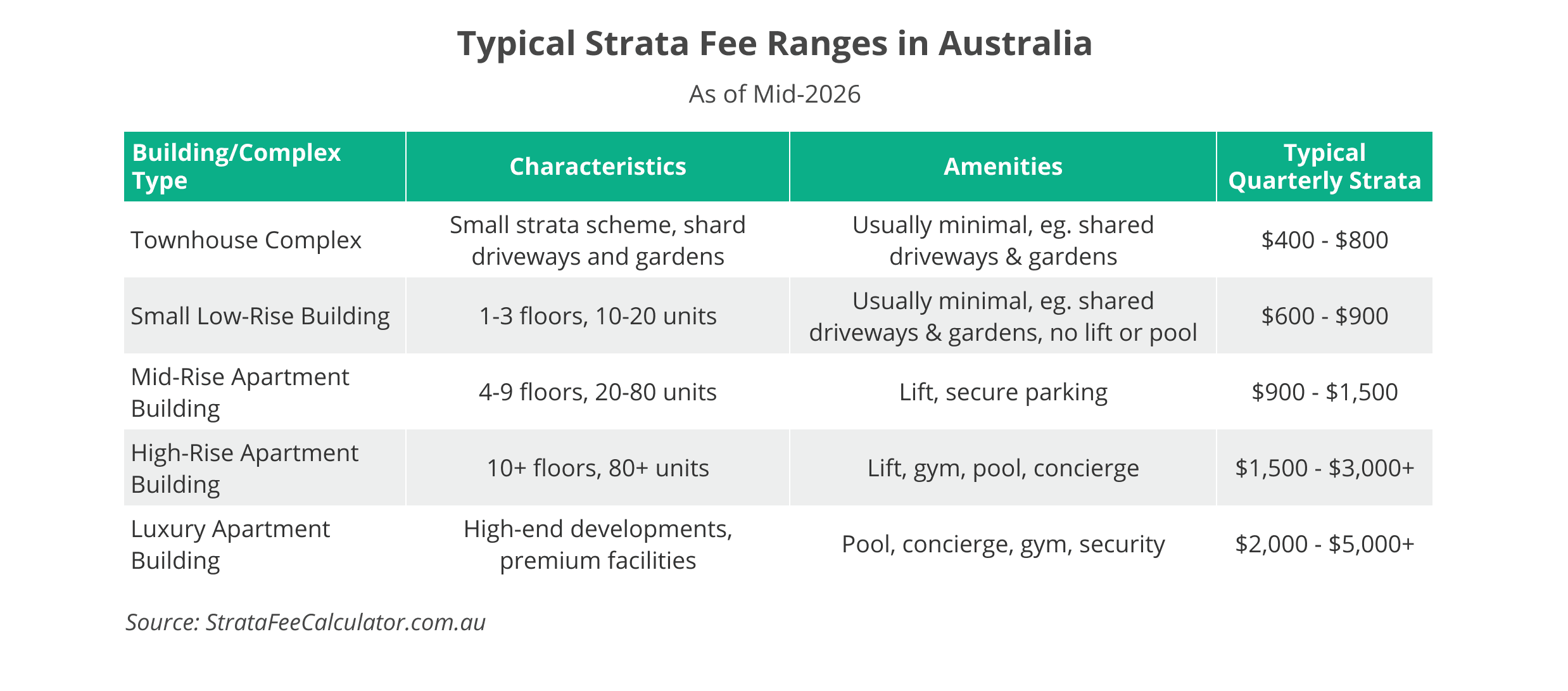
For many townhouse complexes, strata fees cover shared insurance, external building maintenance, gardening, driveway upkeep and contributions to a sinking fund for future repairs. That is typically $400-$800 per quarter (StrataFeeCalculator), varying by location and the complex's features.
Standalone houses don’t have strata levies, but that doesn’t mean they are maintenance-free. Homeowners are still responsible for roof repairs, fencing, exterior painting, landscaping, insurance and other ongoing maintenance costs. Instead of paying these costs collectively, they’re simply paid individually as issues arise.
Strata properties are not automatically more expensive or cheaper to own than houses. Rather, ownership costs exist regardless of property type. Strata simply changes how some of the holding costs are managed.
When should investors be cautious?
Of course, not every strata property makes a good investment.
Some developments deserve greater scrutiny, particularly those with luxury facilities such as pools, gyms and lifts that can significantly increase ongoing levies. The table below shows how expensive strata fees can become as the amount of amenities increases.
Investors should also pay attention to the financial health of the owners corporation, including whether adequate funds have been set aside for future maintenance and whether there is a history of frequent special levies.
Large, high-density developments may also present additional challenges, particularly if many similar properties compete for buyers and tenants.
Therefore, like any investment, due diligence matters. The goal shouldn’t be to avoid any strata property: it should be to understand which ones carry unnecessary risks.
Don’t confuse strata with poor investment performance
Another common misconception is that strata properties don’t deliver strong capital growth.
This perception largely comes from apartments. In many cities, high-density apartment markets have experienced periods of oversupply, limiting price growth. Below is an example of the SA3 of Brisbane Inner, where a large wave of apartment buildings were built and supplied to the market in the mid-2010s. Unit prices only started growing around 2022 after the excessive supply was absorbed and some demand continued to be squeezed out of the house market as affordability pressure intensified.
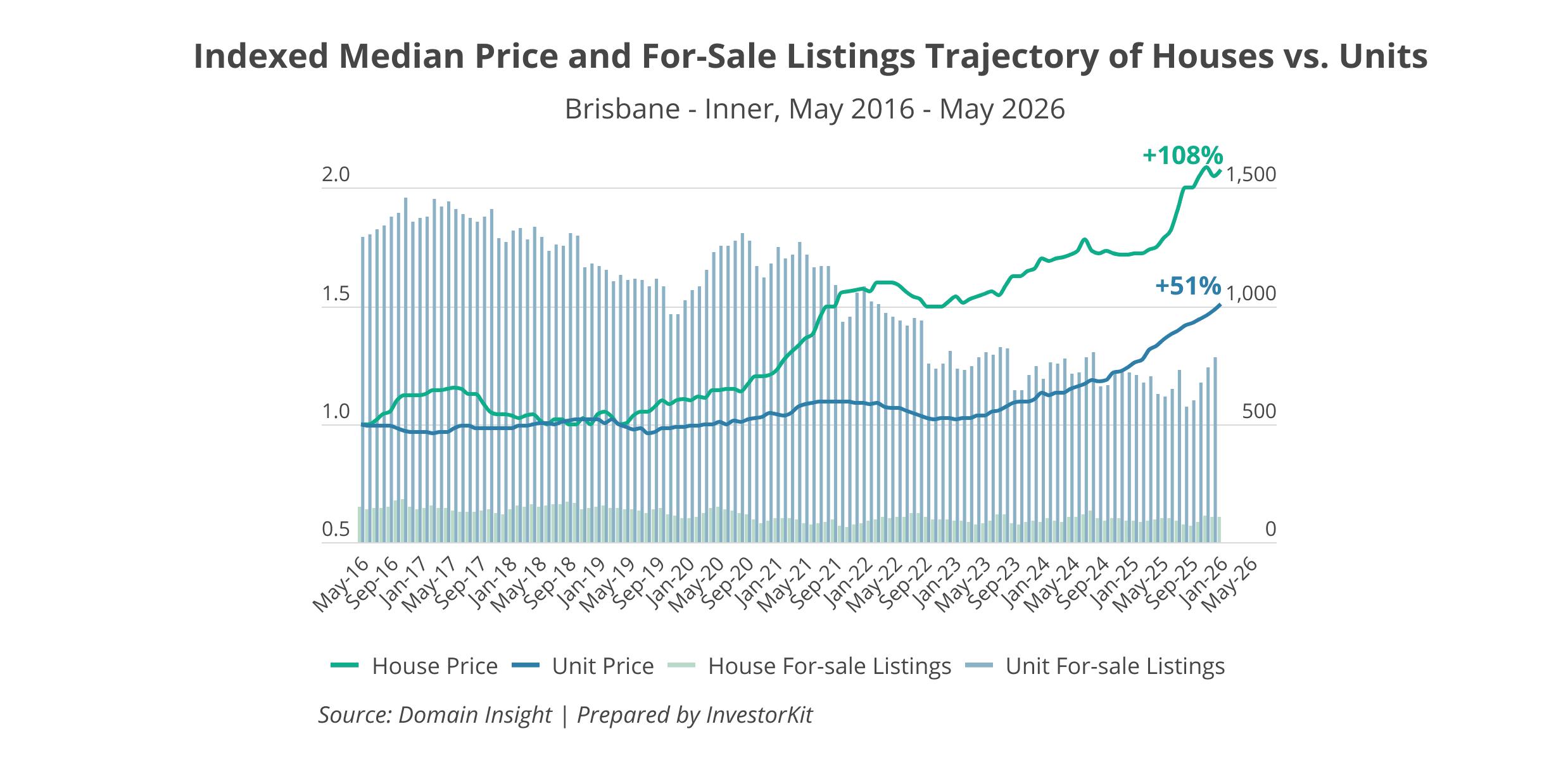
So it is oversupply, not strata itself, that is the real issue.
Investment performance is driven by the same fundamentals regardless of title type: supply-demand relationship, scarcity, owner-occupier appeal and the strength of the local economy.
This is why established townhouses can perform very differently from high-density apartments.
Many townhouses are located in mature suburbs where opportunities to build large numbers of similar homes are limited. They are often built in smaller boutique complexes with fewer shared facilities, lower ongoing levies and strong appeal to buyers seeking lifestyle or additional space without the price tag of a detached house.
An example is the Melbourne SA3 of Moreland - North. It is a well-established middle-ring region with 88% of unit stock being townhouses (hence we can use unit price trajectory as a proxy of townhouse price trajectory in the chart below). The chart also shows that there hasn’t been a large amount of new unit (mainly townhouses) supply added to the market over the past decade. As a result, unit/townhouse price growth has been largely tracing house price growth in this region.
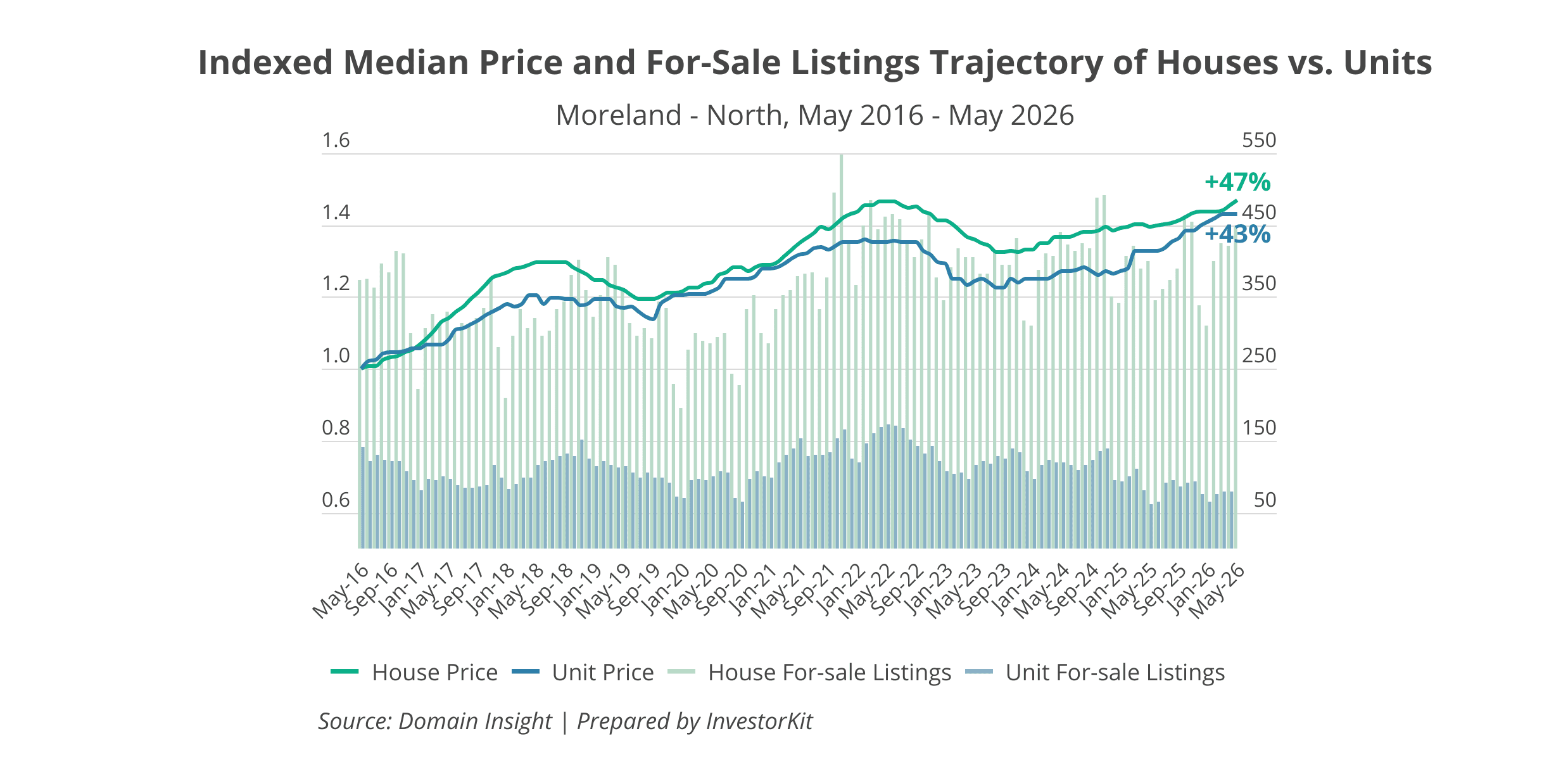
Over the past decade, many established townhouse markets across Australia have demonstrated steady long-term capital growth, and in some markets their performance has been comparable to nearby houses, just like what we see in Moreland - North. While they may not always outperform detached homes, they have provided investors with an opportunity to enter high-quality locations at a much lower purchase price (eg. Moreland - North’s median house price is now $836k, while the townhouse median is just $629k).
This distinction is becoming increasingly important as housing affordability continues to deteriorate. For many investors, the choice is no longer between buying a house or buying a townhouse. Instead, it is between buying an investment-worthy townhouse today (in this article, we discuss why townhouses can be investment-worthy in the current environment) or delaying their investment journey, missing out on growth opportunities, just to wait for the moment when they can afford a detached house.
As a data-driven buyer’s agency, InvestorKit help investors understand market trends, evaluate opportunities and make confident property decisions aligned with their long-term goals. If you’re interested in learning more about which markets and property types may be suitable for your investment journey, book a FREE discovery call with the InvestorKit team. We’d love to help you explore your options.
Keep Reading



" transform="translate(5 5)" width="14px"/></svg>)