
" transform="translate(9 6)" width="6px"/></svg>)
Townhouses: The New First Step Towards Financial Freedom
For decades, detached houses have been considered the gold standard of Australian property investing. Larger land content, strong long-term capital growth and broad buyer appeal have made them the preferred choice for many investors.
But today’s market looks very different from the one investors entered just a few years ago.
House prices have climbed significantly across much of Australia, interest rates remain elevated, and tax changes are making investment properties more expensive to hold. For many investors, particularly those buying their first or second investment property, the biggest challenge is no longer choosing which house to buy, but whether buying one is still financially achievable.
This is where townhouses are becoming increasingly relevant. They may not replace detached houses, but they can provide an effective stepping stone for investors looking to continue building wealth without stretching their finances beyond a comfortable level.
Australia’s housing market has become less accessible
The Australian property market has changed rapidly in recent years.
Across the country, more markets have moved into higher price brackets, making detached houses increasingly difficult to access for everyday investors.
As the chart below shows, in 2021, there were 177 SA3 regions (more than half) with a median house price below $600,000. By 2026, that number had fallen to just 62 (less than one-fifth). More importantly, many of these remaining affordable markets are small or remote regions with relatively limited housing stock and lower transaction volumes, making them not ideal for investment.
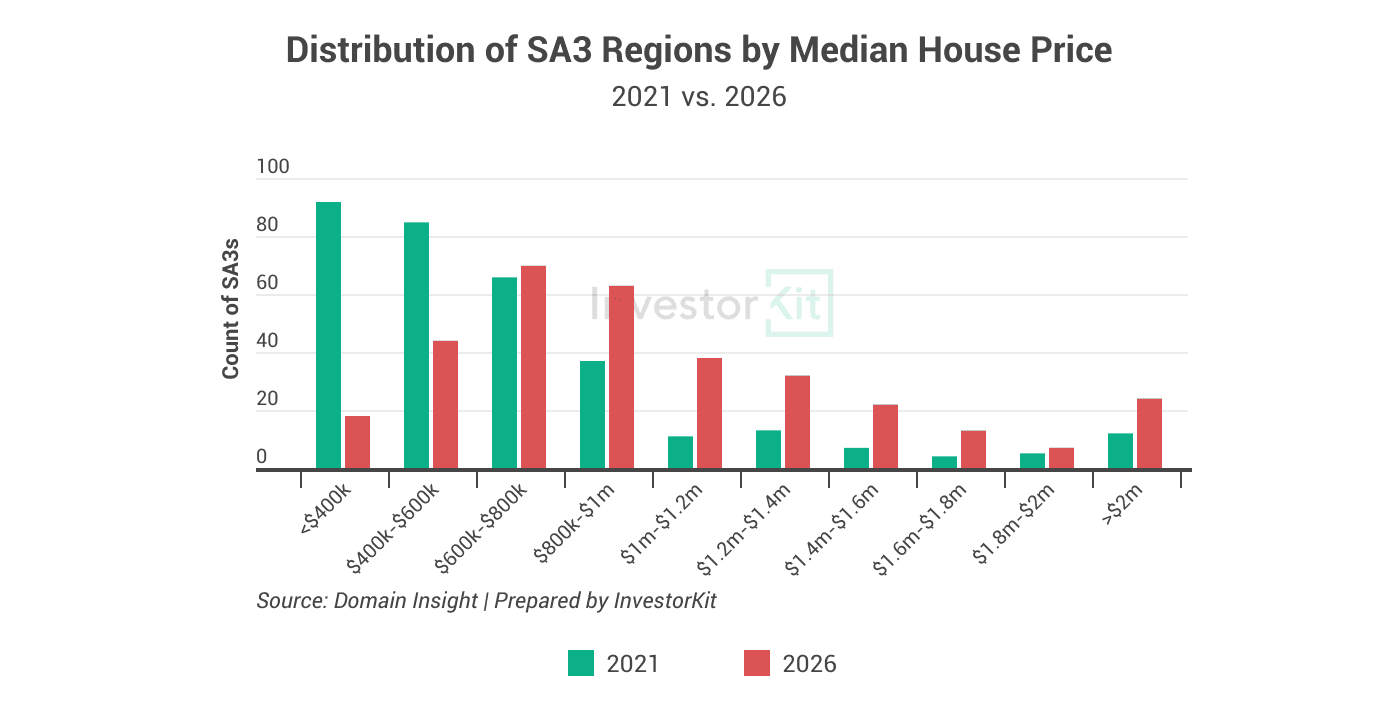
Besides price growth, affordability has also been challenged from several other directions. Higher interest rates have reduced borrowing capacity, meaning investors may now qualify for substantially smaller loans than before. At the same time, the changes to negative gearing and capital gains tax concessions are further squeezing borrowing capacities and increasing holding costs.
Under these circumstances, many investors may be asking “Can I still invest in property?”
It’s a question often shaped by the assumption that detached houses are the only investment-worthy residential asset. However, in the current environment a more practical question may be “How can I continue investing in today’s market?”
Why more investors are considering townhouses
Townhouses occupy an increasingly important space between detached houses and apartments.
Compared with houses, they are typically more affordable, allowing investors to enter quality suburbs with a lower purchase price and a smaller deposit.
At the same time, townhouses generally provide stronger rental yields than detached houses.
To examine this, we analysed 21 capital city SA3 regions where more than 90% of all units are townhouses. While Australia does not yet have a dedicated townhouse market dataset, these markets provide a close proxy for townhouse performance.
As the chart below shows, townhouses deliver higher median rental yields than houses in most of these markets. The yield premium is particularly evident across Greater Melbourne and Greater Perth, while in Greater Brisbane the difference is generally smaller, with a handful of markets showing slightly higher house yields. Overall, however, the pattern is clear: townhouses typically provide stronger rental income than detached houses.
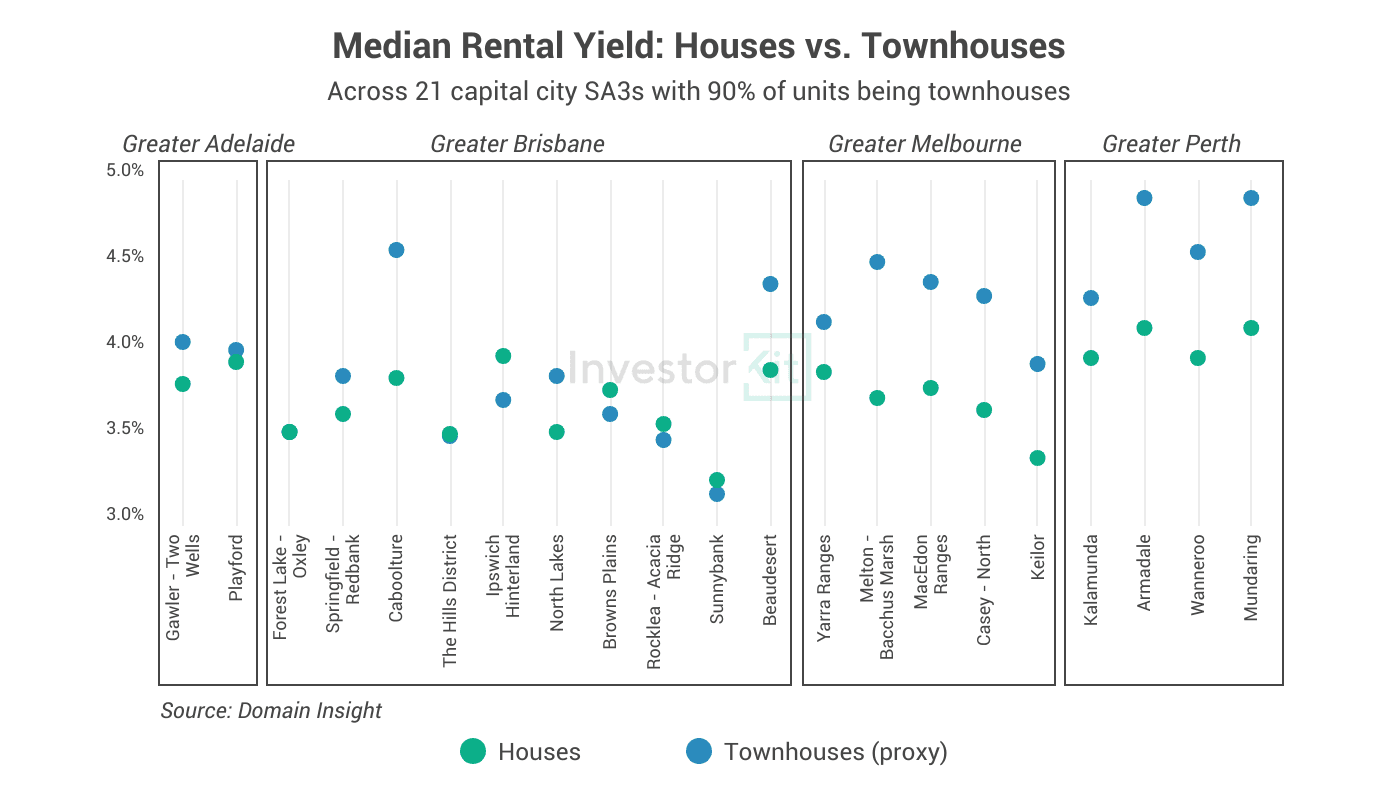
This additional rental income can help offset holding costs, particularly in a higher-interest-rate environment.
The long-term growth gap is smaller than many investors expect
Many investors assume choosing a townhouse instead of a detached house means giving up a substantial amount of capital growth.
Our research suggests the trade-off can be much smaller.
We analysed the capital growth performance of 275 Melbourne townhouses between the last two sales and compared each property’s annualised capital growth with the annualised growth of its local house market over the same holding period.
As the chart below shows, townhouse growth has generally tracked the performance of the surrounding house market over time. While detached houses have typically achieved slightly stronger annualised growth, the difference is often much smaller than many investors expect.
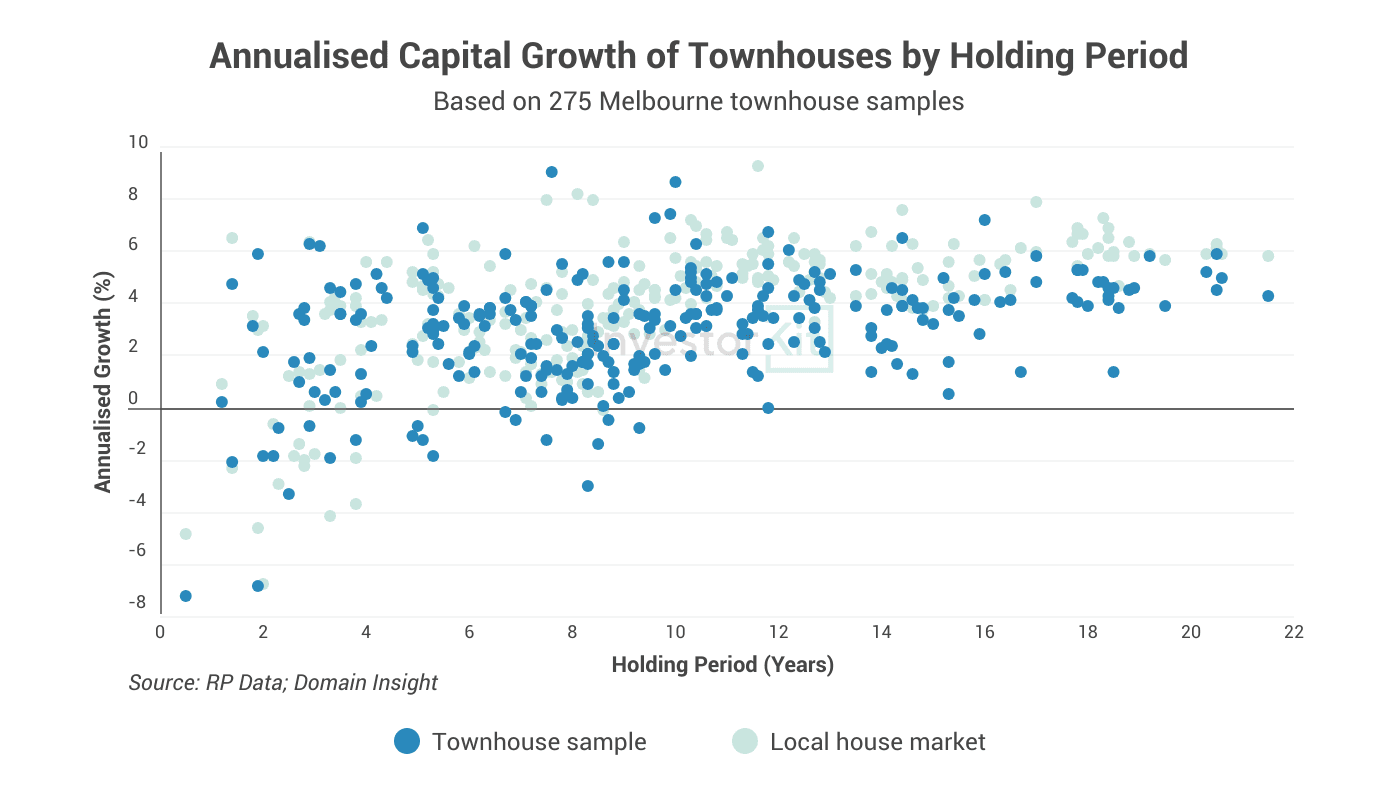
The next chart makes this relationship even clearer by plotting the growth difference between each townhouse and its corresponding local house market.
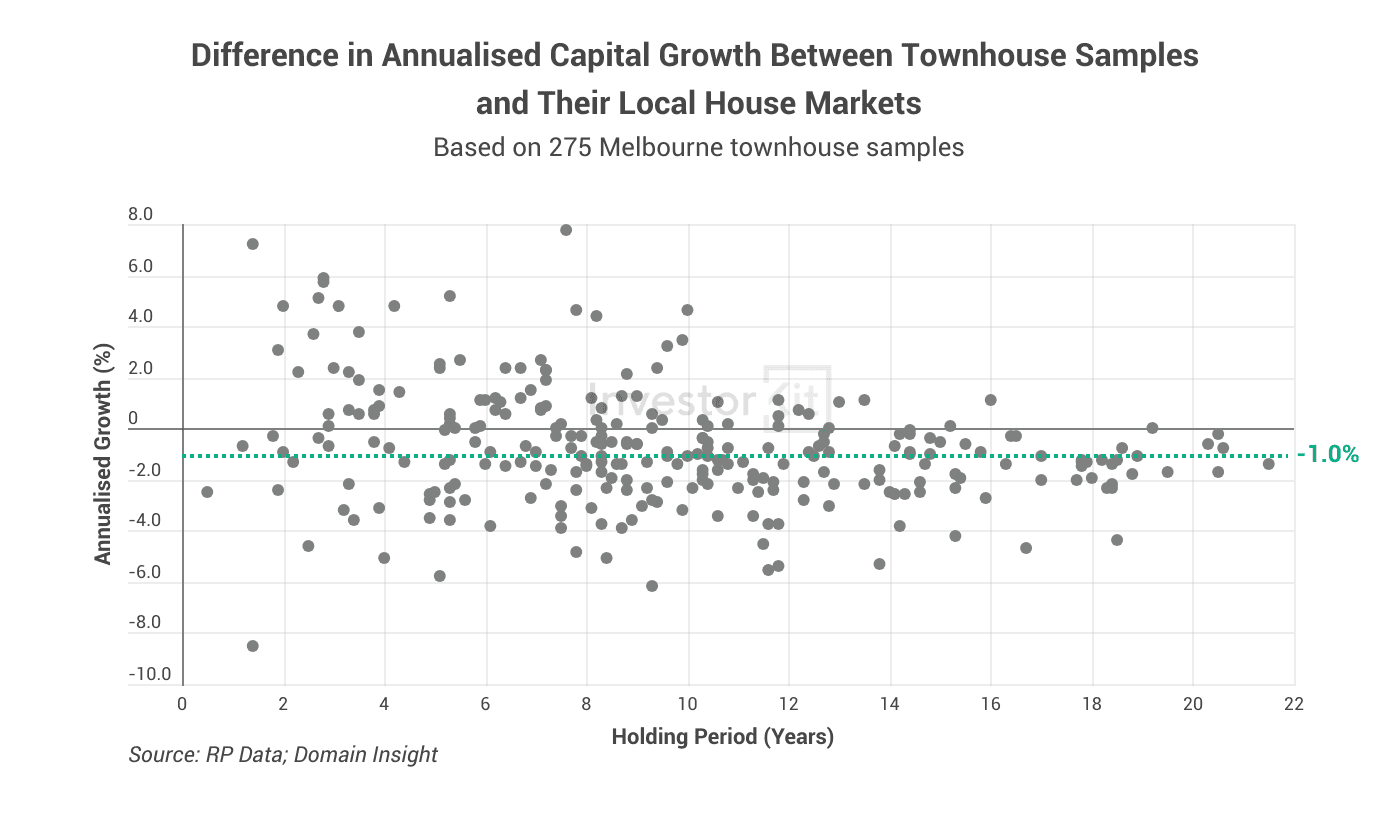
In the cases of shorter holding periods, the performance gap varies considerably, reflecting the influence of market cycles and transaction timing. However, as holding periods become longer, the results start to converge. Across longer-term holdings, townhouses have underperformed their local house markets by around 1% per year on average.
Total returns matter more than capital growth alone
Many investors compare property types based solely on expected capital growth.
However, a property’s overall investment performance depends on more than just value appreciation. Rental income also contributes to total returns.
As the previous section showed, on average, townhouses have historically underperformed their local house markets by approximately 1% per year over the long term. While the gap should not be ignored, it’s also important to view it in context. For many investors, the lower purchase price and stronger rental income of a townhouse can compensate for this modest difference in capital growth.
The chart below illustrates this concept. If we add a 1% rental yield premium, which is commonly observed across many townhouse markets, to the townhouse capital growth rates of our Melbourne townhouse samples, the difference in overall annual returns becomes much smaller and would gradually converge towards zero over longer holding periods.
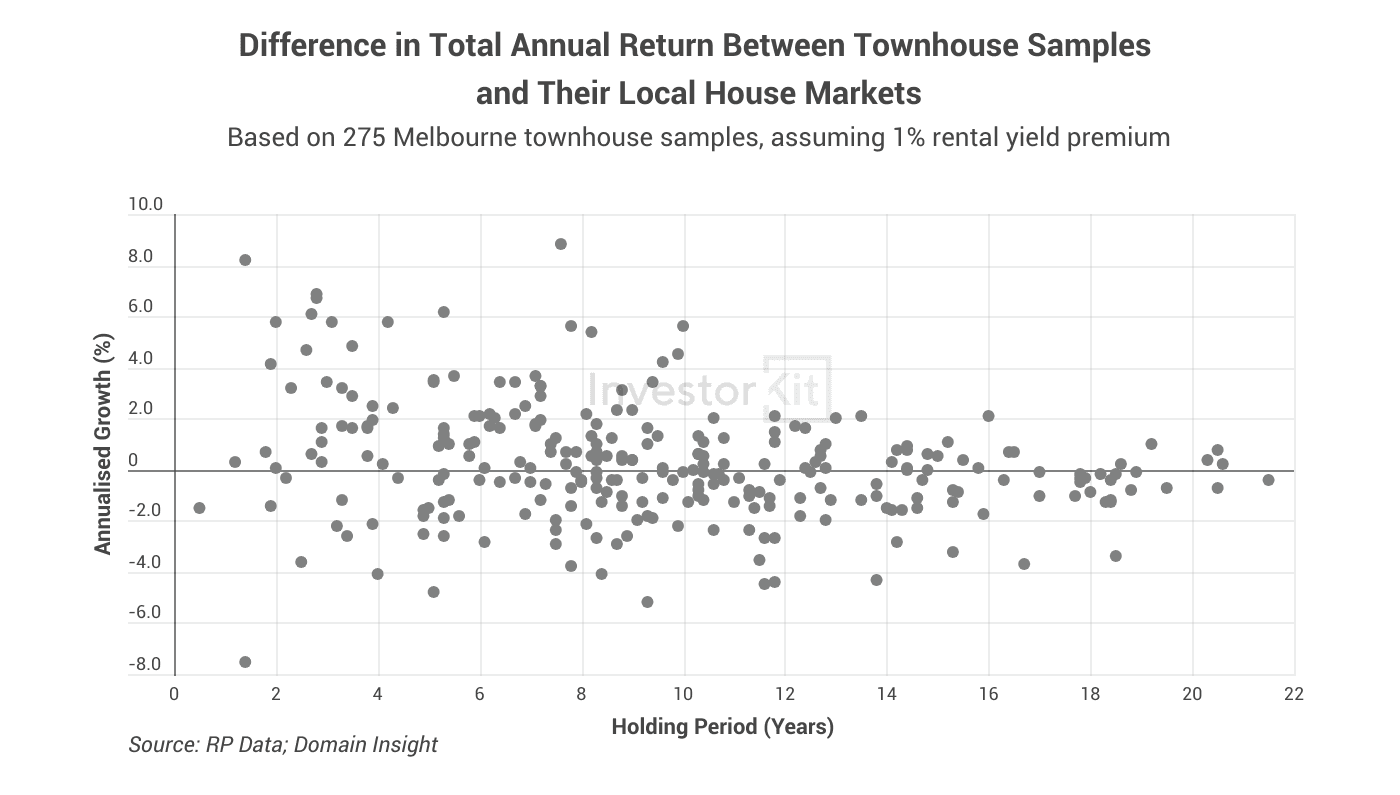
Of course, this chart is intended as a simplified conceptual illustration rather than a guarantee of future performance. Not every townhouse would provide an exact 1% yield premium, and investment outcomes would always depend on the quality of the property and the market in which it is located.
However, the broader message remains important: it’s a good idea to evaluate both capital growth and cash flow when comparing property types. A carefully selected townhouse with stronger rental income may deliver total investment returns that are as competitive as, or even better than, detached houses.
That’s what makes townhouses a great stepping stone for many investors to continue building wealthy through property in the new environment. For many, purchasing a well-selected townhouse today can create better long-term outcomes than delaying their investment journey while waiting for a detached house to become affordable.
Over the long term, time in the market usually beats timing the market.
Not every townhouse is investment-worthy
Of course, this doesn’t mean every townhouse represents a good investment.
As with any property, including detached houses, performance depends on where and what you buy.
At InvestorKit, we generally favour established townhouses, with good land component, located in well-established suburbs with constrained future supply. We also prefer developments with reasonable ongoing holding costs and without the high-maintenance facilities that can significantly increase strata levies.
These principles help reduce some of the risks associated with oversupply while improving the likelihood of sustainable long-term performance.
We’ll explore these selection criteria in much greater detail in a future article.
As a data-driven buyer’s agency, InvestorKit help investors understand market trends, evaluate opportunities and make confident property decisions aligned with their long-term goals. If you’d like to learn more about which markets and property types may be suitable for your investment journey, book a FREE discovery call with the InvestorKit team. We’d love to help you explore your options.
Keep Reading



" transform="translate(5 5)" width="14px"/></svg>)