This transcript was generated automatically and may contain small errors.
Affordability continues to be raised as an issue, but prices keep rising. Factors that are keeping property prices high haven't changed. We still have very expensive construction costs. It's still very difficult to get labor. There's a supply challenge.
All of those things are compounding. You throw in a few interest rate cuts and things start to change quite dramatically. An interest rate cut. Interest rate cut. Interest rate cuts.
Have pushed up property prices. We know every cycle is different, and you can't look at a previous cycle and say, all right, well, last time interest rates rose, this market did this, so therefore it will do it again. I think a lot of people really got caught out with Gold Coast. There's definitely varying impacts with different infrastructure. A hospital is probably better than a sports stadium.
I mean, there's probably a way there. It's Brisbane's new Olympic precinct. The biggest infrastructure spend in the state's history. One of the things we have been talking a lot about is what's the impact of the Olympics on Brisbane, and the impacts aren't always that positive. Welcome back to another episode of the Property Nerds podcast, and we love it more than ever when it's not just us three nerds, Adrian, Jack, and I, but we get a fellow nerd joining us in the world of data-driven investing or just data overall.
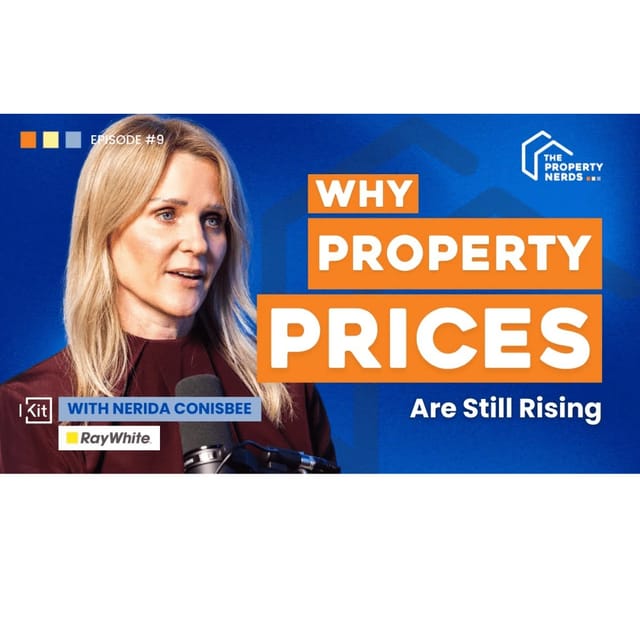
In this particular case, we had Nerida Connersby, the chief economist at Ray White, join us for the show. Now, this is her third time on the show with us, so it's really exciting to have her back again. Today, we uncover more on the trends of interest rates and the likelihood impacts of some key cities. Number two, we go into the world of infrastructure, things like hospitals, train lines, what makes a difference, what hasn't, and the importance of understanding sentiment in the world of infrastructure. Lastly, we also go into the world of data, but from the eyes of Ray White, what makes them different, how does their business collect data and go deeper into it to unpack it from multiple angles, whether it's commercial property, residential property, auctions, and more.
So let's speak to Nerida, chief economist at Ray White, on the Property Nerds show. Nerd alert! Property Nerds, the home for data-driven property investors, where we uncover Australia's hot and cold markets, latest headlines, and trends. Nerida, welcome back to the Property Nerds. Thanks for having me.
Well, it's been great just actually having you on not only once but twice on the show before. You're a fan favorite. Everyone really gets to go into the numbers, into the insights, something you do so well. But in the last time you joined the show, you were with the REA Group, now a chief economist at Ray White. So we'd love to dig a little bit deeper into some of the new and key insights, I guess the key differences that you're really uncovering in your time here at the Ray White Group as the chief economist versus, say, previously at the REA Group.
Yeah, sure. I guess they're quite different companies. They're both in property. REA Group is an advertising company, so they create listings and put them online to sell homes. Ray White is actually involved in the selling of homes, and it's a little bit broader than that.
They sell homes. There's a private equity component of the company called HomeTrack, and so then started to rename that prop track and started to use their own insights. Very similar journey at Ray White. So Ray White, again, very heavy investment in data, using a lot of the data from insights from within the business, things like auction bidding data, things like time on market, very much focusing just on Ray White data. But since then, I've also established a data team focusing on property data, which is a company called Neoval, and again, a very, very heavy investment in that to make sure that we have interesting insights and also to create a revenue stream for the company.
That's really cool, Nerida. You mentioned a few things around the investment in data, but also quite a few different areas with this data that you have, whether it be residential, commercial, auction data. You also mentioned lending data as well. Do you think that having all of these separate insights and data and bringing it all together has really developed the insights or the general broader trends that you've seen? Yeah, absolutely.
I think one of the things that is quite interesting about my role is that I've obviously got the data, and so I can do very, very deep insights into the data, and I've got a team of data analysts, and so they're also super clever and looking around and seeing what the trends are. But we also get a lot of really interesting insights from the business, so talking to agents week to week, month to month can be really interesting. Quite interesting end of last year. So when we're looking sort of around September, October, I was in Brisbane at the time talking to agents, and they were saying, you know, the market's really hot. It's doing really well.
We don't know when it will slow down. And then by November, I turned up, and they're like, oh, it's really changed. Open for inspections. You know, they're not as strong as they were. And at the time, price growth was still showing, you know, it was still showing pretty decent price growth, but then November and December in Brisbane ended up being quite weak.
And so it gave us a little bit of a quicker insight into what was potentially happening in the market. I'm interested to know that there's, like, Ray White Group has a, like, it's, I thought it was just a sales agency company taking such a big interest in data. Like, I'd expect that from a buyer's agency, but not so much on the sales side. So just educate me on that, why that is. Well, it's a few things.
I guess one of the big ones is brand. So I do a lot with our media team. I do a lot of media. I do a lot of television. So it's good for the Ray White brand.
Also, we do a lot of events. My team does a lot of events. So that could be industry body events. It could be events for our Ray White businesses. So, for example, I was in Ipswich last week talking to a group of first-time buyers with our loan market and our Ray White businesses.
Vanessa Radar and my team is speaking to a group around superannuation, investing in superannuation. And so that's a critical role that we play is allowing for engagement with consumers. And then, I guess, just giving our agents something different to talk about. So, you know, we do write a lot of content. So I write a weekly piece.
Vanessa Radar writes a weekly piece. I've got Atom Gotian in my team who writes very, very data-heavy pieces, but making them, you know, very consumer-friendly. So that's a component. And also just giving them material to give their clients. So one of the really big projects for us this year, we do a monthly report called Ray White Now, which is a market update.
We are now working out, or we have worked out a way to localize it on a suburb-level basis. So I think, you know, with the emergence of AI, writing text was always a bit that prevented us from providing, you know, volume in terms of suburbs. But now with AI, we are able to do that. It's funny you mention the content that you put out because when we were before the podcast, Adrian mentioned that he actually received one of your weekly invitations. And it was surrounding interest rates.
So can we shift the conversation to interest rates? Do you see any immediate effects on the interest rates coming down or any kind of delayed effects that are going to happen? Yeah, it's been really, really interesting since the end of last year. So I mentioned before that a lot of the market, well, everywhere was slowing down November and December last year. We were seeing month-on-month price declines, even in very, very hot markets like Perth.
And it looked like the market was, you know, it had taken a while, had taken a lot of interest rate rises to slow it down, but it was finally happening. But then in January, we started to see a very distinct change in the market. So there wasn't many auctions. We weren't able to see it through our auction data, but we started to see it through our pricing data quite quickly that prices were starting to increase. And it came earlier than expected.
We knew that a rate cut was looking highly likely in February. But I think what happened is that a lot of the insights around the interest rates cuts coming through started to become more common knowledge. You know, there was a lot of data that was coming through to show that inflation was under control, the economy was slowing, it was highly likely that the Reserve Bank would cut in February. And as a result, prices started increasing from then. So we started to see that happen.
We continue to see growth accelerate through February, March. And then by June, it was coordinated. We were then seeing coordinated price increases across the country and accelerating price increases. Is that just instant sentiment? Like people just think, oh, the rates are going down, let's just go right more.
Yeah, probably. I guess, you know, I guess we are in a constrained supply environment. So it makes sense. If you have more money, you spend more money. So I think that definitely is the case.
But then I guess all the underlying factors that are keeping property prices high haven't changed. We still have very expensive construction costs. It's still very difficult to get labor. There's a supply challenge. So, you know, all of those things are compounding and you throw in a few interest rate cuts and things start to change quite dramatically.
Nerida, on the interest rate parts, one would look from say Byron Bay up to Tweed Heads, Gold Coast, Brisbane, Sunshine Coast, that area is just attracting enormous amounts of population movement and that seems to be fundamentally underpinning people moving to growth. We were just there in Cairns for end of financial year, we had a great time. It was winter. I was walking around in a singlet. I was in Melbourne last week so I didn't have that experience.
Opposite. So that area is continuing to see a lot of population growth, very expensive to build. Will it see the same growth as it's seen over the past five years? Probably not. If you have a look at a market, obviously Nick Switch, as I mentioned before a couple of weeks ago, Nick Switch prices have doubled since prior to the pandemic.
So the median has gone from about $375,000 to about $750,000. Could Nick Switch keep growing? Potentially, but it's certainly not going to double over the next five years. So I think you do need to be mindful of past performance, but you also have to be mindful of the fundamentals. And also, I guess the other thing is around affordability.
Although affordability continues to be raised as an issue, but prices keep rising. So it is an interesting one for us to look at because why can prices in Sydney just keep shooting up when we know that people are really struggling to get into the market? Loving the show and keen to invest? Well, book your free discovery call and we'll actually walk you through how to build a high growth portfolio without all the guesswork. Just jump onto the link in the show notes or visit investorkit.
com. au to book your discovery call. And now let's get back into the show. Fundamentals, another element of fundamentals is something that you studied quite closely also is the world of infrastructure. And so when we look at infrastructure, especially major projects, whether it be hospitals, train stations, or all these sort of things, how have they affected markets in your review?
Obviously, people think everything infrastructure must mean everything's amazing, but sometimes they don't always match each other in the way we think. So what are your reviews of infrastructure like major projects? Mentioned a few of them there. And how have they affected housing markets in your review? Yeah, so we did a piece on this at the start of the year because it is one that everyone says like, they're adding a train line, what will it mean to my house price?
You know, what will it mean to values? And so it is something that we constantly talk about, but never really had done a peer review on what the impacts have been. So we went through and we did a peer review and what we found was the big studies that have been done show that a ferry, a new ferry terminal is really good. So probably a few other things, you're near the water, we know people like water. So that was one.
But the other one was really a train line was the second, had the second biggest impact. So if you get a new train line in, obviously, if you're on the train line, you know, backing on the train line, it's not great. But if you're in walking distance to a train station, that makes a significant difference to property values. From there, you know, you do start to see things like major projects such as major freeways, obviously not great if you're super close to it. If you're a bit further away, it does lead to a benefit.
So it does depend on the infrastructure and what it is and also your proximity to it and how much you can benefit from it. But even at a very like small level, you know, you look at a local retail centre, you put in a fantastic cafe and suddenly that whole retail centre lifts, suddenly that neighbourhood lifts and they can be quite subtle being the changes to the availability in a neighbourhood and what the impact is on values. Do you see those infrastructure projects overlaying? Like if there's going to be a train station, does that mean there's automatically going to be a freeway? Because I know that wouldn't be the same for ferries, you know.
There's no ferries going out in Camelton. I know there's a new train line going through Leppington down there. Like I'm sure that's going to extend. Does that mean that there's a freeway that's going to be added there? Yeah, not necessarily.
But I think you do raise a good point about investment in areas. And, you know, one of the things we have been talking a lot about, it's particularly in Brisbane, is what's the impact of the Olympics on Brisbane? And when you look through research on the impact of property values, the impacts aren't always that positive, but it's also a lot to do with how well the Olympics have been implemented. But probably more importantly, the infrastructure that has been provided. So somewhere like Sydney, the fact that they put stadiums out at Sydney Olympic Park and they made a heavy investment in getting accessibility out to Western Sydney because of the Olympics did lead to a rapid change in the way people viewed that area.
And so I think, you know, we know that in New South Wales, Western Sydney is a huge focus by the government to make sure that it is very livable. And as a result, it will continue to lift values and more that they invest in those areas. When we talk about the infrastructure, you sort of mentioned a few different types, like, you know, train stations being really, I guess, the most impactful for different areas and price demand. But if we were to talk, I think a lot of people usually are always targeting hospitals. That seems to be one that people really think are important.
And if we were to sort of categorise them, say, as an example, hospitals versus, you know, sports stadiums, as you kind of mentioned, how do you see them sort of value against each other in terms of price growth or demand? I think a hospital is probably better than a sports stadium. I mean, there's probably always a ranking. But then again, if the stadium has been well located or, you know, it's, I don't know, there's always different factors that can lead to a change. But, you know, if you have a look at a hospital and how many people will regularly use a hospital, it's probably not.
Employment as well. Employment as well. Yeah, that's absolutely true. So, you know, there's definitely varying importance of very impacts of different infrastructure. You know, I mean, there's even negative infrastructure too.
You know, no one wants a cemetery in their backyard. So, you know, there's always different things that people really don't like and as a result don't really want to be in a suburb or be close to that facility. Yeah. So for your everyday person who's looking and judging infrastructure for potential price demand and price growth, would it be safe to say that general rule, look at ongoing employment for that? Yeah, employment is absolutely important.
And I think too, there's also the rezoning that comes through from employment. So if you have a look at, say, the Northern Beaches Hospital in Sydney, it wasn't necessarily the hospital itself that led to a significant uplift. It was also the zoning changes that went through. So you had a lot of, you know, standard suburban homes on 600 square metre blocks and suddenly you needed a lot of high density to accommodate workers. And as a result, the values increased a lot.
Similarly, with a lot of the planning changes that are being made around train stations at the moment, you've got, you know, single homes that are suddenly worth a lot more because developers can get much higher densities on those properties. When we talk about the infrastructure, you sort of mentioned a few different types, like, you know, train stations being really, I guess, the most impactful for different areas and price demand. But if we were to talk, I think a lot of people usually are always targeting hospitals. That seems to be one that people really think are important. And if we were to sort of categorise them, say, as an example, hospitals versus, you know, sports stadiums, as you kind of mentioned, how do you see them sort of value against each other in terms of price growth or demand?
I think a hospital is probably better than a sports stadium. I mean, there's probably always a ranking. But then again, if the stadium has been well located or, you know, it's, I don't know, there's always different factors that can lead to a change. But, you know, if you have a look at a hospital and how many people will regularly use a hospital, it's probably not. Employment as well.
Employment as well. Yeah, that's absolutely true. So, you know, there's definitely varying importance of very impacts of different infrastructure. You know, I mean, there's even negative infrastructure too. You know, no one wants a cemetery in their backyard.
So, you know, there's always different things that people really don't like and as a result don't really want to be in a suburb or be close to that facility. Yeah. So for your everyday person who's looking and judging infrastructure for potential price demand and price growth, would it be safe to say that general rule, look at ongoing employment for that? Yeah, employment is absolutely important. And I think too, there's also the rezoning that comes through from employment.
So if you have a look at, say, the Northern Beaches Hospital in Sydney, it wasn't necessarily the hospital itself that led to a significant uplift. It was also the zoning changes that went through. So you had a lot of, you know, standard suburban homes on 600 square metre blocks and suddenly you needed a lot of high density to accommodate workers. And as a result, the values increased a lot.