

May 11, 2026
Will Housing Tax Reform Reduce Housing Pressure, Or Just Shift It?
Even if tax reform changes who buys property, it does not remove the underlying demand for housing. Most likely, it would simply shift housing pressure from one market to another…
The 2026 federal budget announcement is approaching.
This time, investors may face “significant” tax changes.
At this stage, several possibilities are being discussed.
For CGT, the current 50% discount could potentially be replaced with either:
- an inflation-based indexation system; or
- a smaller flat discount such as 25%, 30% or 35%.
For negative gearing, Labor could potentially:
- abolish it entirely;
- restrict it to newly built properties; or
- cap the number of properties that can be negatively geared.
There is also growing speculation around changes to the taxation of discretionary trusts, although the details remain unclear.
The purpose of these reforms is fairly straightforward: reduce investor demand, improve affordability for first-home buyers, and slow down house price growth.
And to be fair, there is logic behind that thinking. Tax settings do influence investor behaviour to some extent, and few serious economists would argue otherwise.
But Australia’s housing challenges are more complicated than simply “fewer investors equals more affordable housing”.
Even if tax reform changes who buys property, it does not remove the underlying demand for housing. Most likely, it would simply shift housing pressure from one market to another within the system. At the same time, a shift in demand wouldn’t fix the supply issues that are contributing heavily to the affordability crisis.
We’ll break it down in this blog.
What The Government Is Trying To Achieve
The argument for changing negative gearing or the CGT discount is that investors currently have advantages that owner-occupiers don’t.
If property investment becomes less tax-effective, investor demand may slow. In theory, it could reduce competition and make it easier for first-home buyers to enter the market.
That is the core policy objective, and honestly, I can understand why the idea resonates politically. Housing affordability has become a genuine issue across Australia, especially in the east coast cities.
But the public conversation sometimes oversimplifies where the pressure is actually from.
Australia’s Housing Problem Is More Structural Than Tax-Driven
Australia’s affordability pressures are fundamentally driven by a mismatch between limited housing supply and fast-growing demand.
Over the past 5-10 years, we have had:
- reduced stock mobility due to high transaction costs;
- rising construction costs;
- labour shortages;
- slow land release;
- approval delays;
- infrastructure bottlenecks; and
- consequently, not enough new housing being delivered fast enough.
At the same time, demand has continued growing – high migration has been driving strong population growth.
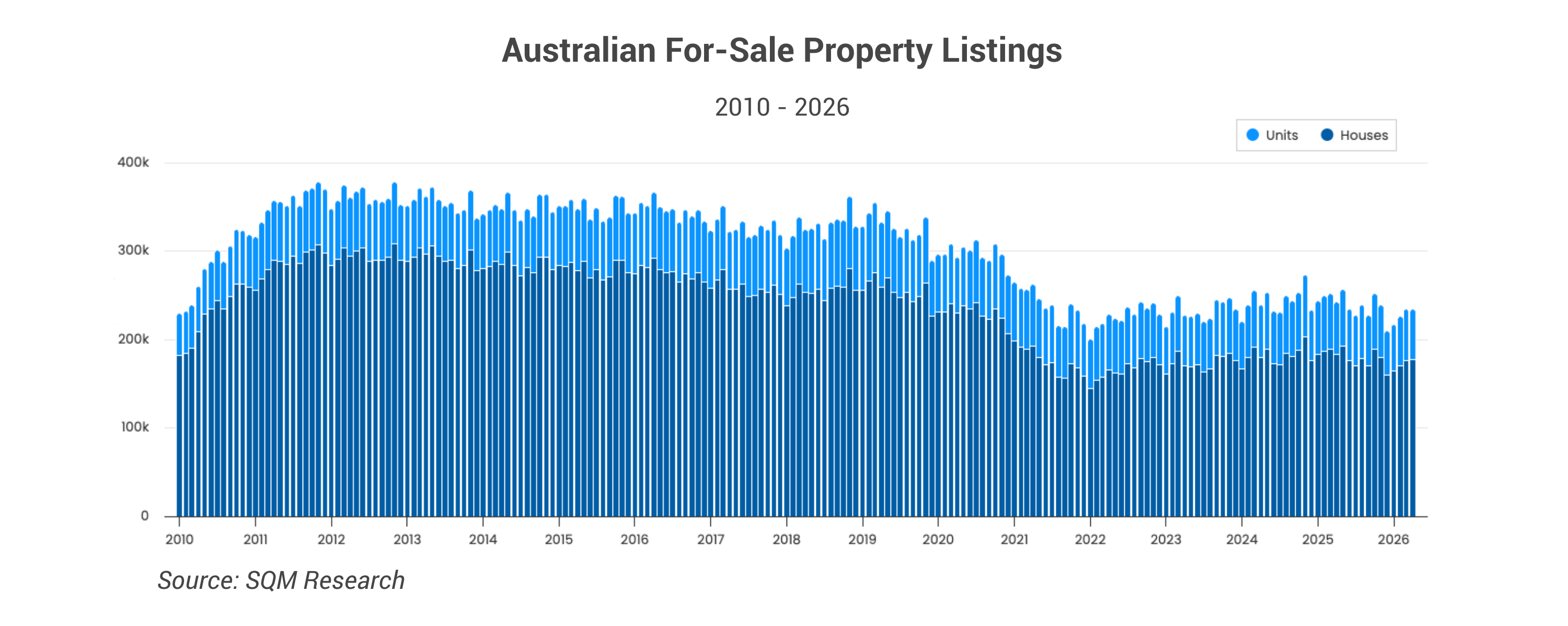
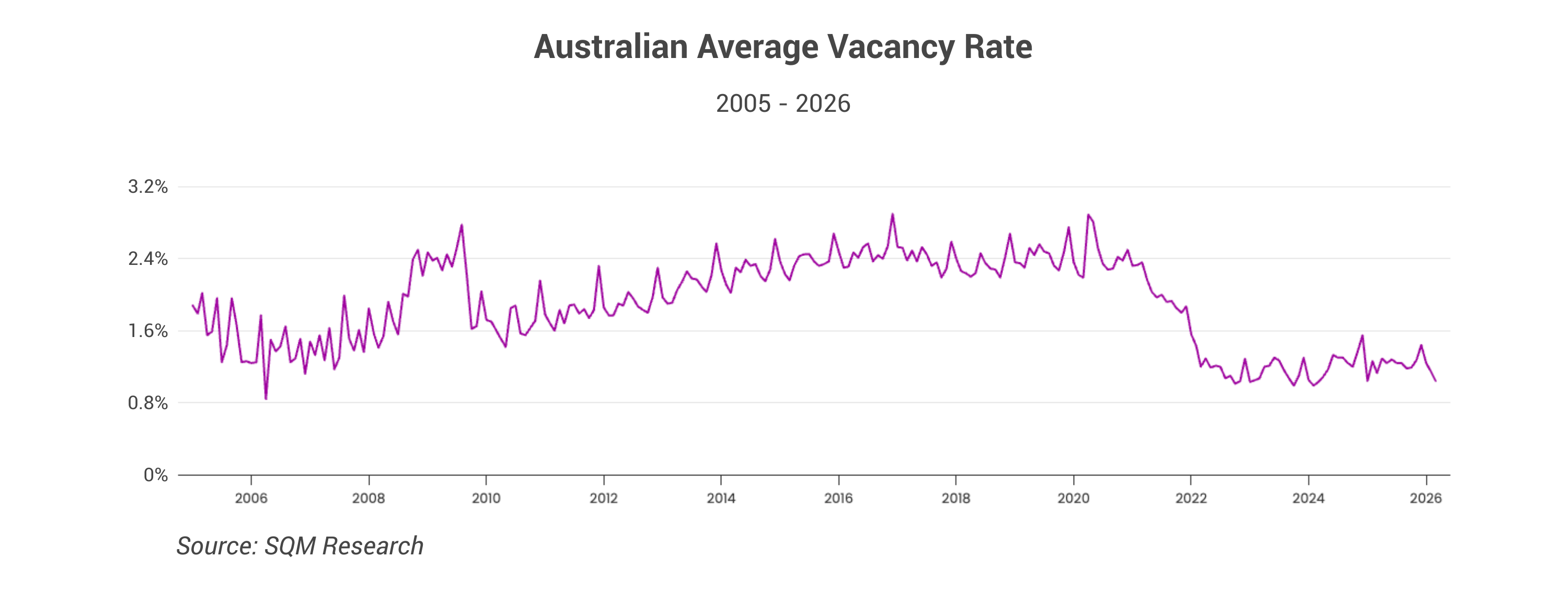
As a result, stock for sale and for lease have both declined significantly compared to pre-COVID levels:
- The national total number of for-sale listings is now 30% lower than in 2019.
- The national average rental vacancy rate has dropped from 2.5% in 2019 to the 1.0%.
As long as the supply-demand imbalance exists, housing market pressure and price growth will persist. Tax settings may influence demand at the margins, but they do not suddenly reduce population growth, stop migration, or create a large amount of new housing supply.
That’s where I struggle to see how tax reform can solve affordability problems.
Housing Demand Will Redestribute, But Not Disappear
As mentioned above, housing demand won’t simply disappear, even if tax reform reduces investor participation. A more realistic outcome is that owner-occupier demand replaces investor demand instead.
Admittedly, some households can transition from renters to owner-occupiers in light of the tax reform, but the renter-to-owner-occupier transition will hardly be a simple one-to-one shift.
Many renters are not financially ready to buy immediately, especially in expensive cities like Sydney, Melbourne, Brisbane, etc.
In reality, it is more likely that higher-income renters or first-time homebuyers with much stronger equity positions will be the ones best able to transition smoothly into ownership.
At the same time, there will still be a significant number of renters who continue relying on rental housing, which is potentially shrinking faster than the renter pool. And if that happens, competition in the rental market may intensify rather than improve, further worsening rental affordability.
Improving ownership access for some households does not necessarily mean housing becomes more affordable across the system, particularly if rental affordability deteriorates at the same time.
Taking My Own Situation As An Example
My partner and I rent in Potts Point, which is one of Sydney’s more established and tightly held inner-city suburbs.
Realistically, even if our landlord decided to sell the apartment tomorrow, we probably wouldn’t buy the property ourselves.
Partly because buying an apartment in Potts Point does not align with our current investment goals, and partly because purchasing a house in this part of Sydney that meets our lifestyle needs is far beyond our financial reach at this stage.
If it’s not sold to another investor, the buyer would most likely be:
- a higher-income couple;
- a downsizer; or
- someone with a much stronger equity position (eg. family-assisted FHB)
If that happened, we would still need somewhere to live.
- One possibility is that we would need to compete harder for another rental property in the same area, potentially paying higher rents.
- Another possibility is that we move farther from the city in exchange for affordability, compromising on lifestyle and convenience in the process.
- A third possibility is that we eventually transition into ownership, but in a much more affordable suburb farther from the CBD, sacrificing more lifestyle and convenience.
Many households would likely go through a similar process. Housing demand does not really disappear, but it moves:
- geographically;
- between rental and ownership markets; and
- across different price points.
From my perspective as a renter, affordability wouldn’t necessarily improve just because there are fewer investors. In fact, the pressure could become even greater, through higher rents, longer commutes, or compromises on lifestyle and convenience.
Tax Reform Will Likely Reshape Investor Behaviour
One important thing to keep in mind is that markets rarely remain static after major policy changes.
Even if tax reform does not fundamentally solve affordability issues, it can still significantly reshape investor behaviour across the property market.
- Negative gearing reform may drive demand toward higher cash flow
If negative gearing becomes less favourable or more restricted, investors will likely become far more selective about where and how they allocate capital.
Instead of simply exiting the market altogether, many investors may adapt by prioritising:
- Stronger cash-flow properties;
- higher-yield markets;
- more affordable price points; or
- new builds, if incentives become more favourable there.
That shift may become particularly noticeable in higher-price, lower-yield markets, where cash flow is already under pressure.
- The CGT discount reform may have more complicated effects on investor behaviour
Changes to the CGT discount could also affect investor behaviour, but in two competing ways.
If the current 50% CGT discount is replaced with a lower flat discount, such as 25%, the after-tax benefit of holding property for large long-term capital gains would be reduced. That could make some investors less willing to hold assets passively purely for the tax-advantaged long-term capital gain outcome. In that sense, a lower discount could encourage more active capital recycling, where investors sell, rebalance, or redirect capital into assets with stronger fundamentals.
But at the same time, there is a competing effect.
A lower CGT discount means a higher effective tax bill when an investor sells. For investors sitting on large unrealised gains, this can create a lock-in effect, leading them to delay selling to avoid the painful tax expense. This is especially relevant in property, where selling already involves high transaction costs, including agent fees, legal costs, and stamp duty on the next purchase.
So the impact of CGT reform on stock mobility is not straightforward. Which effect dominates would depend on the final design of the reform, including whether the government uses inflation indexation, a smaller flat discount, grandfathering rules, or transitional arrangements.
How Markets Historically Adapted to Policy Changes
We have already seen how markets adapt to tax reforms and policy changes, both domestically and overseas.
- Incentives for New Builds
One possible reform to negative gearing is to restrict it to new builds. Australia has experienced how markets reacted to new-build-specific incentives during the HomeBuilder period (2020-2021).
HomeBuilder successfully stimulated construction demand, but it also coincided with rising construction costs, labour shortages, project delays, and significant pressure on builders as industry capacity struggled to keep up.
It was a reminder that stimulating demand is one thing, expanding supply capacity fast enough is another.
That is something many people underestimate.
If governments heavily incentivise new construction again while the industry is already dealing with labour shortages, material constraints, builder collapses, and feasibility pressure, the market response may become more complicated than expected.
- Negative Gearing Reforms
In New Zealand, the government phased out mortgage interest deductibility for many investment properties from 2021 to 2025, while maintaining incentives for new builds. In the UK, Section 24 reforms, gradually phased in from 2017 to 2020, reduced the tax effectiveness of leveraged property investing for landlords.
In both cases:
- investor demand became relatively more cautious;
- investors became more cash-flow focused;
- some investors shifted toward higher-yield markets;
- some investment properties were sold; and
- rental market dynamics evolved.
But neither country solved housing affordability with just that tax reform.
That is partly because housing systems are influenced by many more forces than tax policy alone, especially in markets already facing supply constraints.
What Investors Should Actually Focus On
History has shown that when policy changes, the market does not stop functioning, but rather adapts.
For investors, the risk lies in becoming overly focused on political headlines while overlooking the broader fundamentals that continue to drive Australia’s housing market.
While tax policy matters, over the long term, housing performance is still heavily influenced by:
- supply scarcity;
- population growth;
- infrastructure investment;
- employment growth;
- wage growth;
- construction pipelines;
- etc.
Markets with persistent housing shortages won’t suddenly lose pressure because tax settings change.
If anything, some markets may become even tighter from a rental perspective if investment slows while population growth remains strong; some affordable/high-yield markets may become even more sought-after as investors become more cash-flow-sensitive.
Again, demand would shift, and markets would adapt.
As the budget is to be announced in the evening of 12th May, we’ll continue to share further insights into what it could mean for Australian property investors.
At InvestorKit, we believe property investing decisions should be driven by clarity, long-term fundamentals, and strategic thinking rather than short-term noise or political headlines.
If you would like clarity around your next property purchase in this changing environment, feel free to book a free discovery call with our team.