

April 20, 2026
Western Sydney Airport Corridor: Which Region Is Best Positioned for Growth?
With the Western Sydney International Airport opening in late 2026, billions in transport and aerotropolis investment are reshaping the surrounding regions. The real question is, does the growth story apply…
With the Western Sydney International Airport opening in late 2026, billions in transport and aerotropolis investment are reshaping the surrounding regions. The real question is, does the growth story apply equally across the corridor?
We put the 3 SA3 regions under the lens: Camden, Liverpool and Penrith. Each of the SA3s is within the airport’s immediate catchment, but at a different stage of maturity. Camden is a greenfield corridor, Liverpool is a transitional hub, and Penrith is an established centre.
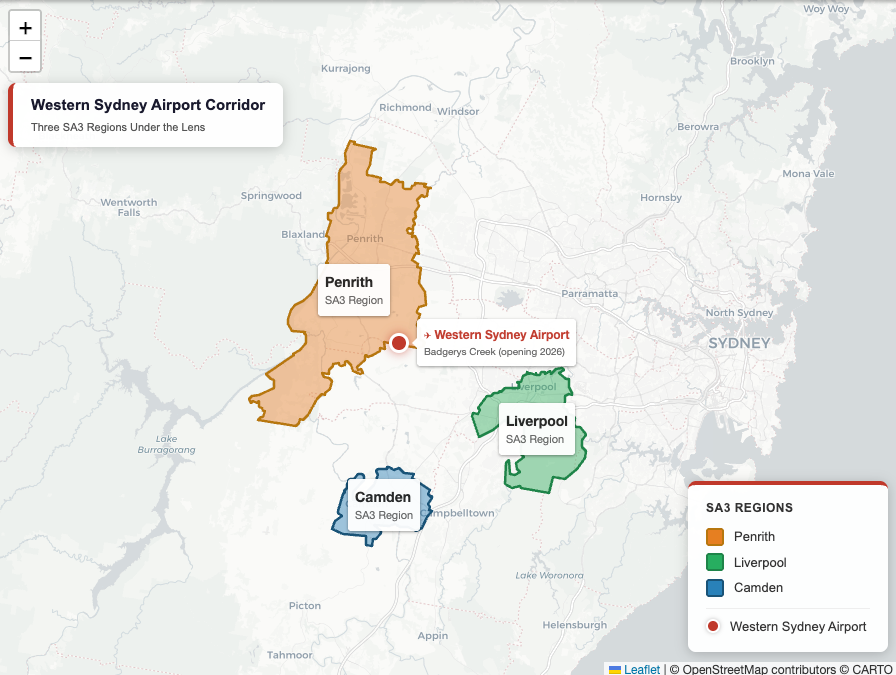
Across the board, the corridor’s market fundamentals are strong: a robust local economy and high market pressure in both the sales and rental markets. However, investors don’t buy corridors; they buy local market conditions, shaped by the interaction between supply and demand.
In this blog, we’ll begin by examining the macro story, investigate the local market conditions for the 3 chosen SA3s, and conclude with a short-term forecast for each market.
A Strong Local Economy
Before looking at property metrics, it’s worth understanding what’s driving the demand in this corridor at a fundamental level: people and jobs.
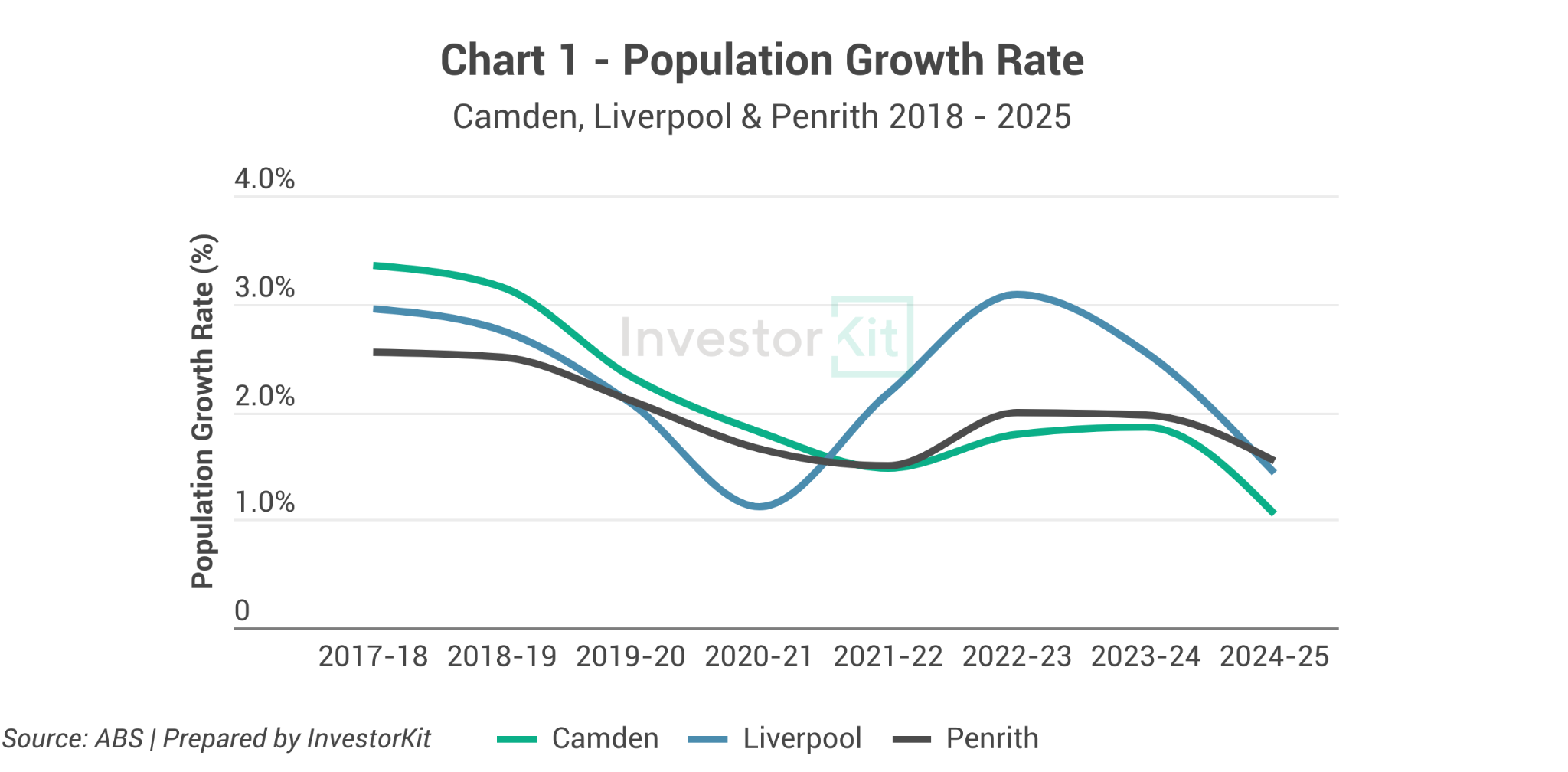
Population growth across all 3 regions has remained healthy over the past 7 years, reaching 1%-1.5% by 2024-2025. Liverpool has shown the most notable surge in recent years. Meanwhile, Camden, which led the pack earlier with rates above 3%, has gradually normalised as its initial greenfield boom matures.
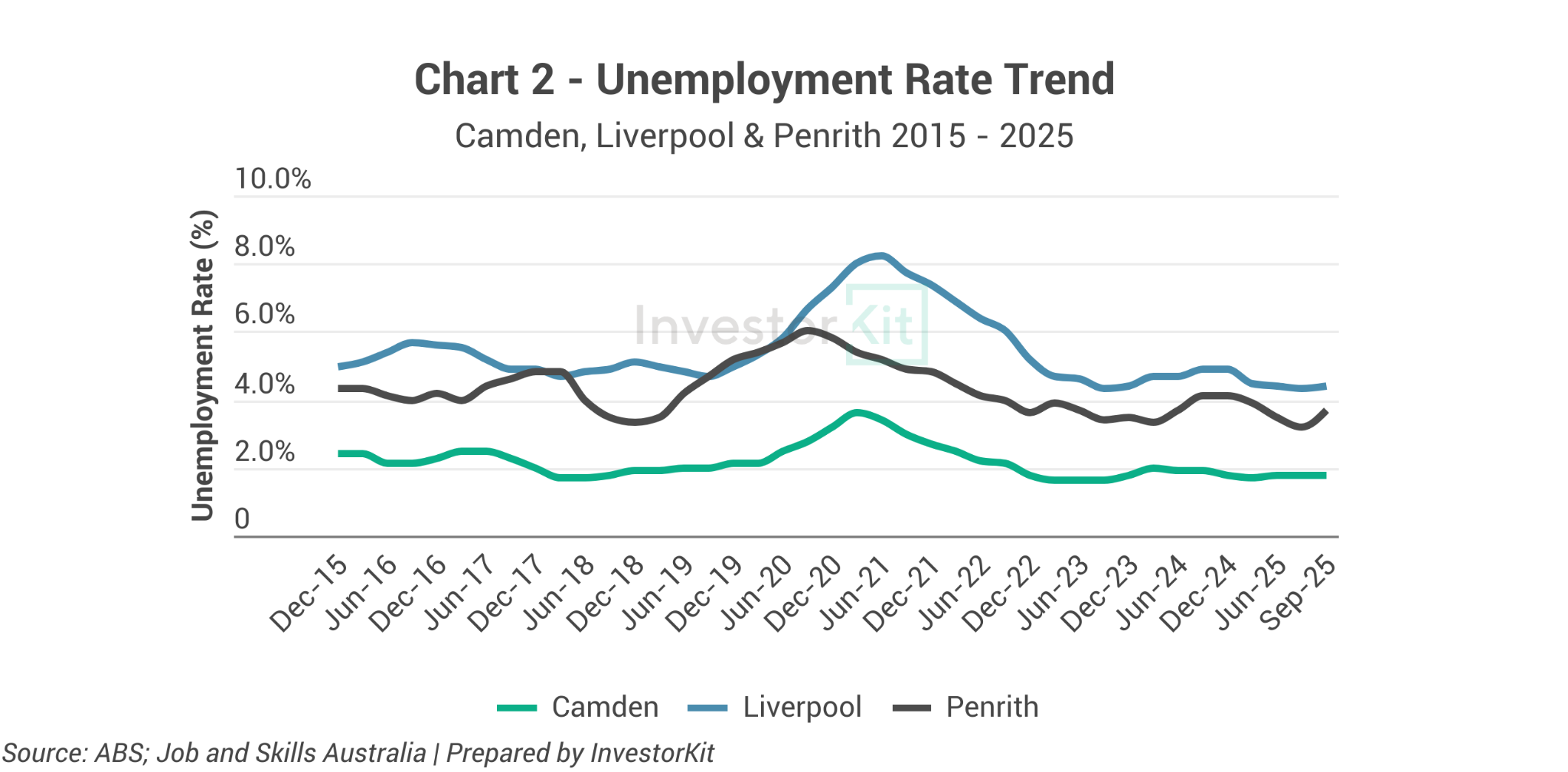
Unemployment across all 3 regions spiked during the COVID period, with Liverpool most affected, peaking above 8%. Since then, rates have normalised back to pre COVID levels and held steady. Camden consistently sits at the lowest, currently at 1.8%. Liverpool and Penrith sit at 4% and 3.7%, respectively. These low and stable rates provide income support for housing demand in the local market.
Together, these 2 indicators paint a clear picture: the corridor has a growing population and a resilient labour market.
Sales Market: Prices Rising, Demand Strengthening
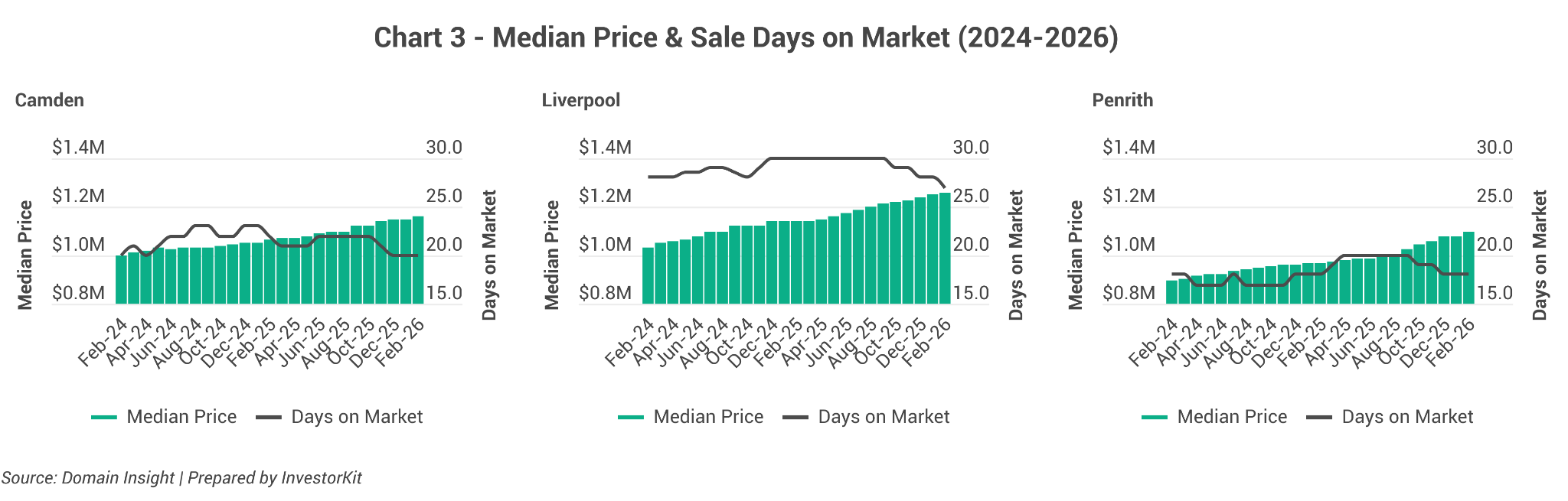
Median house prices have risen strongly over the past year across all 3 markets (Camden +9.2%, Liverpool +10.5%, Penrith +13.1%) and are now all above $1M (Camden $1.16M, Liverpool $1.26M, Penrith $1.095M). Camden and Penrith have low and steady days on market, implying consistent demand momentum. Liverpool’s days on market stabilised in mid-2025 and has since declined, suggesting improving selling conditions.
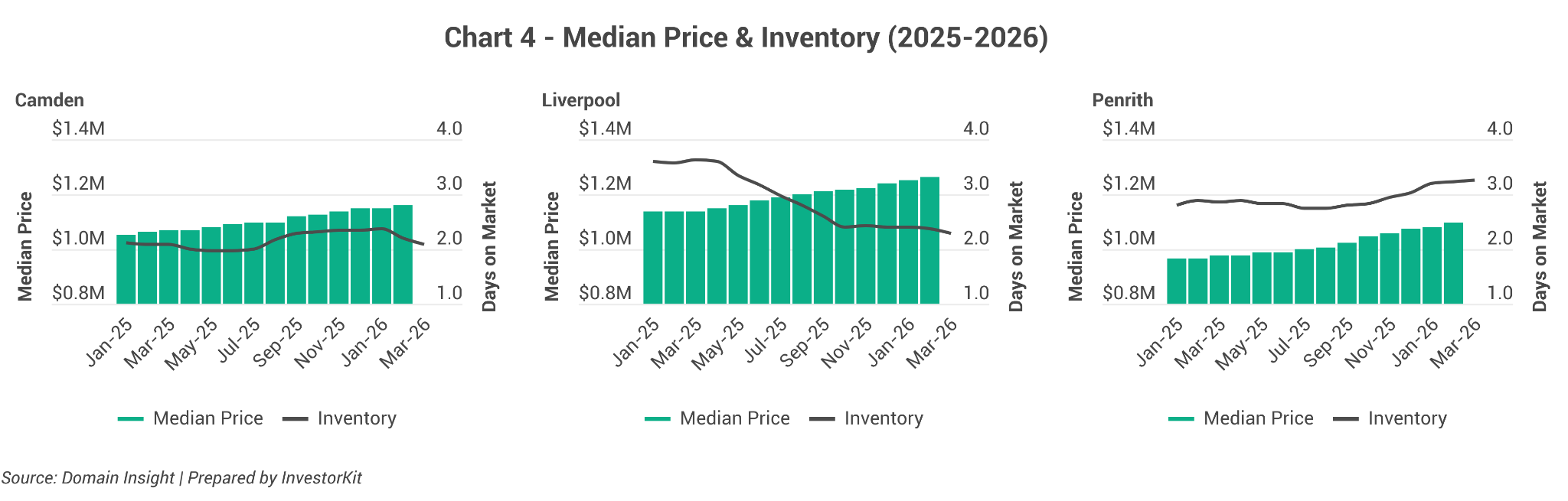
Camden’s inventory has declined in recent months, and Liverpool has seen a strong drop from previously elevated levels. Both now sit below 3. Penrith’s inventory has risen modestly but remains in the lower 3s.
Camden and Liverpool pair low inventory and falling days on market, suggesting strengthening demand momentum. Penrith’s days on market also continue to fall, and with inventory in the balanced range, conditions there are healthy.
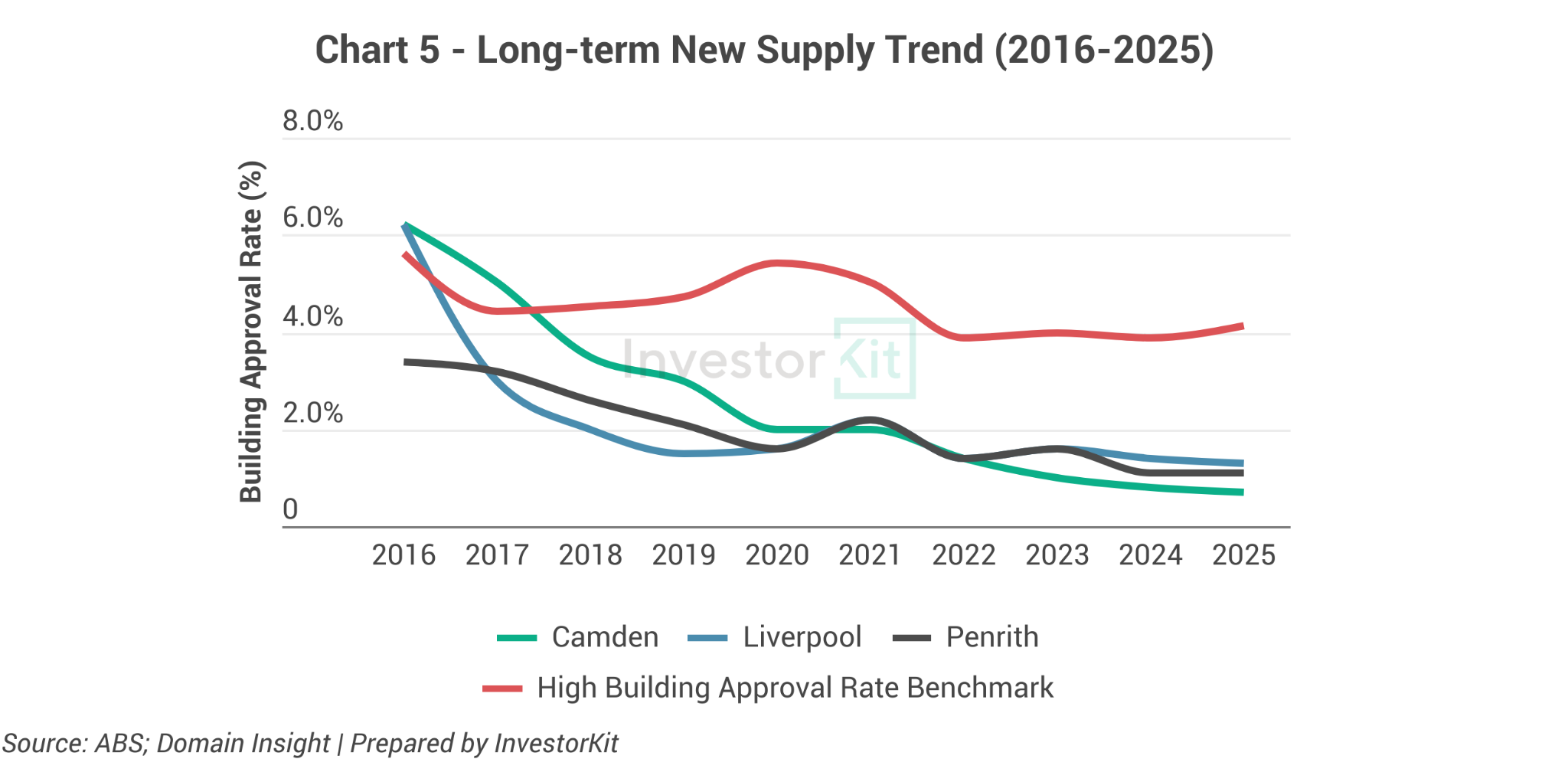
Incoming supply, measured by building approval rates, was elevated across the corridor from 2016 to 2020. Since then, approvals have declined significantly, settling between 0.7% and 1.3% by 2025, well below the high building approval rate benchmark. At these levels, this indicates minimal oversupply risk.
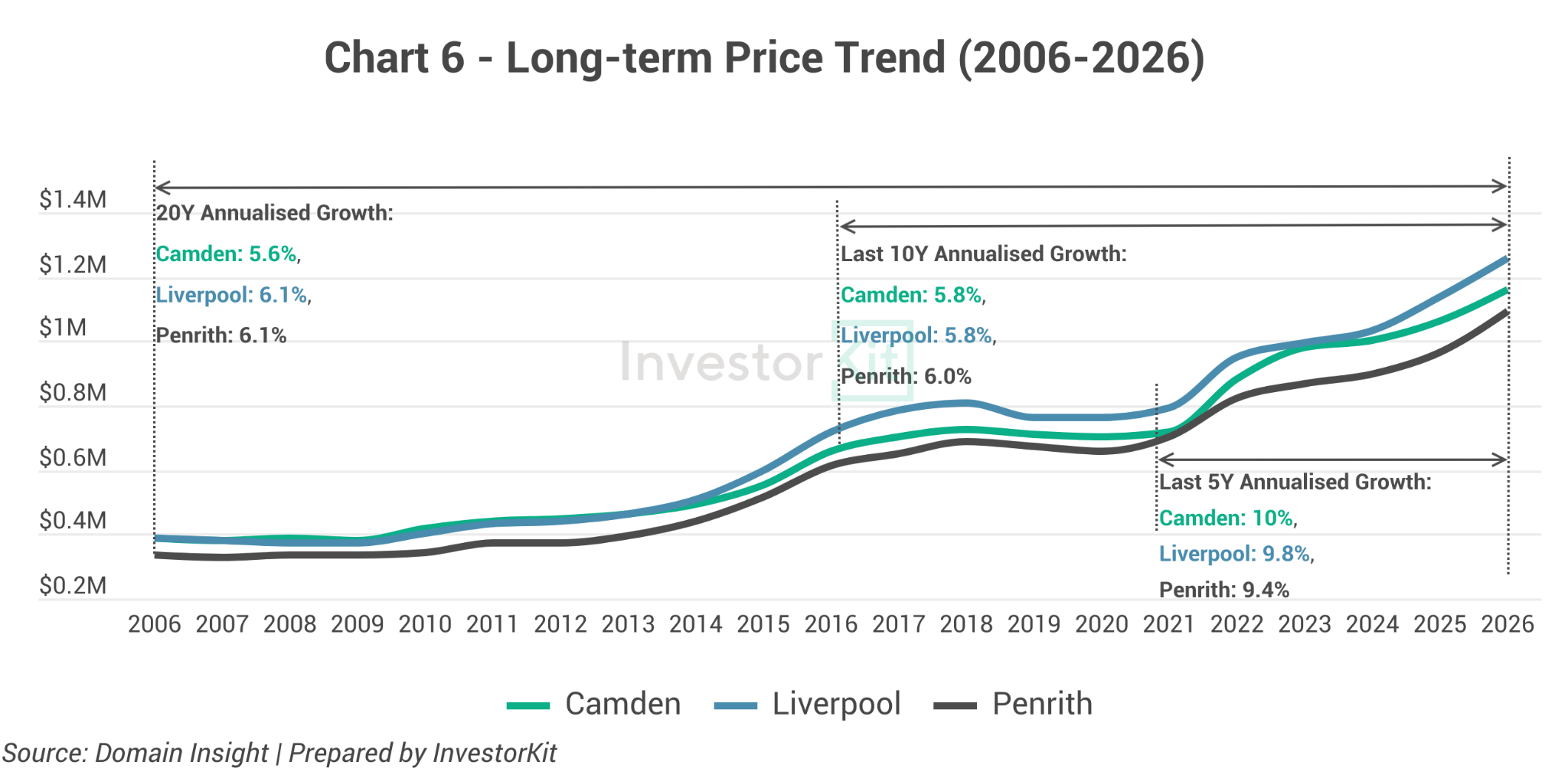
Over 20- and 10-year horizons, annualised growth across the 3 markets sits at 5.6%-6.1%, broadly in line with Australia’s long-term national average (5%-7%). The recent 5-year window tells a different story: Camden has grown at 10% per annum, Liverpool at 9.8%, and Penrith at 9.4%. The acceleration likely reflects a combination of factors: low interest rates during 2021-2022, relative affordability compared to inner Sydney, and the corridor’s improved local demand conditions.
Tight Rental Market Conditions
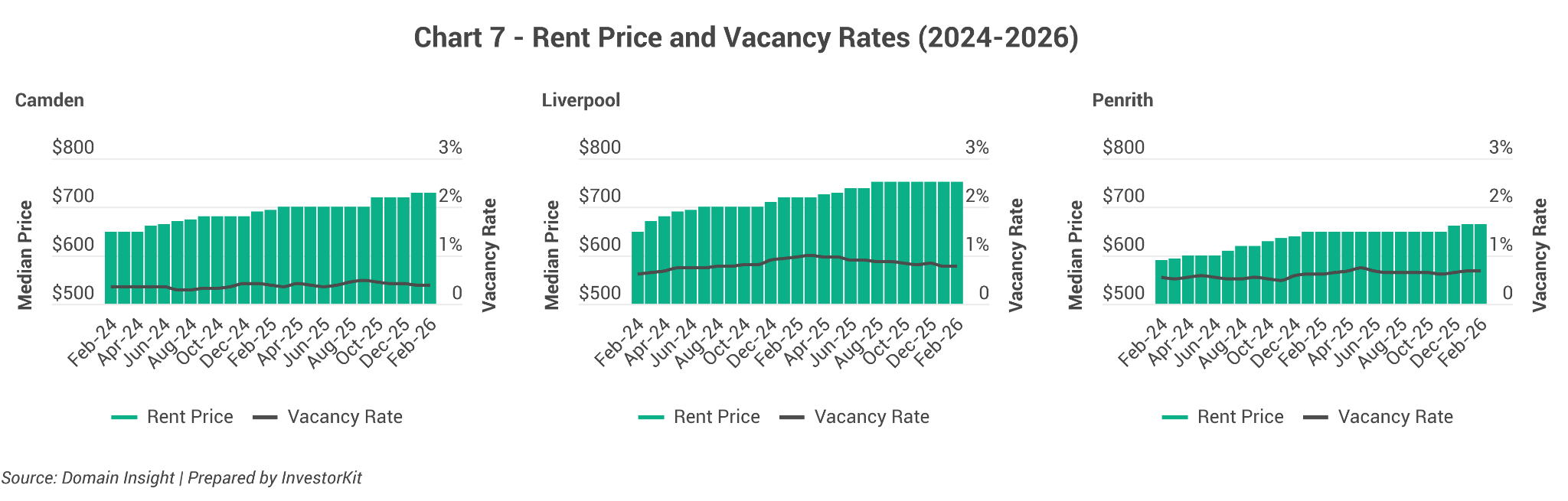
The vacancy rate across all 3 regions is below 1%, indicating tight rental conditions. Rent growth over the past year has varied: Camden (5%) and Liverpool (4.2%) have seen moderate growth, while Penrith (2.3%) has experienced weak growth. If interest rates remain high, elevated borrowing costs may keep some would-be buyers in the rental market, further supporting upward pressure on rents.
Affordability: Sales Stretched, Rental Still Accessible
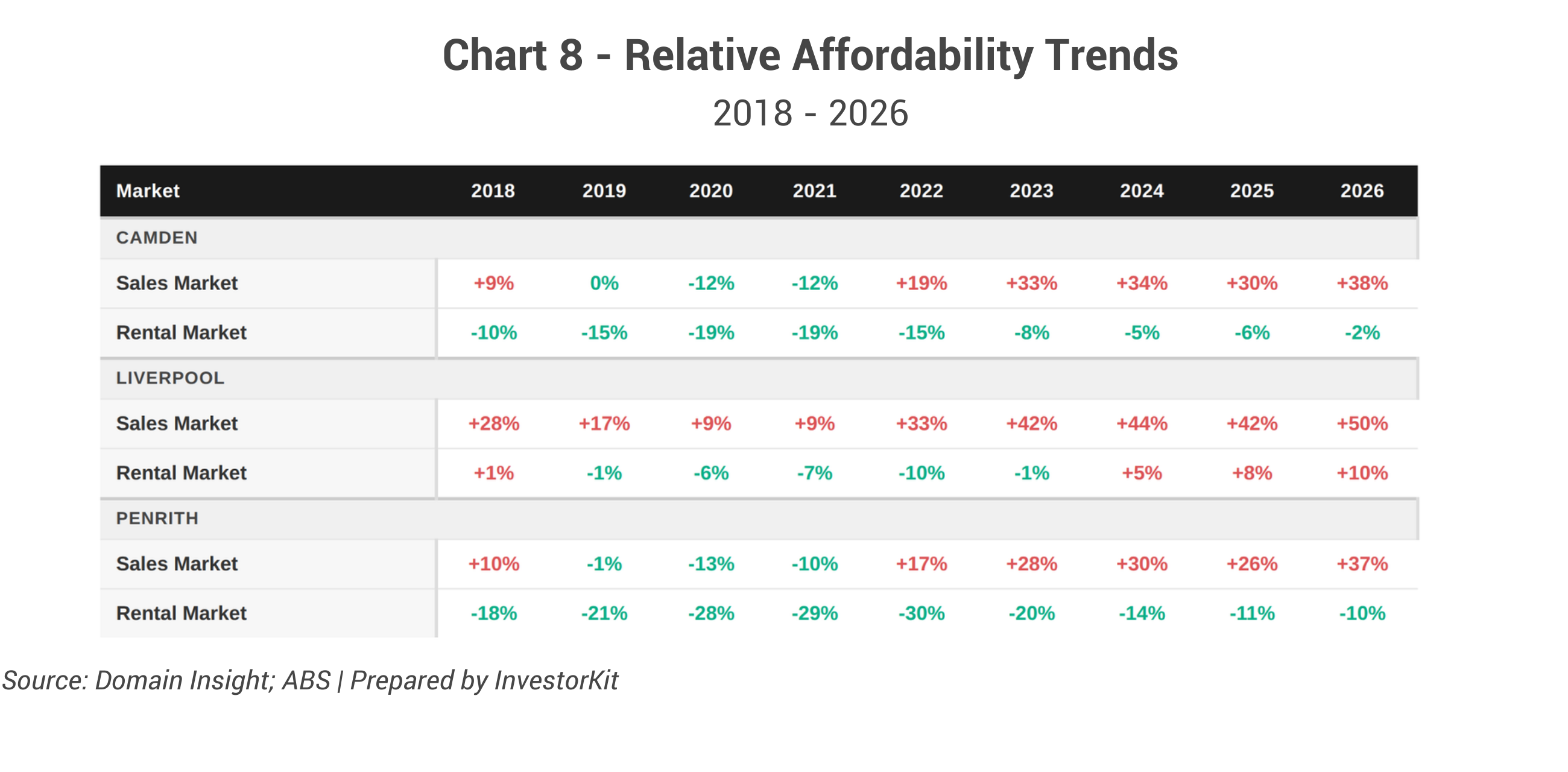
The above chart shows the relative affordability to local income levels. Based on the above, sales market affordability has deteriorated significantly across all 3 regions since 2022, with Camden (+38%), Liverpool (+50%), and Penrith (+37%), all moving well above their 2018 baselines by 2026.
While sales affordability has stretched well above the 2018 baseline, rental affordability has held closer to local income levels. Camden (-2%) and Penrith (-10%) remain undervalued, and Liverpool is the only area in the overvalued zone (+10%). That said, rental affordability has also declined across all 3 regions since 2022.
Outlook
The corridor’s macro fundamentals of healthy population growth, low and stable unemployment, and low oversupply risk are consistent across Camden, Liverpool and Penrith. On top of these foundations, demand momentum is strengthening across all 3 markets, with days on market trending down in recent months
In the short term, Camden and Liverpool are best positioned for price growth. Both have low inventory (2.08 and 2.28, respectively) and declining days-on-market, signalling high market pressure. Penrith also shows healthy pressure, with declining days on market and inventory sitting in the balanced range.
On the rental side, the vacancy rate is below 1%, and elevated borrowing costs are likely to keep buyers in the rental market, supporting near-term rent growth.
Broader Takeaway
The Western Sydney Airport Corridor has the demand fundamentals that property investors look for. But strong fundamentals at a corridor level don’t automatically translate to the same opportunity everywhere within it. The markets that combine those fundamentals with tightening supply-demand conditions are the ones most likely to see the next leg of growth.
Want to find markets with strong demand, tight vacancy, and room to grow? Book a free discovery call with InvestorKit, and we’ll show you where the data is pointing.