This transcript was generated automatically and may contain small errors.
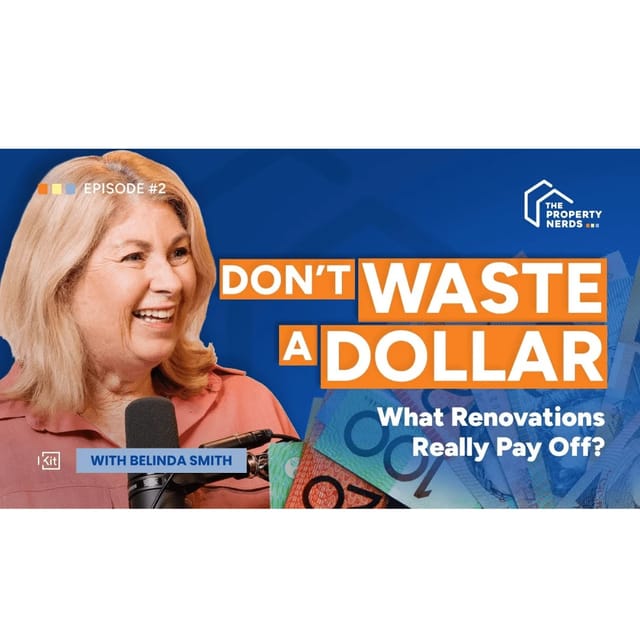
Welcome to another episode of the Property Nerds podcast. Today we've got Belinda Smith from Rare, which is Renovate and Real Estate Consultancy Collective. She'll be joining us on the show and we'll be talking through some exciting things on the renovation front, questions that we get asked often, what you should do under 5K, what you should do under 20K, what you should do above 20K, and so much more when it comes to renovating, including what's hot and what's not as well. So tune into this episode where we speak to Belinda and learn more. Nerd alert!
Property Nerds, the home for data-driven property investors, where we uncover Australia's hot and cold markets, latest headlines and trends. Belinda, welcome to the Property Nerds show. Thank you for having me. We are very, very lucky to have you here, the renovation, can I call you the renovation queen of Australia? Yeah, why not?
That might upset a few people, it doesn't matter. Look, we don't mind them, we don't mind them, but I wanted to really just jump into it today because this has been a burning question from many of our clients and just those even on our podcast, they've asked us about renovation specifically, so we're very lucky to have you on. But what I wanted to jump onto was going through different tiers of budgets, you know, the under 5K, the 5 to 20K, and then 20K above. Hear it straight from you, what you think under 5K, the best things you could do if you're doing it either DIY or if you're getting some professional help as well. Yeah, I think number one, it's important to have a budget and to stick to that budget, it's really crucial.
Under 5K, your best spend is on paint. And if you can DIY, that budget will go a long way, but paint is your best friend. It makes things feel better, clean better, smell better, look better. It makes a property appeal to market, so paint. When you go up a notch, then you can start to pay attention to kitchens and bathrooms, and kitchens and bathrooms really matter to a buyer.
And all in accordance to the demographic, not spend too much on a property. So yeah, kitchens and bathrooms, definitely a clean and a spruce up, perhaps paint covered doors or replace a benchtop, maybe a splashback. When you go up that notch, you can spend just a little bit more. But if you've got unlimited budget, then we're looking at flooring, we're looking at tiles, we're looking at new paint throughout, perhaps curtains, just finishing off a property to really appeal. But it doesn't matter what the budget, it's all about the area and not spending over and above what you should for the demand in that area.
Well, I mean, speaking of the paint thing, you know one of the funniest things I'm seeing these days, it's horrible, please don't do it anyone, but it's those landlord pages where people are like ripping into landlords for just grabbing the paint and there might be a windowsill and there might be like some bugs there and they'll just go, oh yeah, we'll just start white paint over that one, that'll do. Straight over the mould. Definitely don't do that, right? On the paint stuff, like is there areas that you prefer as a core focus or is it just more like, hey, get the walls done, the ceilings done, like just the whole throughout, like a white tone I'm guessing, or is there something that you prefer, like this is the thing? I think you've got to get people inside the house in the first place, so street appeal is one thing, just clean the house on the outside, do the gardens, paint the front, perhaps style up around the front door to draw your potential buyer through that property, that's really important.
Once you're inside, just neutrals, neutral colours and warm colours, not cold whites and cold greys, you want to connect someone to a space, people will pay more for a property and they'll be very, very eager buyers if they can imagine their families inside that home, so lots of neutrals, lots of layers of textures, you don't have to be that, you don't have to be an interior designer to create a really beautiful home if you just layer up all the neutrals and the textures and have everything flow from one room to another, you want someone to be on a journey when they come into your house, so right from the front door, right through, through into the hallway, into the kitchen, kitchens have to be, they are the heart of the home, that is so true what people say about kitchens, they have to be functional, clean, they have to be somewhere where a mum can imagine nurturing her kids and her family and spending time there, and the bathrooms, they're everybody's preparation time for work, you know, showers in the morning, but more than that, if they can have a resort feel to them, you'll definitely get more for your property if you can create those two spaces with those two things in mind. Yeah, I think with the whole kitchens and bathroom, I love you just giving clarity on that, just go to those areas, those are the core areas, the funniest thing with the kitchen these days is like, it's really important to have it look pretty, but I'm finding the usage is getting lower and lower and lower of the kitchen, like Uber Eats is like hotter than ever, box microwave meals, the whole time consumption thing, everyone's like really, really into that these days. Shame on you young people. We're ruining the kitchen, sorry Belinda, it's now going to move. I'm just saying I've never Uber Eats.
That's goals, that's goals to be able to do that. Okay, cool, so we've got the whole under five, we've got five to 20, and 20 plus, when you're talking flooring, we're talking anything else other than flooring you should put in your top few list, or flooring's the main one, is there something in flooring that you feel like, okay, this is my go-to, this seems to be a winner each time? Oh, definitely, wood look floors, whether it be vinyl planks or hybrid or your engineered timber, and they're tiered according to what demographic you're renovating in, so if you're in a top demographic, the buyer market really do expect those engineered timber floors and really nice tiles, perhaps even stone, and then middle market, you can pull it back a little bit, but it's the same common look, and it is neutral walls, those floorboards, I think we want more warmth in our homes now than ever before, so if you look to what they're doing in movies, while you're watching a movie, do what I do, and that's not pay attention to the movie, just look at the background, we get our hints from what's happening overseas, and just, if you can create that look on a budget inside a home, whether it be a new home or a renovated home, then you'll do very, very well, appealing to the mass market, not doing anything too in your own taste, too wild, too quirky. Yeah, I think that's actually a really good segue to this next question I've been thinking of, it's the thing that buyers get wrong, I want to hear more about that, like where do they think that there's value, they think they're doing a great job renovating, but you just think that there's not much return on that investment, where do you think that's at, so we know what to avoid as investors as well? Oh, definitely taking style too far into one or towards one particular trend, that's just going to knock out the majority of your buyers or polarise people's opinions, so that's the major mistake.
The second one is over-capitalising for that particular property, just spending too much, like going for your Taj Mahal benchtops, which are gorgeous by the way, but you wouldn't put that in a property in a regional place, even if you thought that it's going to make you look like a hero on Instagram, that's not what the journey's about in property investing, it is just keeping it cool for that particular demographic, and people spend money on things that your average buyer won't notice when they walk past, they'll pay attention or go over the top when it comes to what's happening inside the roof cavity, under the floor, out in some corner in the backyard with the tool shed, they'll fuss too much about things and spend too much time and money on things that your buyer's not going to notice when you take them on that journey through your house, which is perfectly styled by the way, by you or somebody else, it doesn't matter, but yeah, never sell a house empty as well, but you know, that's money well spent versus the places where people do waste money along the way, and they do. Yeah, and is there like an area specifically of like external parts of the home, I think tool sheds and things, you mentioned one, but on the external parts we see like the roofs, the windows, the walls, certain street appeal, landscaping, is there some things where you're like, okay, do not touch that, you're just going to sink a lot of capital in, what's your checklist for don't touch this on the exterior and then don't touch this on the interior that you just want to avoid for spending too much money on? I think if you can paint anything to improve it, I will do that all day long versus ripping out, throwing out and having to replace, you've got your dump fees, you've got your replacement fees and all your tradie fees as well as the product itself, so if there's any chance of painting something up to improve it, do that. I think people get really wrapped up about asbestos and feeling like they need to rip it all out and you actually don't, if it's in good condition, if your builder is happy to navigate the renovation around whatever might exist, you actually don't have to rip it in a very unusual way pre-COVID, during COVID, and now in the years to follow? On the COVID part, what about the themes changing?
So as in, have you seen a taste change of pre-2020, post-2020? Is there something that's like the new in and pre-COVID, like no one ever thought that was cool? So do you remember everyone took off to the coast or to inland? Yeah, the Byron Bay lifestyle. So that's what I've noticed the most is that people wanted to create a vibe around their home and they were obviously spending a lot of money on their homes that they might not have considered before.
They were spending money doing things like creating that sanctuary at home because they were spending more time there. They were more aware of their surroundings, whereas people used to just get in the car and go and spend all day in the office and come home at the end of the day. So that definitely changed things. And I think people still have an appreciation for living in places other than what we determined or where we determined we needed to be, which was around the city, CBD. Yeah, I don't think we've all come back as much as some officers would like us to.
They're still trying to entice their workers back. And like, did you notice like... People are used to working from home. With that beachy vibe, was it a lot more blue and whites coming up in your designs or anything like that? Yeah, beachy greens.
Greens and blues are the new neutrals. I was just talking to one of the bosses of Torbmans the other day about what they consider to be neutrals back in the day with beiges, whites, and perhaps even some soft greys. But now blues and soft greens and some of those nude pink colours are really considered to be in the neutral colour palette. And probably because of all of that, we're spending so much more time at home and offices. People were making their offices a place to be.
Yeah, yeah, definitely. There's been changes. I think we're braver with colour again. Yeah, I mean, I was getting that moment myself where I was like looking into the mirror, I was wearing a suit out in the morning, saw a pink pocket napkin and a pink tie, and I'm like, I'm definitely braver than before. I'm like, this is in, this is the new thing now.
Yeah, absolutely. And it swings. I remember in the 1990s, I painted the internal walls of my lounge room. One wall was maroon and the other wall was bright yellow, and I thought it looked amazing. And I'm pretty sure it did in that moment.
And then we've gone right back into neutrals for a long period of time. And now I see what's a thing called colour wash going on where people will paint the ceilings, the walls, all the skirting boards and the architraves and the inside of the door, all the same colour, exactly the same colour, top to bottom, to give that real surround yourself in that mood. You can create a lot more mood with more colour. But if you're renovating to flip, I still advise people just to pull back a little bit on doing things that are too much for your buyer demographic. When we're in the world of renovating, we love colour and seeing what's new and being up to date.
But there's a home that I would do for myself where you can be a little bit braver. But if I'm flipping home, I'm just thinking about the buyer. I'm only focused on what's selling really well in that area. I'll go to open for inspections and see what other successful renovators are doing in that particular area, what the developers are doing in that area. And I'll really pull apart in my mind how they've put their homes together and who's doing really well.
And I'll just go do that. That's actually a really good point because we always believe in the art of comparable sales, days on market, because that speed, if that's happening on certain assets, to me, that's a sign that that's desired and that also is priced right too. But we also like, when it comes to the whole themes post-COVID, coming to your point, I noticed another couple of things come up. Is it me or did you notice tiles getting either like one of two directions in the bathrooms? Much, much smaller, thinner little ones or just monster massive ones.
It feels like this in-between seems to be fading and it's all about how big and wide you can make the tiles to have that luxury look or to get those fancy colours and those little micro tiles in the bathroom. When did this start coming about? Because this is the new thing of late. Just fashion. Just keeping up with the trends.
Yeah, so the smaller tiles are in. It's no good for people who have a dislike for scrubbing grout because definitely those smaller tiles have a lot more grout behind stoves and cooktops and also in bathrooms. But as a feature wall, they work. They're more expensive to lay and your tilers will charge you more. It's not so much the tiles, it's the tiler, I always say.
So a mix and match of those smaller tiles as a feature and the big large tiles, yeah, bang on fashion. Good to know all the themes. You've been reading Home Beautiful magazine. I think my wife's been getting me into a lot of the theme stuff. I mean, you know, the funniest thing is our house doesn't need like any renovation in my opinion, but she's been amazing at trying to go, oh, check this out, look at this, what if we did this to it?
I'm like, this house is 2018 built, like do we really want to do stuff to it? But ideas are there, the chats are there, we're keeping up with the themes and times. Another one I'm noticing is all the gold taps and the gold vanity stuff and the gold shower head. Even just nowadays, I'm finding like a traditional shower head changing to that one coming from the top or the little handle in the bathroom now not in front of you but behind you. Like these little things I'm noticing are popping up a lot more when the people are trying to get that extra feel for that little bit less.
And wall sconces. Yes. Wall sconces. Wall sconces are life. Yeah, yeah, yeah.
Sorry, I keep telling my builders. Yeah, they've really made a comeback and honestly, that is a really economical way of jazzing up a very plain room is a couple of wall sconces make all the difference to a mood. There's a reason why they put those in hotel rooms and cut back on some of the direct from ceiling lighting. It does. It creates mood.
It's functional. It connects people to a space and it's not very expensive. You can go on Temple and Webster or any of those stores and get a wall sconce for $100 or $140 and have a couple and totally jazz up a room. Hey Belinda, whenever I think of renovations, I always think of someone taking their weekends and going to the place that they just purchased and really putting in the work of doing their own renovation. Naturally, what's kind of happened with the market and investors is we're investing interstate.
We're going to purchase where we're not living. Do you have any sort of tips because even for myself personally, all of the properties that I've purchased, I've done renovations on. I've had some alright ones, also made some pretty bad mistakes as well. But yeah, what kind of tips would you have in terms of someone managing a renovation interstate? Yeah, I really like it when people are brave enough to buy anywhere in Australia.
You really don't need to be on site. You don't need to be deep into a paint tin and paint brushes and be covered in dirt to make money out of renovating but also to do up a home. One of the easiest interstate renovations I did, it's just so simple. You get on the phone, you have somebody on the ground, whether that be a rental manager, if you've got somebody who's really cooperative, sometimes they will, sometimes they won't. Even better, a fellow renovator on the ground.
Quite a few of my students all around Australia will work with each other. You just need eyes and ears on the ground to let the tradies in to check the quality of work. So many tools we use now that we never had access to years ago, WhatsApp, so you can send videos and photos. As long as you have a regular check-in point and you've got someone you trust to be on the ground, you can go to franchises like say Carpet Court here and have a really good look at the product that you want to purchase and just take notice if there's a franchise near that house that you're about to buy. So if you're a look and a feel kind of person when you're choosing a product, you can choose locally and you just order near the house and get it delivered and there's so much you can do and it's really a lot simpler than people think.
And that just opens you up to buying all around Australia. Yeah, I think the whole like buying around Australia and then being open to renovate, it opens up so much more. You end up having a better entry price in your stock that you can select from. Definitely. And even if worst case, you can't add necessary value capital-wise, your rental yield almost always is improved because the price on the way in in comparison to the rent you get for those little touch-ups is wildly different.
And then last thing I want to share on that as well is like you think it takes a while or think it takes a certain dollar amount, you've just given us tips in under 5K, 5 to 20K.