This transcript was generated automatically and may contain small errors.
It's over $20 million in assets you've got. If my net worth was $10 million or $100 million, I don't think I would respect myself more. There was a video that was taken of me in Double Bay. I was driving my Lambo and I had my leg kicked up on the seat and people were saying that I was a drug dealer and all this stupid stuff. I didn't have my first full-time job until I was 25.
There was an opportunity to exploit arbitrage. So I would buy a phone for $300 on Marketplace and then sell it for $400 or $450. I'm extremely good at what I do. Quite frankly, any of you try to compete with me, I'll destroy all of you. I don't have to worry about data and all that kind of stuff.
That's your job. That's what I pay you guys for. I trust that it all works because my portfolio goes up. When you often hear about large property portfolios, the conversation is on how great we did as a buyer's agency or how great we were as a team working together. But in today's conversation, this only represents this much of our chat.
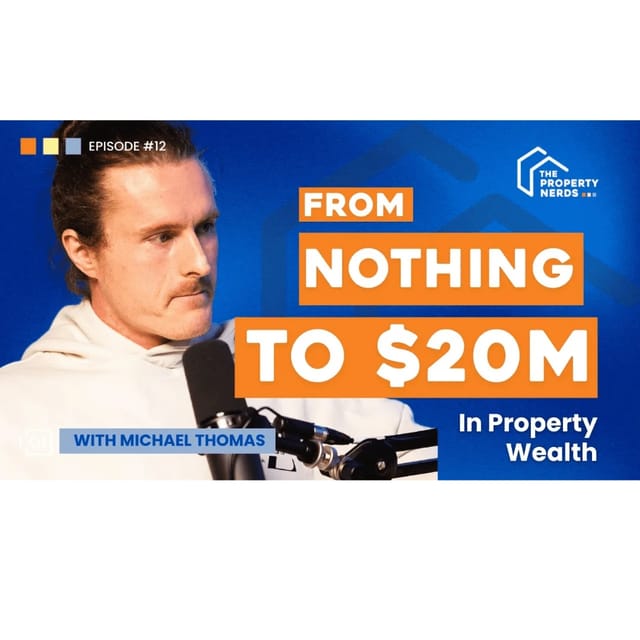
What we wanted to do differently was actually go into the mind of someone who's such a successful investor, go back into their journey where it all started, help them unpack their perspective on thinking, relationships, building a team around themselves, and getting ahead with wealth building. And of course, what all that wealth is for. So in today's episode, we have one of InvestorKit's most successful clients. Michael Thomas joins us with an over $20 million portfolio built across residential and commercial investments, something we've built closely together and now seeing his portfolio flourish more than ever before. Now, we're taking Michael's example here not just to say, hey, everyone can build a $20 million portfolio.
In fact, yes, many people can, but it's more to unpack the thinking, the workings, the relationship, how we as a team come together, but also how Michael's gotten himself ahead through his journey and unpacking it all. So let's get into this episode where you're going to hear more on Michael's journey and what it takes and also what he's achieved as a $20 million property investor. Nerd alert! Property nerds, the home for data-driven property investors, where we uncover Australia's hot and cold markets, latest headlines and trends. Hey, Michael, thanks for coming on the show.
Pleasure. Good to be here. Mate, I spoke about you in the introduction and your portfolio is something that's been phenomenal, not just at your age, but just in general in terms of what Australians are capable of in being able to build in terms of wealth. But I want to go back to before where it all started, and I want to understand more about Michael as a teenager, Michael in his early working years, and just want to bring that to life because the journey isn't just the end outcome. It's also the journey itself that we want to talk about.
And so could you share more about Michael in his teenage years, his early working years to get to all these outcomes and how that's happened? Yeah, so up front, it can be a bit gloomy. You know my backstory, like largely, but for anyone that's listening. So I was riddled with pretty bad mental health throughout most of, if not all of my teen years. And so because of that, I struggled to have any kind of direction with really anything that I wanted to do.
I would even go as far to say that I didn't really want to do anything. It was coupled, it was made, I think, worse by the fact that I was quite capable from a schooling perspective. And so I don't know that much attention was given to me because from other people's perspective, I was doing relatively well. I performed good with all of my grades, et cetera. And on a surface level, I would say that I lived like a very typical life.
I had reasonably stable family, good social circle, good physical health, middle class, upper middle class, like family. And so I would say because of that, it made it quite difficult for anyone to think that anything might have been wrong. But absolutely, there was a lot that was wrong. I struggled, as I said, like quite substantially with mental health, serious depression, anxiety. And throughout the period, I didn't actually even know what it was.
It wasn't until I was doing a psychology subject at university where the tutor was listing all the symptoms for anxiety and depression that I realized that that's what I had. She listed everything and one by one, I met all of that criteria. Sometime later, I reached out to my sister by note and she encouraged me to see a doctor. That doctor told me the unfortunate news that I was the best scoring but worst scoring person that she'd ever seen. So it wasn't exactly something to celebrate, but I at least then knew that there was something wrong and I thought I could maybe address it.
And I think from there is maybe when things started to see some sense of direction. But prior to that, heavily, heavily, heavily involved in video games and not really sure what it is that I wanted to do. I was quite nihilistic. I didn't think that being able to make money was something that I would ever be able to do. I thought that most people had jobs that they didn't enjoy and none of that really made sense to me or seemed appealing.
I didn't want to have a job that I didn't like and spend 40 hours a week doing something that I didn't like. And I think that even further made my interest in my future diminish because why would I invest my time into, well, two reasons. Why would I invest my time into a life that I didn't think I'd be alive for, number one, but also a life that I would enjoy? And so all of that was, I guess, a storm for quite a difficult life for me earlier on. Yeah.
Now, when this life has turned into the more traditional things that we often talk about, which is getting into full-time work or getting started in business, when was it that work kicked off for you as a part of obviously creating this journey or pathway that you've been on now? When did you kick off? So I don't remember the first job that I had. I might have been 18 or 19, but it was only part-time. I didn't have my first full-time job until I was 25.
And between 18 and 25, effectively all I was doing was the minimal amount that I could do to allow my dad to leave me alone. That's such an interesting way to look at it, eh? Yeah. And so that was random odd jobs one or two days a week. Then quite often I would quit that job.
There'd be several months until my dad would encourage me to do something else. Then I'd maybe do a course. So I studied for personal training. I studied for massage. I think there might have been one other thing in there as well.
But all these random things, basically just trying to justify my existence so that my parents would just let me be. Well, I mean, a lot of people start ticking off into their early to mid-20s from university to going and starting their first job. Obviously, hanging around until you're 25 to actually kick off that first job or in your case, getting your hands into many different things isn't traditional. What do you think was the trigger to make you go down this path to begin with? The path of actually finding a job?
Yeah. Well, it all happened by complete luck. It wasn't intentional. In between a massage course, so I qualified myself with Cert 3 massage. And for whatever reason, there was a six-month gap between Cert 3 and Cert 4.
And so during this time, I needed to figure out something that I could tell my dad that I was doing so that he would leave me alone and I could play League of Legends. Jack's favorite, by the way. Yeah, I was a beast. I still play. I was really good, like in the top 0.
001% or something. Unreal. So I don't know how I stumbled across this, but I realized that there was an opportunity to exploit arbitrage with mobile phones. So I noticed that you could - well, it seemed as if phones were listed for less on Marketplace than what they were on Gumtree. I think that was the order.
And so I would buy a phone for $300 on Marketplace and then sell it for $400 or $450 on Gumtree. And eventually, after doing this a few times successfully, I thought, well, if I can do this with an item that's more expensive, then I could potentially see more profit, right? And so I had a little bit of money saved up, and I reached out to a friend in the mode industry. And I said, look, with my money and your knowledge, maybe we might be able to buy and sell some cars. And he said, sure, we'll give it a go.
And on the way back from looking at a car one day, he said, have you ever considered joining the mode industry? And I remember this moment vividly because my reflex response was no, like a strong no. I'm not interested in it, didn't care for cars. I'm not a salesperson. I'm introverted.
None of it appealed to me. But before answering, I took a few moments to think about it, and I thought, well, worst-case scenario, if I don't like it, I'll just quit. And so I said, okay, let's give it a go. I think it was the next day or the day after I went in for an interview. I got the job on the spot, and I think I started either that day or the following day.
And that changed the entire trajectory of my life. Well, you obviously have carried this buy and sell skill set through multiple areas, right? It's been from the mobile phones So there's so many things that I think society has wrong and they try to compensate for a lack of effort by just buying things. I think that fortunately because of my upbringing, the things that I've seen and paying attention to the people around me and the people on TV, I have always understood that more stuff isn't necessarily conducive to a better way of life. Just a side story, I remember when I bought my first Lambo, I was talking to one of my best friends, Louis, who you all know.
And I said to him, after a week, I'm not going to care. And sure enough, after a week, I just... It's not that I didn't care, I'll always have these cars. But that elation that you feel when you first purchase something like that, it disappears. And so that taught me, or rather cemented the fact that more stuff doesn't necessarily result in a better quality of life.
And I'm a big believer that the quality of your life is really just a reflection of the quality of your emotions, right? So if you have nothing but your emotions are strong, then the experience that you have in life will be solid. And things don't necessarily improve or control the emotions that you have. So I think I've gone in a few different directions here, but I've always been a deep thinker. I've always tried to pay attention to people around me, recognize the mistakes that other people make so I don't have to make them myself.
And then I test little things. Right now, I've got a Lambo and a Ferrari. And when I had the Lambo, I'm like, I'm going to buy this Ferrari. And I can guarantee that when I add it into my life, nothing will happen. And I did it, and it didn't.
So I'm always testing little ideas that I have just to give myself, I guess, the confidence that I know what I'm doing, or I think that I know what I'm doing. So yeah, I hope that answers the question. So Michael, when you got into flipping phones and flipping cars, it didn't sound like it was something you were passionate about. You kind of just fell into it. So what advice would you give to someone who's kind of thinking about doing something they're passionate about before they actually take action?
It really depends on what your motive is, right? So if you want to live a life that's completely full of passion and drive, then perhaps it is something that you should do. Personally, I was prepared to forego and leave behind passion for the pursuit of financial freedom. And what I ended up finding, funnily enough, was that I became passionate about being good at the thing that I was doing. I think quite often, I don't know if this is true for everyone, but for most people, if you're good at something, you're competent at something, and you're winning, it's enjoyable.
And what I eventually found is that as I became better, I found that it was more fulfilling and enjoyable. And then that encouraged me to do it more and more and more. I don't think that it's necessarily wrong to try to marry up something that you're initially passionate about, and that will also be financially advantageous. But I think quite often people confuse something that they're passionate about with... Actually, no, what I would say is I think sometimes people think that because they're passionate about something, they'll enjoy doing it.
And I don't think that's necessarily the case. And I'll give an example of that. I've been training in the gym for about 15 years now, right? And earlier on, one of those odd jobs that I did was I worked in the gym. You would think that for someone that's never taken a week off, that working in a gym would be an environment that I would enjoy.
Well, that's wrong. I hated it. And it's because what are you doing in that environment? So I'm quite introverted. I don't particularly like being a people person in small talk.
But what do personal trainers do? That's pretty much what they're doing all the time. They're introducing themselves to people. Hey, how are you? How's your training going?
Blah, blah, blah. And so that's what I had to do. I hated it. Not only that, it was combined with admin tasks and other things that I didn't really have a calling for. Conversely, the motor industry, although I didn't particularly care about cars when I joined, it allowed me to express parts of my personality that I do have a tendency to find more fulfilling.
And I'm a competitive person, and sales allowed me that space to be competitive in the way that an area that I'm more passionate in, like the gym space, didn't. So I think it's important maybe to have some self-awareness around what parts of your personality you find would be expressed in the position that you're looking at, rather than the overarching theme. Because not always is it the theme or the industry that allows you to enjoy the work that you do. It's the actual specific work that you're doing, as well as the people that you're doing it with. Yeah, that's a really, really good point.
I mean, mate, I know this is a bit off topic, but it made me think back to the days of playing sports. And I find myself wired in a slightly different way. It's like when I played cricket, and I was bowling a lot, and I felt like, okay, I'm getting good at this. I hated cricket to begin with, but until I got good at it, that's when I started liking cricket. And so the part where I share similarities on is that if I'd stuck to cricket and maybe just stopped at the point of not getting any good at it, I would have hated it because I hated it all at the start.
I felt like I was forced into it. But then when I started bowling and I started having some good momentum, I was like, I'm kind of into this. This is a pretty cool sport. And then funnily enough, it actually can also do the opposite to you as well because it is a team game. It's not so much in your own control of your efforts and things.
When you do have days where you're not as good or your team isn't as good and you lose a few, I started losing a fair bit. Partially maybe because of me as well. My bowling wasn't as good as I thought. But I mean, as soon as I started losing a fair bit, I didn't enjoy it as much. And sometimes it can be so like, that made me realize that I wasn't passionate about it because I was so attached to the win or loss.
And the basketball was the opposite. I was attached to it, but I wasn't caring about the win or loss. Sorry to interrupt, but I just think this is interesting. There's a study, and I'll completely butcher it, but basically they have rats wrestle each other. And they found that if one rat didn't win a percentage of the time, it was something like at least 30% of the time, it will stop playing.
And I think this is true for humans as well. If you don't at least win sometimes, you'll just lose complete interest. So this is why I think it's so important to try and compete in a field that you do have competency in. Because if you're turning up to work every day and just getting kicked to the ground, you won't be able to do it forever. It does have a time limit on it, in my opinion.
Oh man, such a good point. Actually, I think that's the best way to summarize it. It's like if you're not going to stack up some wins or some micro parts to the journey where it's like, oh, this is great, this felt good. Whether it's a hormonal dopamine release or something, it could be, right? So hence why Jack will go wrestle guys in the car park and do jiu-jitsu with them first before he gets into the class, right, Jack?
He'll come to class all geared up and just go, all right, just beat up four people along the way. Yeah, find out who's on the seven-day trial. We'll go over to you, Adrian. Michael, a lot of the time what we see with a lot of business owners, as you would probably see as well, is they really focus solely just on the business and they don't really think about property as that tool to get them to what you described earlier as that financial freedom or what you're really seeking. What was that sort of trigger moment for you where you started thinking about property?
So I think earlier on I knew that investing, or at least I was told that investing was necessary to multiply and compound your money. I just wasn't sure exactly how it was that I was going to invest my money. And the two obvious choices were stocks or property. And what I did was on my lengthy car trips to work, I would listen to podcasts from both fields. So property podcasts, actually where I stumbled across Arjun, and stock-related equities podcasts.
And I, over time, just naturally grew an inclination towards property over stocks. I think there are some pretty obvious advantages. Leverage, I think when you own property, it feels as if it's a mini business that you have some influence over rather than a company that you have no control over despite having hundreds of people that you won't know. So there are a couple of reasons. But eventually I just compared the two and I thought, no, property is just what I'm more interested in.
So I chose to go down that route. And I also kind of pessimistically believe that the world is so corrupt and the financial system is kind of a Ponzi scheme in a sense. And when you look at the billions and billions of dollars that are wrapped up in property and these mega, mega, mega wealthy people and corporations that are invested in property, they will always look after their own self-interest. I thought that would actually be an enticing place to play because in my opinion, if you have all of these extremely influential people that play in the property space, enough attention to what it is that they're trying to do or their goals that they have, they haven't properly thought about. I was listening to a YouTube video last night on my way to Woolworths and this guy was like, I want to be a billionaire.
And they're like, why? And he didn't even know. It was just because it's something cool to say. There's another guy that I was listening to once and he's like, I need 250 grand a month to live. I'm like, what are you doing?
Like what? 250 grand a month, US. Like, why would you ever need that amount of money? Like fair enough if you, again, trip over it, you become really successful and that's just what happens. But if that's someone's goal, I just don't understand like logically what would ever make them think that that's what they need.
Yeah, like so specific as well to need to live on. Yeah, like I think they've just made it up. So I've just been quite calculated about what it is that I think that I need. And there's been some adjustments because I've moved areas. Now I'm in a more expensive area.
So that's had to climb a little bit. But basically where I am, I'm happy with. And I recognize that my net worth isn't going to be what I respect myself for. If my net worth was 10 million or 100 million, I don't think I would respect myself more. I think what's probably more important to me is to be a net positive on the people's lives that are important to me and that I interact with.
That's kind of like my mission moving forward because I think for the longest time that probably wasn't the case. I think that growing up from 13 to probably 25 and maybe a little bit later on, I wasn't that net positive impact on the people around me. And so that's very important to me. That's more important to me than dying and saying I'm worth 150 million instead of 10 million. It's both plenty of money.
Who cares? That's just my view. Yeah. Now, Michael, on our journey of working together, there's been many things that we've talked through in our conversations, whether it be data, strategy, finance. Has there been anything in that conversation where you've been like, this has been such a big X factor for me or it's shifted your perspective in our time together of working together?
So as you know, I'm not the best person to ask this question to only because I just like devoid myself of all responsibility. As you know, I say to you guys, like, tell me where to send the money, where to sign. Like, I don't want to know about anything else. I will say, though, that I think it might have been our, and you probably don't remember this, but maybe the first property that we were doing together. And I thought in my brilliance that I had found a property that was as good.
And so I said, hey, Arj, I was just curious about this property. And in real time, you said, oh, are you talking about this property with this? I said, yeah. You went at your computer. You just had already done all the research.
I said, yeah. And you said, yeah, it fails due diligence because X, Y, and Z reasons. I was like, shit, okay. This is the guy I want to work with. And from then on, I just had complete faith because, again, like, I know how good I am at what I do because I give it my absolute everything.
And I could tell that you do the same with your work. And over time, I've learned that your customer experience and your reputation, like you specifically, as well as the brand as a whole, is so incredibly important to you that you will do everything that you need to protect that. And one of those things is making sure that the customer gets the results that they want. So I don't have to worry about data and all that kind of stuff. Not anymore anyway.
That's your job. That's what I pay you guys for. I trust that it all works because my portfolio goes up. So there's proof positive that that is the case. But to answer your question, I did try to challenge you earlier on and I got made look like an idiot.
And so from then on, I was just like, I'll let these guys do what they do best and just go along with the ride and see what happens. And it's all been good for me so far. Well, I know one thing I'm definitely not challenging on and that's League of Legends. That's for sure. Yeah.
Jack, I'll hand it to you. You'd say you're financially free now, right? I think so. Yeah. So how has your time and energy shifted as a result of becoming financially free?
So I am able to do things like this. When I was deeply, deeply, deeply entrenched in my business, I would have like severe anxiety if I wasn't at my computer for more than a few minutes at a time to the point where I couldn't drive down the road. Like I was completely committed to achieving the goals that were important to me, like based around finances. So now I'm less anxious. I'm able to do more things.
But largely speaking, I still just work and train. Like I remember one of my friends said to me, he worked with me as well. He said, like, dude, you work so hard to like buy this Lambo. This is the first Lambo I bought. You work so hard to buy this Lambo, but then you work so hard you don't even drive it.
And I'm like, yeah, but it's like my work is what I enjoy doing. Even though I'm not necessarily passionate about what it is that I'm doing, there are aspects of it that I enjoy. I enjoy leading. I only work with people that I like now. I'm the boss.
So if I think someone's a dickhead, I would fire him, but I wouldn't hire them in the first place. And so I'm effectively like just in this sports team of my friends working towards a common goal. So it's enjoyable for me. And if I need to do something, I do it. Like I come here, no one tells me that I can't.
I can work from Thailand and Bali, which I've done a lot of recently. I get to train twice a day. And yeah, if I ever want to do something, I can. So there is freedom, but it's almost like the illusion of freedom because you still have responsibilities that if you're a good person, you will commit to, like my team. Of course, I'm not like I could just say to my team, like, get lost, we're done and go sit in the Bahamas and do whatever people do when they're in the Bahamas.
Pet pigs, I think. I don't know. But I don't find that, one, I don't find that enjoyable, but I have a responsibility as a leader to make sure that these people are looked after. And that's what I'm going to do. So my life has changed to a degree, like in some nuances, but I still do the same things.
I still train all the time. I still work a lot of the time. And I try to look after my health as much as I can. And you mentioned you're trying to have more of a positive impact on people around you. So how have you been more selective with the people that you surround yourself with?
Because obviously you wouldn't have the same friends as you would in high school. No, but that's not slight at them as people. We are just in a very different direction. You know, it becomes difficult to talk with people that you once had a common interest in that now doesn't exist. So what I mean by that is if the common interest was school, which you both participated in, but you're now no longer at school, you now lost that one thing that you're able to communicate with so often.
And so what's happened with people in my life is that they've gone a different path and there's absolutely nothing wrong with that. They have good families, good relationships. I'm single, no kids. So some people would say that they're winning and I'm losing. There's no right or wrong.
This is what's working for me at the moment. But as a consequence of that, I do like to associate myself with people that are trying to achieve good things for themselves, that like to live happy and healthy lives. And not just being successful financially, but I think it's very important that people are just passionate. I'm someone that finds the energies, not to be too woo-woo, but the energies of people quite contagious. So positive people have a very noticeable improvement on my health and well-being.
I feel better when I'm around more positive people that are getting after things. But similarly, the negative effect that I feel when I'm around people that are the opposite or cruel, mean, not interested in things that maybe they should be, that negative response is palpable as well. So because of that, I do have to be very careful, maybe more so than what other people are. Perhaps I have a tendency to be more emotionally sensitive than other people, which might be why I've had issues in the past and I have to be particular about the way that I conduct myself. But I've just become quite cutthroat with my standards.
And it's not just them to me, it's me to them. I've cut people off where I don't think I'm being good to them, I'm holding them back. There's been relationships where I feel as if I'm not allowing them to experience the things that they need to be because there's been ties there and we've had to sever them. And it's not anything personal and it doesn't mean that they're a bad person or I'm a bad person. It was just necessary.
So I try to look at things, again, strategically and just make the decision that I think that makes the most sense for the people that are involved.