
" transform="translate(9 6)" width="6px"/></svg>)
Are Buyer's Agent Services Worth the Cost in Australia? An Honest Breakdown
The most expensive mistake in property isn't the fee for guidance. It's the quiet underperformance of an asset that doesn't fit your strategy. We break down the hidden costs of DIY and when a buyer's agent is and isn't worth it.
“Why would I pay for a buyer’s agent when I can just search myself?”
It’s one of the most common questions in the property market, and a valid one. When you are preparing to deploy hundreds of thousands of dollars in capital, an extra service fee can feel hard to justify.
However, while the fees are obvious and immediate, the cost of DIY could often be indirect and delayed.
In this blog, we’ll move past the sticker price, unpack the “hidden” costs of DIY, and help you determine when a buyer’s agent is and isn’t worth the investment.
The Hidden Costs of DIY
When we see a service fee, it’s natural to file it under “expense”. However, in property, the most significant costs are often those that never appear on a receipt.
If you choose to DIY, you’re not just “saving” a fee; you may be paying in ways that can be harder to spot, and in some cases, more expensive over time.
The Time Tax: Is the Weekend Really “Free”?
A thorough search can run beyond 100 hours once you factor in suburb analysis, speaking with agents and attending inspections.
If your search takes 200 hours and you value your time at $43 per hour (ABS median hourly rate), that’s roughly $8,600 in opportunity cost. For many professionals, their hourly rate is significantly higher.
When Delay Becomes a Cost
The average buyer journey has lengthened from 23 weeks in 2022 to 40 weeks in 2025 (around 5–9 months). By comparison, a buyer’s agent typically completes the process from onboarding to settlement in 13–22 weeks (around 3–5 months).
Even at a modest 5% annual growth rate, a $700k property increases by about $2,900 per month. If the DIY pathway takes up to 6 months longer, that gap alone can translate into paying up to $17,400 more for the same house.
Mistake Risk: The Expense You Can’t Undo
DIY investors could buy in “familiar” markets or miss “red flags” that only a trained eye catches. At InvestorKit, 92% of the properties we review fail to meet our due diligence checklist.
To see how this plays out in a purchase, consider a Sydney-based investor with a budget of approximately $600k:
The DIY Pathway: They look at a high-rise unit in a known market like Parramatta.
The Buyer’s Agent Pathway: Based on market fundamentals, the agency recommends a high-performing regional hub, such as Wagga Wagga.
Chart 1 shows that prices were similar at the start of January 2025: $583k in Parramatta and $570k in Wagga Wagga. Over the past year, the outcomes diverged. Parramatta grew 1.2% (+$7,000), while Wagga Wagga grew 8.4% (+$48,000).
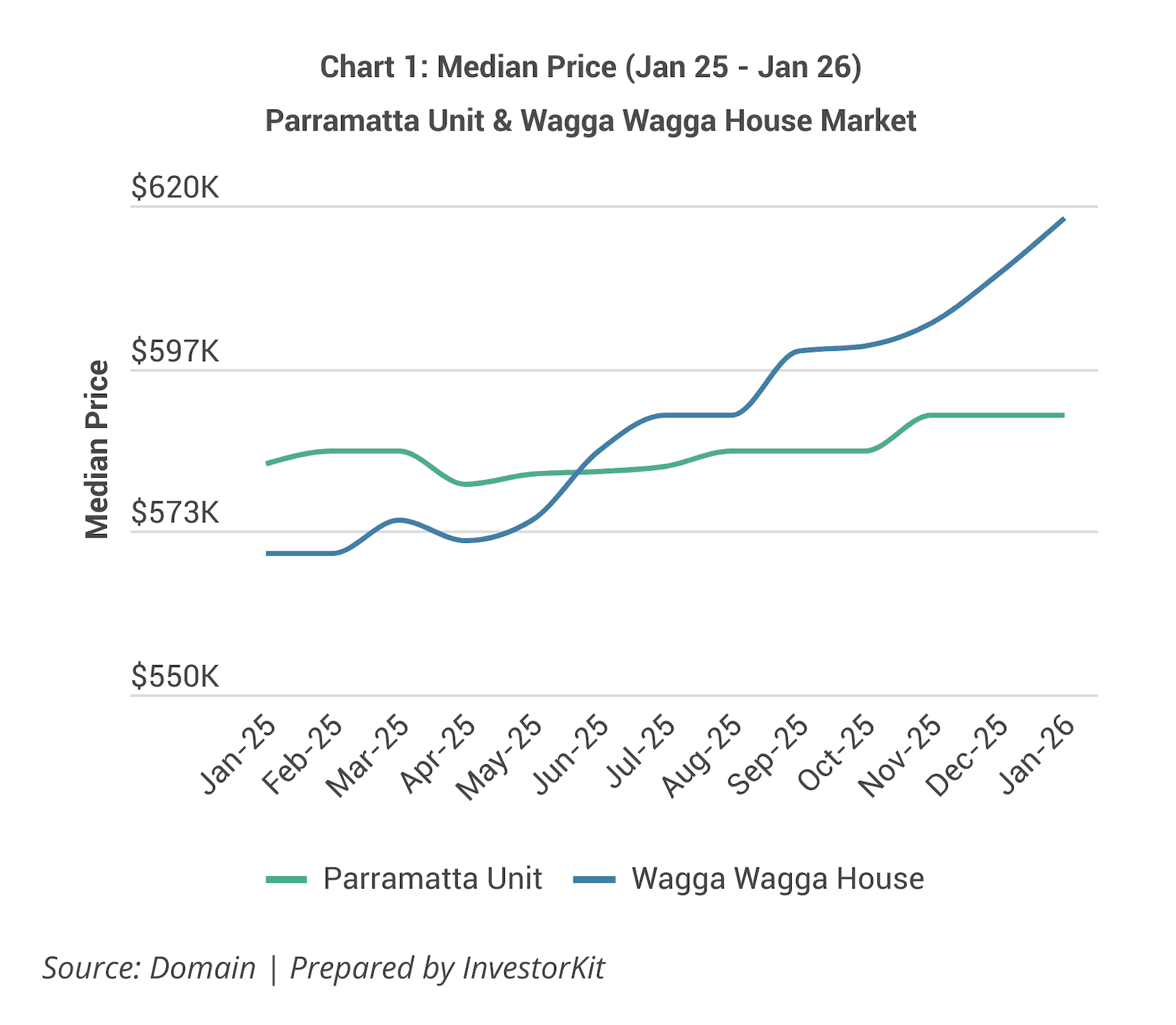
Even after subtracting a $20,000 buyer’s agency fee, the Wagga Wagga investor is $28k ahead in equity in the first year alone.
The point isn’t that one market or dwelling is universally superior. It’s that the fee starts to look less like a cost and more like an investment when it steers you towards the right asset. The fee is paid once, while the performance can compound for decades.
What You’re Actually Paying For
A buyer’s agent fee isn’t paying for someone to “find a property”. It’s paying for skilled execution across the 3 pillars: strategy, research, and acquisition.
Strategy
A good BA examines the purchase through a portfolio lens, by considering sequencing, borrowing capacity and goal alignment, rather than treating each buy in isolation.
Research
A good BA also brings a research engine that’s difficult to replicate in spare time. For example, InvestorKit invests over $800k per year and more than 350 hours per month into market research, supported by paid datasets and systematic analysis. A DIY buyer can purchase raw data, but they still need the frameworks and experience to turn it into insights and decisions.
Acquisition
A BA broadens the option set (including off-market properties), filters through due diligence (InvestorKit rejects 92% of properties reviewed), negotiates to support a fair purchase price, and coordinates settlement to ensure a smooth handover.
End-to-end, the fee isn’t covering a single task. It’s paying for a repeatable system that improves decision quality, reduces downside risk, and helps you purchase with clarity.
That said, a BA may not be the right move for everyone.
When A Buyer’s Agent May Not Be Necessary
A DIY approach works well if you confidently tick most of these boxes.
Capability and Capacity: Reliable research skills, market knowledge and a due diligence process and realistically 10-20 hours a week to commit over the coming months.
Valuation and Negotiation Confidence: The ability to assess fair valuation independently and hold firm in a competitive environment.
Emotional Discipline: The ability to stay objective under time pressure and competition, rather than being pulled by urgency or emotion.
Risk Tolerance: You can absorb the opportunity cost of underperformance, without derailing your broader financial plan.
Conclusion
In property, the real costs are usually hidden: the time you burn, the delay you absorb and the mistake(s) you can’t unwind. The real cost is never the buyer’s agency fee, it’s the “opportunity cost” of DIY leading to a non-performing purchase.
If you have the skills, the time, and the discipline to execute at a high level on your own, the buyer’s agent services may not be for you. However, if there’s an area of your process where you’re less confident, that’s where costs could start to quietly build. It might show up in the price you pay, the asset you settle for, or the growth you miss.
Don’t decide based on the sticker price. Decide based on your financial goals, your capacity, and what a better decision is worth over the life of the asset.
If you value your time and want your next purchase backed by institutional-grade data rather than guesswork, learn more about InvestorKit’s residential buyer’s agency or book a FREE discovery call with the InvestorKit team to see if we’re the right fit.
Frequently Asked Questions
How much does a buyer’s agent cost in Australia?
Buyer’s agent fees in Australia typically range from a fixed fee of $10,000–$20,000 or a percentage of the purchase price (usually 1.5%–3%). The exact cost depends on the scope of service, the property price, and the agent’s experience. At InvestorKit, our fee structure is transparent and designed to deliver measurable value relative to the purchase outcome.
Is a buyer’s agent worth it for property investors in Australia?
For most property investors, yes, a buyer’s agent is worth the cost. The fee is typically offset by better asset selection, faster purchase timelines, and stronger capital growth outcomes. As shown in our Parramatta vs. Wagga Wagga comparison, the right property recommendation alone can generate tens of thousands of dollars more in equity within the first year, even after accounting for the agency fee.
What are the hidden costs of buying property without a buyer’s agent?
The hidden costs of DIY property buying include: the opportunity cost of your time (100–200+ hours of research), the financial cost of delays (a 6-month longer search can mean paying $17,400 more for the same property at a 5% growth rate), and the risk of purchasing an underperforming asset. These costs rarely appear on a receipt but can far exceed a buyer’s agent fee over the life of the investment.
Can a buyer’s agent help me find off-market properties in Australia?
Yes. Experienced buyer’s agents have established networks with selling agents, developers, and property professionals that provide access to off-market listings, properties that never appear on Domain or realestate.com.au. This access can be a significant advantage in competitive markets where the best properties are often sold before public listing.
How long does it take to buy a property with a buyer’s agent vs. doing it yourself?
The average DIY buyer journey in Australia has extended from 23 weeks in 2022 to 40 weeks in 2025. By contrast, InvestorKit typically completes the process from onboarding to settlement in 13–22 weeks. That’s a potential time saving of 3–6 months, which, in a rising market, also translates to a meaningful financial saving.
Keep Reading


" transform="translate(5 5)" width="14px"/></svg>)