This transcript was generated automatically and may contain small errors.
This is a Momentum Media production. Nerd alert! Property nerds. The home for data-driven property investors. Where we uncover Australia's hot and cold markets, latest headlines and trends.
Welcome back to another episode of The Property Nerds. I'm your co-host Arjun Paliwal, CEO at InvestorKit, and I'm here joined by our commercial specialist. Chris, how are you, mate? Good, thank you, my man. How are you?
Yeah, it's good. It's good to be on another commercial episode. I think that's been super, super popular. And of late, we've also noticed how many commercial property inquiries are coming through to us. And so it's really helpful just to give everyone a bit of a taste of what's happening in this world, what we're going through, what we're seeing, and actually genuinely help people see what the deals look like in commercial and what the other side of it is, when to go into it.
But before we do that, mate, for those listening to you for the first time, I know we've done a few episodes together, but for those listening to you for the first time, a bit of who you are and what you do at InvestorKit. Of course, man. So yeah, I'm the head of commercial at InvestorKit. I've been here for the last four years, and I spearhead the commercial acquisition process for our clients from due negotiation to due diligence to settlement. So I handle the deal from top to bottom for our clients.
Absolutely. And when it comes to the deals, we're in that sort of 1. 5, 2 mil to 5 mil range commonly, even beyond. But that's kind of the sweet spot we've been noticing in terms of where we're helping clients with. Mate, what I want to jump into before we jump into today's episode, I know we're going to go through some juicy deals, some things that we picked up and helped some clients with.
But before I jump into that, I just want to give those who are new to this episode or new to commercial a bit of an understanding of when we notice is the right time to invest in commercial, because that will then make this make sense. Because if you're looking at some of these insights and case studies we'll give today, they can sound sexy, they can sound exciting, they can sound very cool, but is it the right time for your portfolio? So I'm going to quickly give a shout out for two moments, right? One moment is where if you're an investor who's built a portfolio of lots of residential properties and you're transitioning, and you're transitioning to cash flow stages of your portfolio. And this is where you're like, I feel good about the compounding wealth my residential has, and I want to move to commercial.
I still have some borrowing capacity that's quite open. And typically we want to see around that sort of two mil purchase price. We have gone as low as that sort of 1. 5 and even some below, but we often find that where we're getting the best deals and working with clients through is that two mil and beyond is the sweet spot, right? That's right.
But when it comes to that moment and you're transitioning, many of these customers also have cash come from business sources, inheritance, downsize of family homes, and they use that. And yes, you can use equity to fund the commercial deals. Many people have used that too, but we find that when you use equity and you're going into a cash flow asset, we often realize that, hey, well, you're not getting as much cash flow as you thought because you're leveraging 105% to that loan. It's still better cash flow than residential, but it's just a thought. So where we find it work best is with those 30% deposits or 20, 25% deposits, depending on the lender, come in and they're from business sources or from inheritance or from downsizing family homes or exiting a few residential properties because that gives you true mighty cash flow, right?
That's right. So that's scenario one. Scenario two is where we've seen clients come in and they've actually are in that consolidation phase of their portfolio. They're usually aged sort of 45 to 60 and they feel like they're looking at that 50s and 60s as that retirement point. And for them, they're selling multiple assets.
They're transitioning high amounts of cash and they're putting it to commercial. So those are the two most typical. The third part that comes up from time to time is those with super balances combined as a household, sort of 600,000 plus. And you'd be surprised people think that there's none that out there that exists, but there's a lot of balances at that 600K combined of super. And they feel like I've got wealth moves happening outside of super.
My financial advisors are comfortable with me looking at property and they come to us for commercial property. So before I go into today's episode, I thought it'd be good to just take a couple of minutes to take through three scenarios, two most common, one extra of where commercial comes into the mix. And that's where Chris comes in to help. And so Chris, we're talking about a couple of deals today. And this particular episode is a bit of a, you know, lessons from some of the best, what goes right, what can improve, what do we look to, you know, actually help with in those situations as well that could have been different in the scenarios.
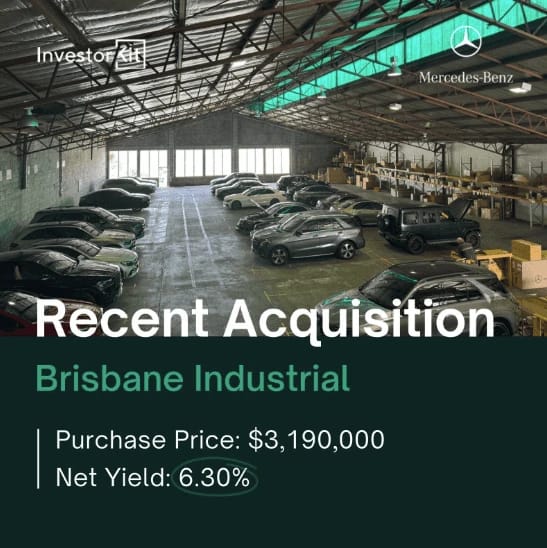
And mate, let's go through some real world examples. What do you got for me? Yeah, awesome, man. So we've got case study one. This is a recent acquisition of ours.
It's a really, it's a good one. Mercedes-Benz is the tenant. There you go. Not only that, it's industrial, one of the most robust, safest asset classes we're investing at the moment, InvestorKit. Yeah.
Nine kilometers from Brisbane CBD. It's a modern 1300 square meter office facility. Oh, sorry, warehouse and office facility. Yeah, that's a big, big facility, right? And they've got a lot of cars, so they need to have that scale.
Mate, that's huge. It's huge. And actually, Mercedes-Benz own the adjacent asset next door. And that's quite a big, substantial facility. And they're using this warehouse essentially to store their cars.
Also, I think they're doing some body works in this facility as well. So a few reasons, but after doing some research into Mercedes-Benz, we all know that Mercedes-Benz is huge. Yeah. They're actually growing their electrical car business as well. And they're expanding their fleet.
So when we look at this deal, we're like, wow, it's right next door to Mercedes-Benz. They own the facility next door. They're expanding their business. And they've just renewed for another three by three lease. Yeah.
So this is an important couple of things to touch on. So firstly, people forget that what you do isn't just the property. You analyze the business. That's right. And people just at face value think, oh, Mercedes-Benz, you know, who's going to care about that one in terms of like, nothing's going to happen.
So I don't care. Yeah, let's do it. This is great. But you go deeper, even though you know it's a big name to go, what's the expansion plans in this perimeter? What are they actually expanding into?
What are they planning in this area? And this is the power of, you know, just getting that extra professional support. But when you look at Mercedes-Benz as well, and all of these aspects, what's important to note is when you get brands of these sizes tenants, it's almost like they don't play the game of the next few years. They play the game of the century. That's right.
Like as in what are the next decades look like? They don't come to a location and just park it there for a quick hit and then move on. They're usually trying to go to a location, cement themselves and exist there forever. I almost like borderline compare it to the McDonald's. Like when they park themselves in a suburb, they're owning market share there.
They're trying to go, this is our new patch. We're going to really be here strategically. The real estate is important to us. And it's the same play Mercedes did. And now they're just expanding on leaseholds, but that real estate's important to them.
That suburb's important to them. Absolutely. It takes a tons amount of money to be able to move your operations, your business. Something like Mercedes-Benz, imagine them moving to another facility where they have to put in work to find that facility location and also move all their stock and their cars and their business. Like it's just, it's almost impossible for them.
Yeah, it's big stuff. I'll be happy to move some of their E-classes, the S-classes, so happy for that. So that's the stuff on the warehouse and the industrial asset. Let's talk about some of the lease because you mentioned three by three. For people that are new to this, three by three is referred to as the initial lease term that they have for three years.
And then it gives the tenant an opportunity to renew or move on. And that notice period can range from two to six months, depending on the deal, but usually two to three months is most common. And then they're deciding, wait, we'd love to be here for another three years. So it's actually a tenant favorable term because it's making the tenant feel like I get to choose those same terms for another three, but it also gives that buyer peace of mind to go, if it's installed into the lease, there are intentions that the tenant wants to take it some good chunks at a time rather than a one by one by one, they're looking at it from a three by three. So for those new to that, that's what that means.
And that also means that if it was tenanted the whole way through just for those two segments of the lease, you could see until 2031 that the tenant remains there and then we could redesign But even with that similar land value in many outer parts of Melbourne and Brisbane, we're still seeing the cap rates of Brisbane far superior. And so it just shows that the rents continue to catch up with it even though the growth occurred. Whereas most cities, when that level of boom occurs in a market, we usually see cap rates come right down to 5% or 4. 5%. But then we're seeing them still hang and be touching the sixes even though there's a boom rate happening of growth.
So that's a very, very solid one to jump into. So that's investment one. Let's jump into investment two. Now for this one, disclaimers alert, this is as wild as it gets in terms of the best of the best. And we have to admit that like, you know, deals like this don't fall on our desk every day.
No, that's right. And so we always have parameters of net yields we like to operate in, 5. 5 to sort of 7. 5 depending on assets there, but 5. 5 to 7.
And sometimes you get a unicorn like this that drops on the desk once every, you know, fair few months, right? But then this is super exciting. Let's jump into it. It is. So we have a mixed use asset.
It's got a bunch of industrial usage and it's got some office with medical as well. So we have a mixed use asset here. It's located in a light industrial precinct in Gladstone, Queensland. So it's a well-known regional town in Queensland, north of Queensland. It's 100% fully leased, which is great, which is what we want to see across 10 different tenants.
The net little area is 1,800 square meters and the site area is 3,000 square meters. So quite a big. So big block, major industrial, mixed precinct, 10 tenancies. And you've got tenancies across mining, medical, light industrial, all sorts, right? Where did this one land from a net yield perspective?
So we purchased this asset at 9. 07% net yield. Wow. This is wild. Absolute wild.
And in this sort of interest rates, it's day one positive cash flow, even if you got the money from equity. That's right. Which is crazy. So our client, our dear client, Michael, he receives 120K net cash flow from this property. Unreal.
One asset. One asset. How much did this set him back? 2. 745 million.
Now in the world of commercial, that's actually very affordable. It is. I know it sounds crazy just to say on a podcast, like a couple of those affordable, but in the world of commercial, that's very affordable. And what I loved about this deal was that even though the numbers look really good, this is a big X factor here where I'm very grateful to have you in the squad. This part, many people would have seen the net yield from the get-go, even at asking price, and wouldn't have asked a cent lower.
Just because the money's so good at that point. You're like, hey, let's just do it. But how much was asking and how much did you push them down to after some good back and forth? Yep. So the asking price was 2.
- And yeah, we secured it for 2. 745. That's big. 155,000 cheaper on an asset where people would look at that net yield from the get-go and go, I want this now.
That's right. A unicorn like that, people just jumped onto instantly, but we're like, no, hold on a minute. We've got due diligence to do. We've got to negotiate better. Whilst it's a unique asset, it's very tough to get comps on assets like that.
You dug deep to find some dollar per square meter rates all across the city to go, where is that sweet spot? And the agent understood you. That's a big thing. People negotiate for the sake of negotiating, but then there's negotiating in a way where agents understand where you're coming from. That's how you truly win.
Where you can actually present a case study, a story, an angling of what you see versus what they see versus, oh, no, I just want to put an offer of this much. And it's like, how does someone translate that? And if you do the agent's work for them, where you give the translation to them, you know what they do? Just take it back to the vendor and go, now, we've had some back and forth now. A couple of these sales and a couple of those sales, a couple of these areas, I think it's a great deal, but you've made their life easier.
So people forget that to get deals, it's reduced to friction and you get the price you want. I don't know if this works for you, Arj, but I feel like real estate agents treat buyers' agents differently. Oh, 100%. In the deal? 100%.
I mean, think about it, right? You've got two people with the information ability to access it. You've got two people who are trying to make a deal happen so the buyer's agent, seller's agents know the seriousness of it, but the seller's agents know that they're not going to be mucked around. Yes, there's some people that do, but the seller's agents know they're not going to be mucked around in the sense that there's a committed client that's made that buyer's agent go above and beyond with the effort. And then now it's just like, how do we tango?
So it's like you're figuring out a solution rather than sussing out the person. And that's why we get that X factor when it comes to negotiations or when it comes to deal structuring. And also you don't know what you don't know. So if people are approaching deals like this, they would look at the net yield and go, that's great, here's asking. There goes $155,000 extra.
Someone else would have gone, oh, well, that lease is great already. Why think of all the potential it has in the future? Whereas you've thought of all the other things. Speaking of that, let's talk about the potential of the deal or all the things that you're seeing and what made this deal great, I guess. So when we look at this deal, we look at, okay, asset type, light industrial, medical, different offices, different industries.
Okay, ticks, diversification across different tenants. So that's what we want to see, right? There's 10 different tenants. However, there's a head lease. So one of the tenants is operating their forklift license business from this asset.
So there's a big industrial portion at the back. They lease out the most space in the facility as well. However, they've taken a head lease out for $249,000 net. They cover all the outgoings. Which is that 9% yield, right?
Correct, which is that 9% yield. However, this head lease company is subletting all the other space to the tenants at a higher dollar per square meter rate. So these smaller subtenants are essentially paying for this guy's rent to run his business out of, and he's getting much more, or he's getting roughly just over 20K more in additional rent profit from operating his business out of here. This is what you call a win-win. I've never seen a win-win like this, right?
And this is also where business owners who can play it smart can actually now rent and be winners. Because this person's essentially not paying any rent, and he's making all his rent payments back from other businesses he's subleased to. So it's like he's operating a major forklift company with an extra quarter million profit per annum simply because no rental payments for the industrial precinct they're operating. Like a quarter million profit per annum is not small, right? If you're running at 2.
5 million in revenue, that's 10% increase in profit margins. Do you know what I mean? That's 10% profit, right? That's unreal. And rent's covered.
And rent's covered. And I think there's a little bit on top they're getting too, so they're probably covering a bit of bills there, right? So what I think that shows is not only the win-win for all, which means that forklift person, why would they leave? Because remember, if you're in a small center, in a major regional center, but a small center in comparison to capitals, the frequency and availability of these types of properties is very low. That's right.
So for him to go and even shift to find someone else that can do the same deal like he can and sublease it in the same way is going to prove difficult because now you're not only shifting where you currently are, but his profit margins will go down a quarter of a million immediately if they move. And then he's got to find that same story to find somewhere else to sublease. Then he's got to convince six to eight to 10 other tenants to come in and sublease. Then you have multiple lease agreements drawn up that they're going to have to operate and create as a subleaser. So it's too hard basket now.
Why not stick at one place as long as possible and have no rent whilst I operate a business there? And that makes it a win-win for them, a win-win for us because we're getting strong cap rates. And we're not greedy. We're not going to go, why don't we do all of that? It has the option for the person to do it in the future if they don't keep extending leases and option terms aren't there.
But we'd rather create a win-win and have a forever tenant in a long-term asset and have this asset paid off pretty quickly. That's exactly right. So how we look at this deal, Arj, is we're getting above market cap rates. So we've got a bit of a cap rate compression to happen there once we do a reval.